


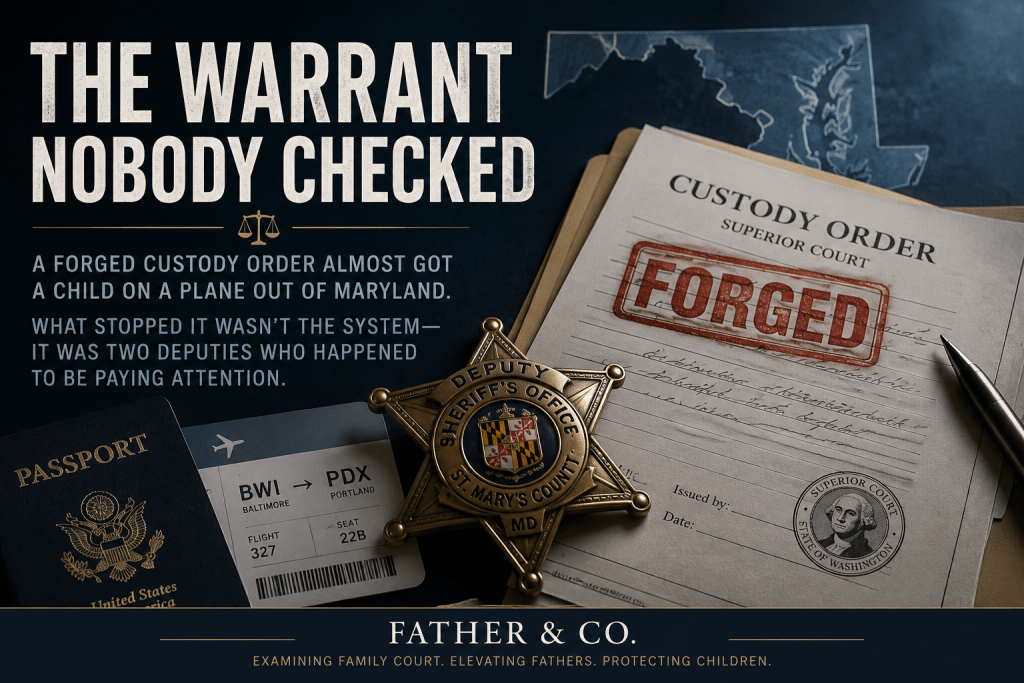
A forged custody order almost got a child on a plane out of Maryland. What stopped it wasn’t the system — it was two deputies who happened to be paying attention.
On August 3, a Washington state woman was ordered held without bond in St. Mary’s County District Court. According to charging documents reported by The BayNet, Tara Annette Reynolds, 36, had flown to Maryland carrying paperwork she said was a custody order from the Superior Court of Klickitat County, Washington — one that purportedly directed the St. Mary’s County Sheriff’s Office to hand over a child under 16 and return the child to her.
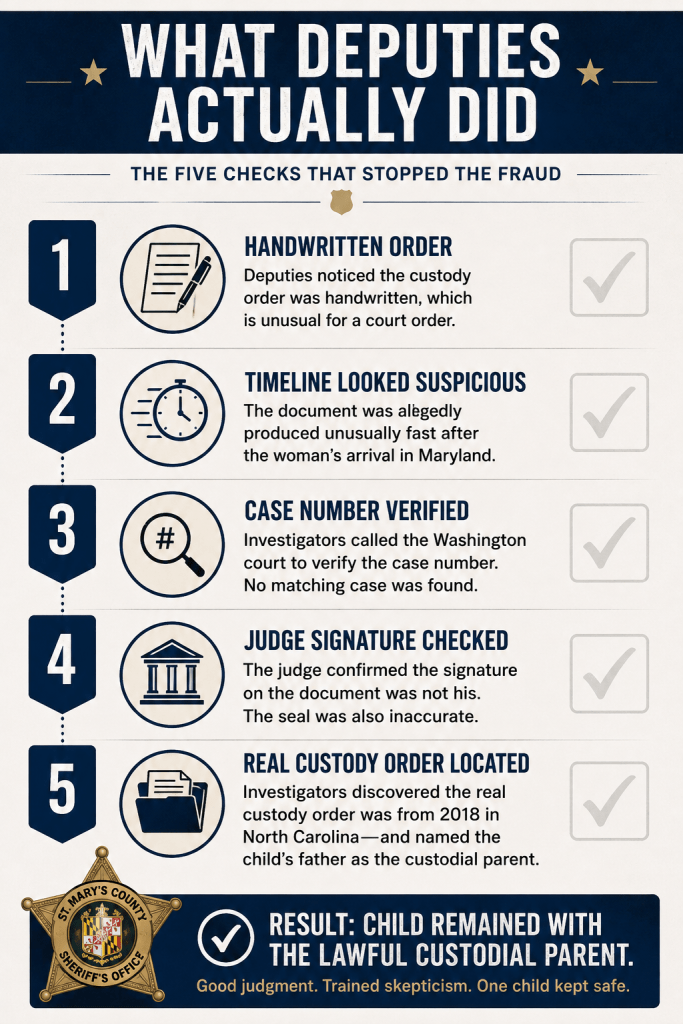
Deputies didn’t hand the child over. They read the document, noticed it was handwritten, noted it had allegedly been produced unusually fast, and made a call to the Washington court instead of the airport. What came back: no matching case number, no scheduled hearing, an inaccurate seal, and a judge who said flatly that the signature on the page wasn’t his. The real custody order, investigators later determined, was a 2018 order out of North Carolina — and it named the child’s father, not Reynolds, as the custodial parent. A search after her arrest turned up two Baltimore-to-Portland tickets, the child listed as the second passenger, departing that same day.
It’s a story with an ending most people will find satisfying: the fraud was caught, the child stayed with the custodial parent, the case moves to trial September 24. It’s also a story that, read closely, exposes something Father & Co. keeps running into from a different angle each time — a piece of the family-court machinery that works only because a specific person, on a specific day, chose to look twice.
“What stopped it wasn’t the system—it was two deputies who happened to be paying attention.”
Two tracks — and a document that belonged to neither
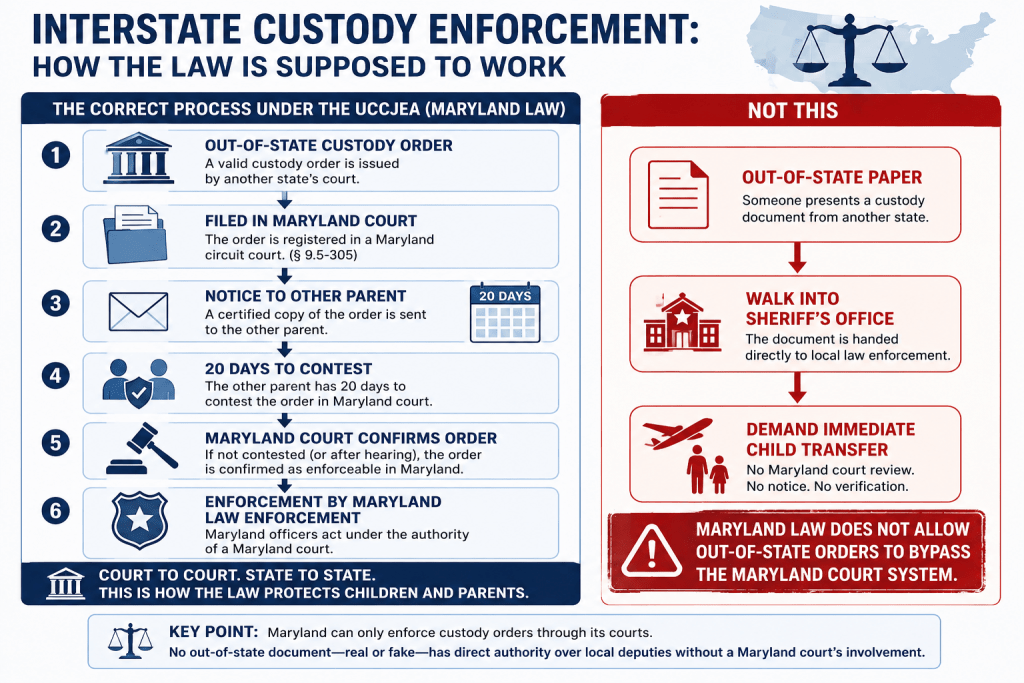
Every state but Massachusetts runs interstate custody enforcement through some version of the Uniform Child Custody Jurisdiction and Enforcement Act. Maryland’s version — Md. Code, Family Law § 9.5-101 et seq. — gives a parent holding an out-of-state order two paths to get it enforced here, and both of them run through a Maryland court.
The first is registration, under § 9.5-305: file the order with a Maryland court, a certified copy goes to the other parent, and that parent gets 20 days to contest it before the order is confirmed as enforceable here. Slow, on purpose. It builds in notice and a chance to object before anyone’s custody status changes.
The second exists for exactly the situation Reynolds described to the Sheriff’s Office by phone — a child about to be moved out of reach. It skips registration, but it doesn’t skip the courthouse. Under § 9.5-311, a petitioner files a verified application in a Maryland court; a Maryland judge, on sworn testimony that the child is imminently likely to suffer serious harm or be removed from the state, may then issue what the statute defines at § 9.5-101(r) as “an order issued by a court authorizing law enforcement officers to take physical custody of a child.” A warrant. It is enforceable statewide the moment it’s signed, and the law requires a hearing on the very next judicial day. It is built to move fast.
What it is not built to be is a document one court hands directly to another state’s deputies. Maryland’s duty to honor an out-of-state custody order, under § 9.5-303, is a duty that runs court to court — Maryland courts recognize and enforce out-of-state determinations that were made with proper jurisdiction. Nothing in the statute lets a piece of paper from a Klickitat County court, real or fake, instruct a St. Mary’s County deputy to act on its own say-so. Maryland’s own law enforcement role, spelled out narrowly at § 9.5-316, is limited to officers assisting the Attorney General in locating a child — not executing whatever custody paperwork gets handed to them at the door.
“Maryland law doesn’t let an out-of-state custody order command local deputies without a Maryland court’s involvement.”
Reynolds’s forged document, in other words, wasn’t a convincing forgery of Maryland’s fast track. It was something with less legal grounding than that: a paper claiming a kind of direct, cross-border authority over local deputies that Maryland law doesn’t actually confer on any out-of-state order — real or fabricated — without a Maryland court’s involvement first. The scheme’s real bet wasn’t that the forgery would pass a documents check. It was that patrol-level officers, under pressure and short on time, wouldn’t know the statute well enough to recognize that the whole premise of the paperwork was legally hollow before they’d even gotten to the signature.
What actually verified the document
Here’s the part worth sitting with. Nothing in the reported sequence describes a step that required verification with the issuing court before Reynolds’s paperwork could be acted on. What happened instead was that deputies found the document itself suspicious — handwritten, allegedly produced unusually fast, with “other irregularities inconsistent with typical court orders” — and the St. Mary’s County State’s Attorney’s Office picked up the phone and called the Washington court to check. Investigators also learned the paperwork carried a web address where blank versions of similar-looking forms were publicly downloadable, meaning the surface plausibility of a document like this is cheap to manufacture even if the legal authority behind it is not.
“The fraud was caught because someone looked twice—not because the process required them to.”
That’s diligence, and it worked. It is not, on this record, a mandated checkpoint. A document purporting to direct law enforcement to remove a child from a custodial parent is one of the highest-stakes papers that can cross a deputy’s desk, and it was caught here by trained skepticism about its physical form — not by any procedural requirement that officers confirm, before acting, whether an out-of-state custody paper even carries the authority it claims. If the forgery had looked more official — typed, a passable seal, a case number that wasn’t obviously fabricated — the outcome rides entirely on whether the deputies on duty that day happened to know enough UCCJEA law to be suspicious of the premise, not just the penmanship.
Who the gap actually threatens
Father & Co. covers this territory because the people most exposed by a soft spot like this one are custodial parents who did everything right — who have a real, standing order, who are current on every filing — and who are still one convincing forgery away from a stranger showing up with paperwork that looks official enough. In this case that custodial parent was a father. The vulnerability itself isn’t gendered; a document that can be handwritten, backdated, and walked up to a sheriff’s desk can be aimed at any custodial parent, mother or father, by an ex-partner, a relative, or someone with no legal standing at all who has simply learned what a pickup order is supposed to look like.
“The vulnerability isn’t gendered. Any custodial parent is one convincing forgery away from the same risk.”
It’s also worth naming plainly what position this puts law enforcement in. The consequence of either extreme response is severe: comply too readily and an agency has just handed a child to someone with no legal right to them; push back too hard against a document that turns out to be real, and an agency risks obstructing relief in a case where minutes genuinely matter. Officers are asked to make that judgment on the spot, off a piece of paper, with no built-in mechanism telling them whether the document is even the kind Maryland law would let them act on.
What this isn’t a call for
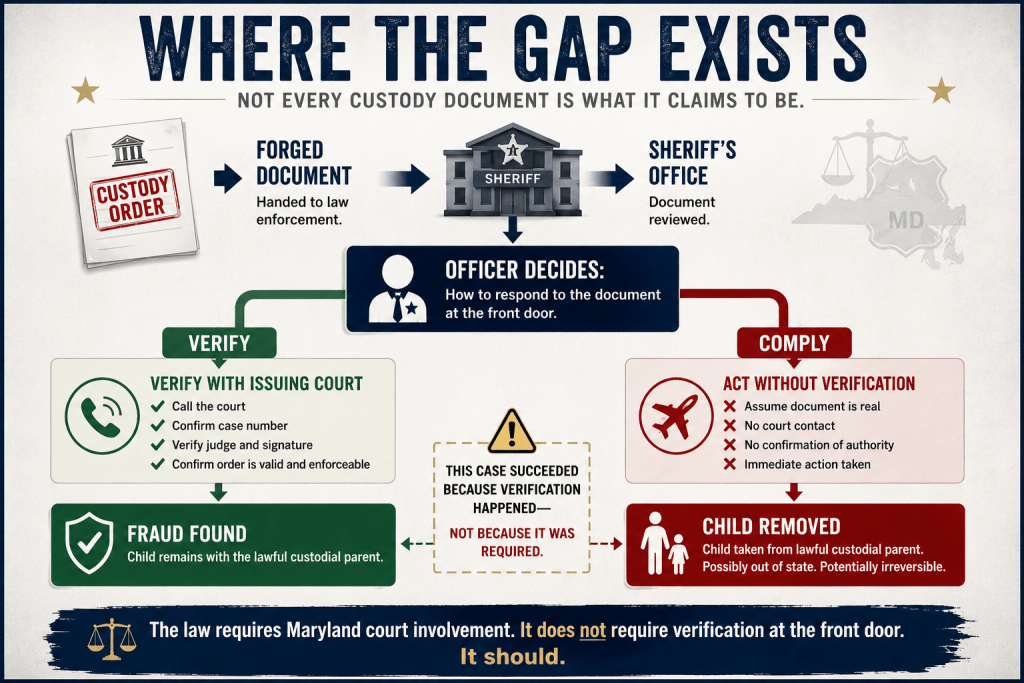
It would be easy to read this as an argument for slowing Maryland’s own emergency warrant process down — more paperwork, more delay, more friction before § 9.5-311 relief can move. That would be the wrong lesson, and it would miss what actually happened here. The gap this case exposes isn’t in the emergency track itself, which already requires a Maryland petition, sworn testimony, and a judge’s finding before a warrant issues. The gap is at the front door — the moment any custody paperwork, homemade or genuine, in-state or out, gets handed to a law enforcement agency by someone demanding immediate compliance. Nothing requires that moment to include a call to the issuing court, or even a basic check of whether the document claims an authority Maryland law actually recognizes, before an agency decides how to respond.
St. Mary’s County got that moment right. The statute doesn’t require that anyone does.
“St. Mary’s County got that moment right. The statute doesn’t require that anyone does.”
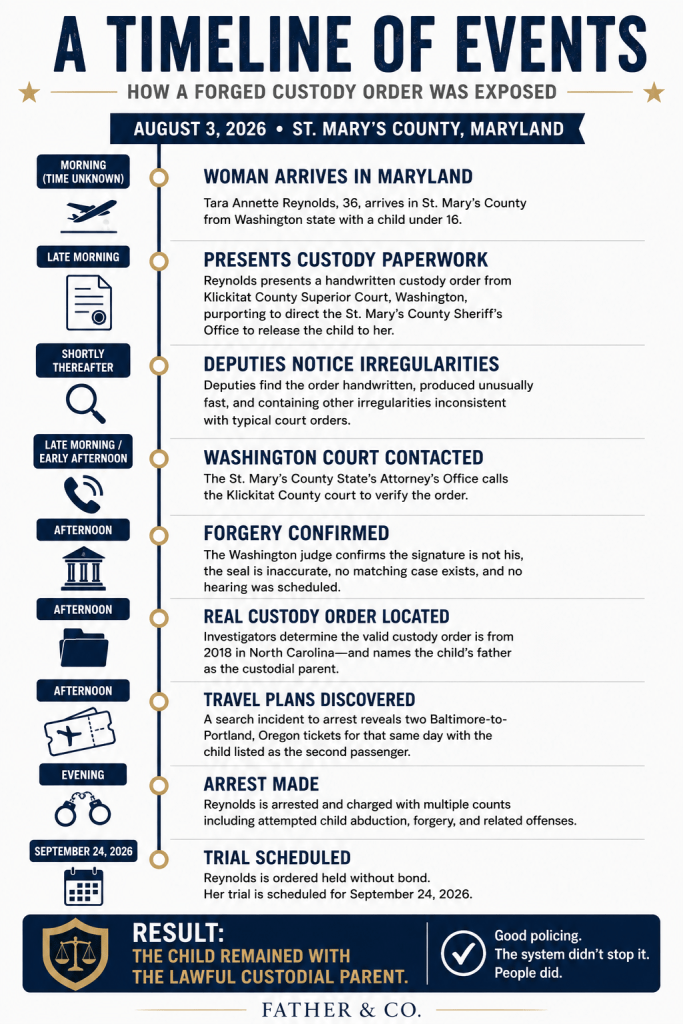
This piece is based on public charging documents and reporting by The BayNet.
Father & Co. examines structural patterns in family court, custody enforcement, and child welfare systems. This piece draws on reporting by The BayNet, “Washington Woman Held Without Bond After Allegedly Using Forged Custody Order To Take Child From St. Mary’s County” (Aug. 6, 2026), for the underlying facts of the arrest and charging documents, and on the Maryland Uniform Child Custody Jurisdiction and Enforcement Act, Md. Code, Family Law § 9.5-101 et seq. — specifically §§ 9.5-101(r) (definition of “warrant”), 9.5-303 (recognition and enforcement of out-of-state determinations), 9.5-305 (registration and the 20-day contest period), 9.5-311 (petition and judicial findings required for a warrant to take physical custody of a child), and 9.5-316 (role of law enforcement officers) — for the statutory framework described above.

Need help reviewing or organizing court or formal documents?
Father & Co. offers non-legal document review and organization for people representing themselves. This includes clarity, structure, neutral tone, and timeline organization — not legal advice or representation.
Have a story, experience, or resource to share?
Submissions are reviewed with care and discretion. We respect privacy and handle sensitive information responsibly.