



New Jersey’s rewrite of its custody statute puts kids’ preferences on the record. That’s the easy part. The hard part is what happens before a child ever opens their mouth.
New Jersey’s core custody statute, N.J.S.A. 9:2-4, was rewritten this year under a bill known informally as Kayden’s Law (S4510/A5761), signed into law and effective January 20, 2026. The amendment does two things that matter procedurally, and preserves one piece of discretion that headlines about children “getting a voice” tend to skip past.
Legal commentary on the amendment has widely characterized it as elevating child safety to a “threshold” question the court must resolve before moving into the broader best-interests analysis — a meaningful reframing if the final enacted text bears that out, though it’s worth noting as characterization rather than a line item quoted directly from the statute. What’s unambiguous in the bill text itself: courts are barred from ordering “reunification therapy” — programs designed to force contact between a child and an estranged parent — unless there’s generally accepted, scientifically valid proof the approach is safe and effective, and good cause is shown by a preponderance of the evidence. And, for the first time as a matter of statute rather than custom, judges must put findings on the record when they order a custody arrangement contrary to a child’s expressed preference.
That last piece is the one making headlines. It’s also narrower than it sounds — and understanding why requires reading the statute the way a lawyer would, not the way a headline does.
“New Jersey didn’t give children a voice. It gave children’s already-expressed preferences a harder floor to fall through.”
What the law actually changes
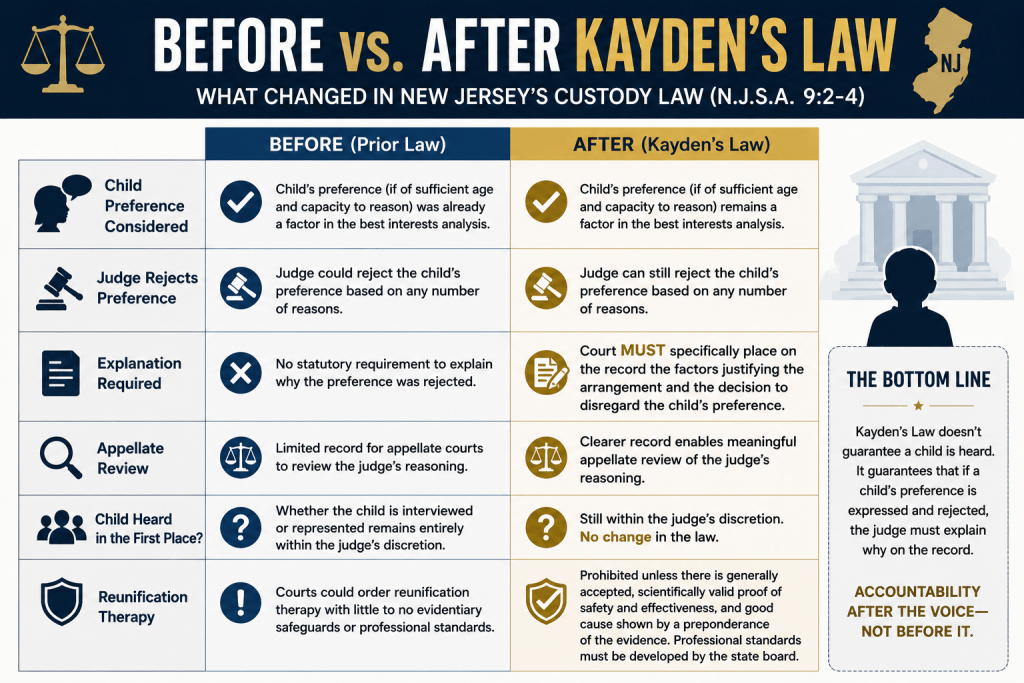
It’s worth correcting a common misread first: a child’s preference was already a listed factor under the prior version of 9:2-4 — “the preference of the child when of sufficient age and capacity to reason so as to form an intelligent decision” is not new language. What’s new isn’t that children’s preferences count; it’s what happens when a judge disregards one.
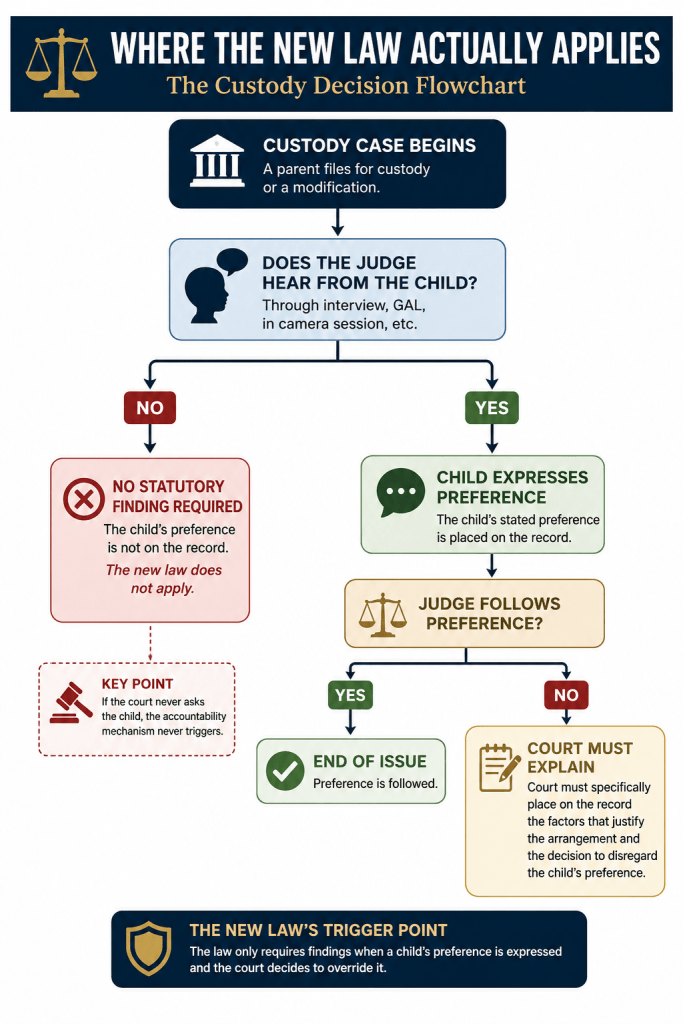
Before this amendment, a judge could discount a child’s stated preference — often on the theory it reflected coaching by whichever parent had more day-to-day access to the child, rather than the child’s own reasoning — with no statutory obligation to explain that call. The amendment closes that specific gap. Under the new subsection, if a court orders an arrangement contrary to a child’s expressed preference, it must “specifically place on the record the factors which justify the arrangement and which justify the court’s decision to disregard the child’s expressed preferences.” That’s a real procedural constraint: it converts an unreviewable judgment call into a reviewable one, which matters on appeal and matters for anyone trying to document a pattern of a court dismissing a child’s input without cause.
“It converts an unreviewable judgment call into a reviewable one.”
The reunification therapy provision is the sharper reform. It responds to a well-documented problem: court-ordered programs, some run as residential “camps,” that attempt to force a child back into contact with an estranged parent through methods that look less like therapy than compliance training. The bill also directs the State Board of Marriage and Family Therapy Examiners to develop formal professional standards specifically for reunification therapy — an acknowledgment that no such standards previously existed for a practice courts had been ordering regardless.
What it doesn’t change
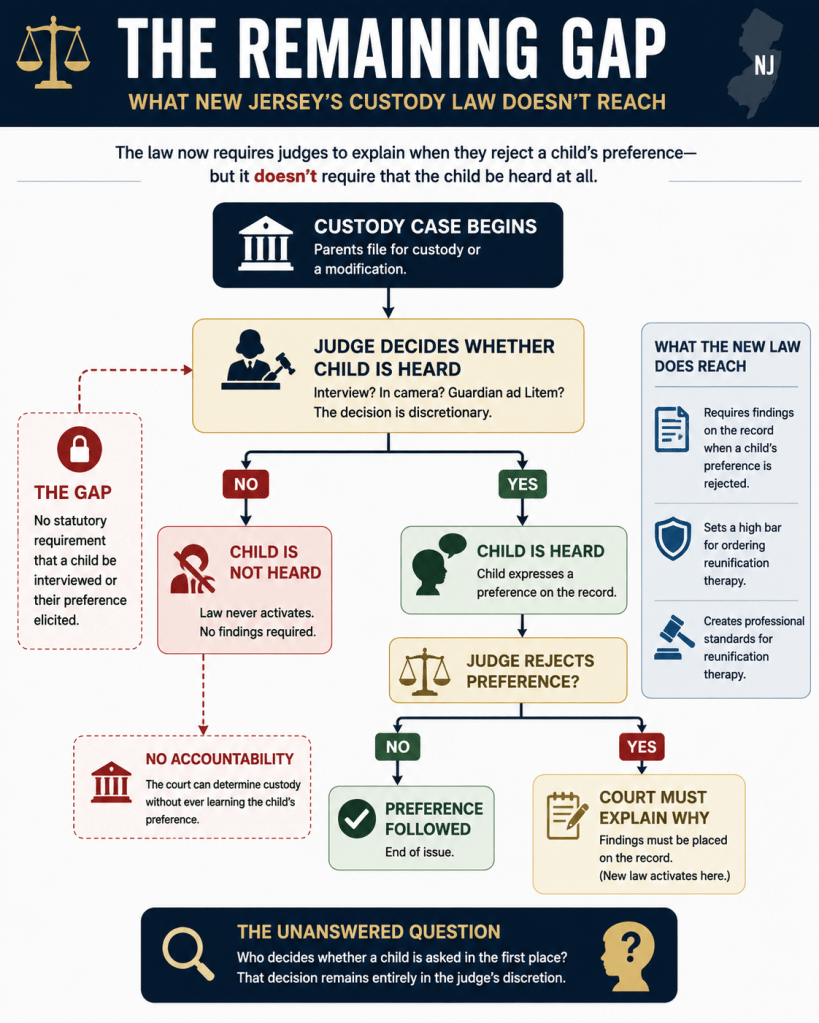
Here’s the part that gets lost in “kids now have a voice” framing: the statute does not require a judge to interview a child in the first place. Whether a child gets heard at all — whether the court grants an “audience,” orders an in-camera interview, or appoints a guardian ad litem to represent the child’s expressed interests — remains discretionary. The new findings requirement only activates after a preference has been expressed and the court decides to override it. If a court simply declines to solicit that preference, or never appoints anyone to elicit and represent it, the accountability mechanism never triggers.
“The statute does not require a judge to interview a child in the first place.”
That’s not a hypothetical loophole. It’s the same discretion that existed before the amendment, just relocated one step earlier in the process. A statute that mandates explanation only at the point of rejection does nothing to guarantee the child is asked in the first place.
“The accountability mechanism never triggers if the court never asks the child.”
The fight brewing over “whose voice”
Advocacy coverage of the bill’s committee process has described pushback from matrimonial-bar organizations, on the theory that giving children’s preferences more statutory weight risks placing them in the middle of conflict and could be exploited by whichever parent has more day-to-day influence over the child — the coaching concern, dressed in child-welfare language. That specific characterization comes from advocacy commentary rather than primary committee testimony, so treat the framing as one side’s account of the objection rather than a verified quote.
“Preference and influence are genuinely hard to disentangle in a contested custody case.”
That concern isn’t baseless. Preference and influence are genuinely hard to disentangle in a contested custody case, and courts have real reason to be skeptical of a stated preference that maps suspiciously well onto whichever household has fewer rules. But it’s worth naming plainly what the objection also protects: a system of court-appointed therapists, evaluators, and supervised-visitation vendors whose engagement — and billing — depends on custody conflict staying unresolved. An objection to “too much weight on children” from professionals paid by the hour to manage the fallout of that same conflict deserves scrutiny on both grounds at once, not just one.
The actual pros and cons
What this gets right:
Converts an unaccountable judicial discretion (silently discounting a child’s preference) into a reviewable one, via the new findings-on-record requirement.
Puts a real evidentiary floor under reunification therapy — generally accepted, scientifically valid proof of safety and effectiveness, good cause by a preponderance of the evidence — closing off a practice that had operated on almost no procedural check.
Directs an actual licensing board to build professional standards for reunification therapy where none previously existed.
What it leaves open:
No statutory requirement that a child actually be heard in the first place — the gatekeeping discretion (whether to interview a child or appoint someone to elicit their preference) stays with the judge.
“Sufficient age and capacity to reason” — the existing statutory standard for weighing a child’s preference — remains as undefined as it was before this amendment; the amendment changes what happens after a preference is expressed, not how maturity gets assessed.
The findings-on-record requirement is only as strong as appellate willingness to actually scrutinize those findings — a paper-compliance risk if courts treat it as boilerplate.
The structural read
New Jersey didn’t give children a voice. It gave children’s already-expressed preferences a harder floor to fall through — a real and worthwhile change, but a narrower one than the coverage suggests. The open question the law doesn’t touch is upstream of all of it: who decides whether a child is asked in the first place, and what happens to a parent — of either gender — cut out of that decision before the record-keeping requirement ever has a chance to apply.
“The open question is upstream of all of it: who decides whether a child is asked in the first place?”
That’s the gap worth watching as the first contested cases under the amended statute work their way through New Jersey’s family courts.
Father & Co. covers structural patterns in family court, not individual cases. This piece is based on the primary text of S4510 (amending N.J.S.A. 9:2-4), effective January 20, 2026, cross-checked against independent legal commentary. Where a claim relies on secondary characterization rather than the statutory text itself, that’s noted in the piece.

Need help reviewing or organizing court or formal documents?
Father & Co. offers non-legal document review and organization for people representing themselves. This includes clarity, structure, neutral tone, and timeline organization — not legal advice or representation.
Have a story, experience, or resource to share?
Submissions are reviewed with care and discretion. We respect privacy and handle sensitive information responsibly.