



Part four of an eight-part series examining five unreported appellate opinions in Reichert v. Hornbeck.
On June 2, 2023, the Appellate Court of Maryland issued the most consequential unreported family law opinion in this series.
It came out of an eight-day trial. It resolved five distinct legal questions, any one of which would independently qualify as a strong publication candidate under Maryland Rule 8-605.1. It contained detailed findings — from a circuit court judge who had presided over this case for years — calling a father’s conduct toward his child “mental abuse,” describing the parent-child bond as “mentally damaging and unhealthy,” and characterizing the father’s thinking as “erratic and delusional.” It awarded $100,000 in attorney’s fees. It permanently transferred sole physical and legal custody of a child from the parent who had raised him for years to the parent who had previously been found by courts to have neglected him while intoxicated on multiple occasions.
The opinion that affirmed all of this is No. 1370, September Term 2022, authored by Judge Kevin Shaw. Under Maryland Rule 1-104, as it was written at the time, it “may not be cited in any paper, brief, motion, or other document filed in this Court or any other Maryland Court as either precedent within the rule of stare decisis or as persuasive authority.”
To understand why that designation is indefensible, you have to understand what was at stake — in the courtroom and in the law.
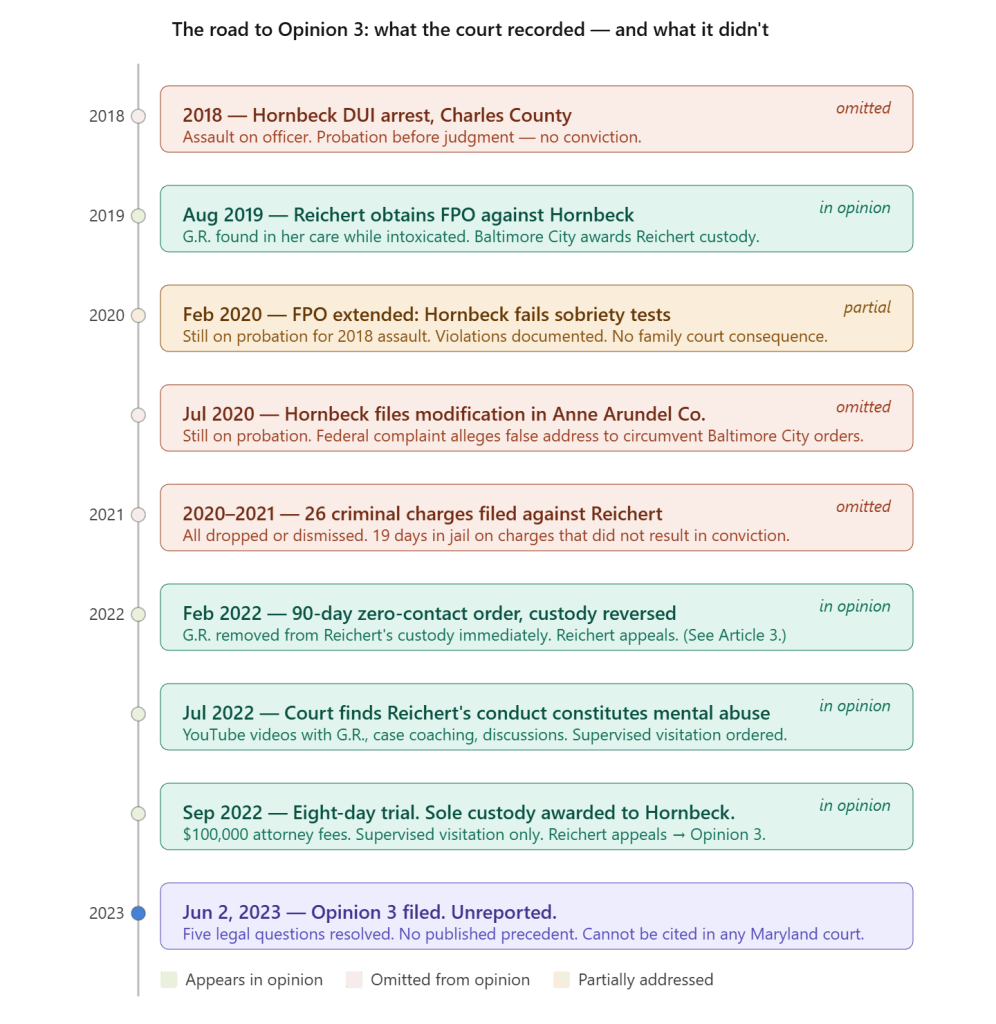
What the Opinion Doesn’t Start With
Opinion 3, like the two unreported opinions before it, opens with a factual summary constructed from the record in the light most favorable to the party who prevailed. That is the legal requirement on appeal. It is not a balanced account of what happened.
Here is what it does not start with.
Jeff Reichert had primary custody of G.R. because Sarah Hornbeck had that custody taken away. In 2019, courts in Baltimore City found Hornbeck had neglected G.R. while intoxicated. A Final Protective Order was issued. Hornbeck was restricted to supervised visitation every other weekend. In October 2019, both parties signed a 48-page consent order giving Reichert primary custody with tie-breaking authority — a consent order that Hornbeck signed, reflecting her acknowledgment of the findings against her.
In 2020, Reichert sought to extend the protective order because Hornbeck had failed multiple probation sobriety tests. The probation she was violating was for a 2018 arrest in Charles County, Maryland, where she had been charged with driving under the influence and assaulting a law enforcement officer. She received probation before judgment — charges resolved without conviction despite the assault on police. The court extended the protective order.
That same month — July 2020, while Hornbeck was still on probation, one month before it ended — she filed a modification petition in Anne Arundel County. According to the federal civil rights complaint Reichert later filed, which survived a motion to dismiss in federal district court, she falsely claimed to reside there when she actually lived in Baltimore City, specifically to circumvent the Baltimore City court’s orders and the consent order’s mandatory mediation clause.
By February 2022, after proceedings this series examined in Article 3, Reichert had been jailed for eight days on contempt charges for not producing G.R. for visitation, and the court had stripped him of primary custody and imposed a 90-day zero-contact order. He had also, by this point, been arrested multiple times on criminal charges — 26 in total — all of which were ultimately dropped or dismissed. He had spent 19 days in jail on those charges.
The September 2022 merits trial — eight days — was the culmination of this sequence. It was the proceeding that would determine, permanently, who would raise G.R.
Reichert lost. The appellate court affirmed. And the opinion that sealed that outcome is unreported.
The Trial and the Findings
The eight-day hearing ran from September 6 to September 15, 2022, before Judge Alison L. Asti in the Circuit Court for Anne Arundel County. The court heard testimony from both parties, from custody evaluator Helen Laird, from child access supervisor Gena Caruna, and from family members and friends of both parties.
At the conclusion, Judge Asti issued findings that were extraordinary in their language. She found that Reichert had “enlisted G.R. in a ten-year battle with mom.” She found that G.R. “at one time refused to call her mom, called her a ‘devil in human skin,’ which the Court found very disturbing.” She found that Reichert was “unable to follow court orders, unable to foster a relationship between G.R. and his mother, and unable to move forward from endless disparagement and litigation involving the child.”
On the mental abuse finding — which had first been entered at the July 2022 review hearing, two months before the merits trial — the judge was explicit: Reichert had made YouTube videos titled “Judicial Child Abuse” in which G.R. participated. He had involved G.R. in court filings. He had discussed the case extensively with G.R. in violation of court orders. He had, the judge found, taught G.R. “not to trust professionals, authority, or the Court.”
The custody evaluator, Helen Laird, whose testimony the opinion quotes at length, was equally direct. She testified that Reichert had engaged in “adultification of G.R., distorting the boundaries of the parent-child relationship by discussing age-inappropriate information with him in talking about the custody proceedings.” She testified that he had placed G.R. “in the role of ally in the battle against G.R.’s own mother.” She warned that “when the father attempts to convince the child that the police, lawyers, therapists, custody evaluator, and the judge have all conspired against him during custody litigation, the child will experience confusion, lack of trust in authority, self-doubt, fear, long-term pathological, psychological impact on him.”
The trial court’s findings were damning. Despite all the harm the system caused to Jeff Reichert, the appellate court affirmed all of them.

What the Record Also Contains
Appellate opinions present the record as the winning party constructed it. Opinion 3 presents the custody evaluator’s testimony, the judge’s findings, and Hornbeck’s arguments. What it does not present — because it is not required to — is the record that Reichert built, the arguments he made, and the questions the opinion never addresses.
The child whose hostility toward his mother is treated as proof of Reichert’s coaching had expressed those same views years earlier — before the specific period of coaching the court identified. It was G.R.’s 2019 account of Hornbeck’s intoxication that led to the protective order giving Reichert custody. It was G.R.’s reports that she had physically abused him that led Reichert to seek the 2020 extension. Those reports were credited then. Now, similar reports were evidence of Reichert’s wrongdoing.
Different court. Same facts. Different outcome.
The opinion treats the custody evaluator’s conclusions as reliable and well-founded. Reichert argued — and the record supports his argument — that the evaluator had selectively interviewed collateral contacts, had attended numerous hearings in a way that departed from standard evaluator practice, and had rejected or failed to contact several of the neutral witnesses he identified. The appellate court disposed of this argument in two paragraphs, noting that the rule gives the evaluator discretion to determine who qualifies as a “high neutrality/low affiliation” source and that no evidence of bias appeared in the record. Whether a custody evaluator can unilaterally define the universe of neutral contacts and thereby insulate her conclusions from challenge is a meaningful legal question. It is answered here. Unreported.
The psychological evaluations admitted over Reichert’s objection — prepared by Dr. Wolff and Dr. Lefkowits — are described in the opinion as properly admitted because the custody evaluator laid the foundation for them. Reichert argued that Dr. Wolff’s report failed to address the 2019 protective order against Hornbeck, failed to identify that her post-2019 access was supervised, and contained material omissions. The appellate court affirmed admission, holding that the evaluator’s testimony provided sufficient foundation and that any error was harmless. Whether a psychological evaluation that omits a prior court finding of neglect against the same parent is nonetheless admissible in a proceeding where that parent is seeking sole custody is a question every family law practitioner needs answered. It is answered here. Unreported.
Reichert argued the court failed to give sufficient weight to G.R.’s expressed preference to live with his father. The opinion acknowledges that after the 90-day no-contact period, G.R. “still wants to have primary visitation with dad.” The court expressly overrode that preference, finding that G.R.’s desire to live with his father was itself a product of the alienation and therefore could not be given dispositive weight. This is one of the most contested holdings in parental alienation law: can a court disregard a child’s expressed custodial preference on the grounds that the preference was manufactured by the parent the child prefers? The answer given here is yes. Unreported.
The Five Legal Questions and Why They Matter
The opinion resolved five distinct legal questions in the course of affirming the trial court. Each one will arise again in Maryland family courts. None of them can be cited.
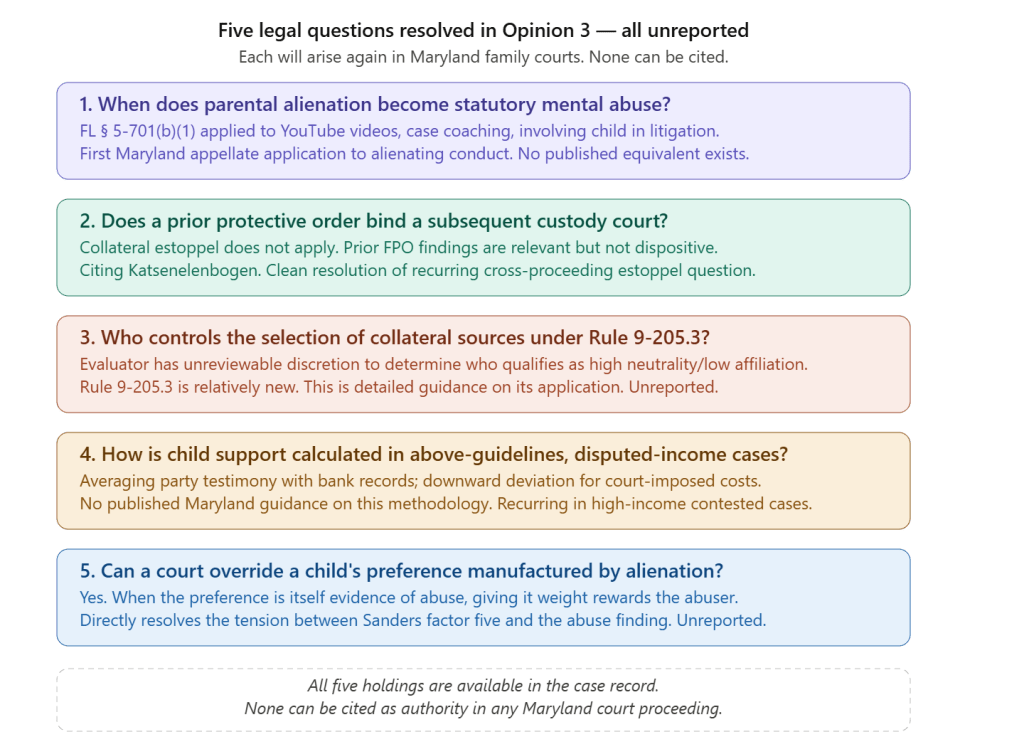
One: When does parental alienation constitute “mental abuse” under FL § 5-701(b)(1)?
This is the question at the center of the opinion and the most significant legal contribution it makes. Maryland Family Law § 5-701(b)(1) defines “abuse” to include mental injury to a child under circumstances indicating the child’s health or welfare is harmed or at substantial risk of being harmed by a parent. The statute has long been applied to physical abuse. Its application to parental alienating conduct — involving a child in litigation, coaching a child to distrust authority, producing public videos with the child criticizing the court — is the legal question this opinion answers for the first time in any Maryland appellate court.
The opinion does not treat this as a close call. Judge Asti’s findings are extensive and specific. The appellate court affirmed them without hesitation. But “without hesitation” is not the same as “with published guidance.” The line the court drew — between high-conflict parenting and statutory mental abuse — is drawn in an unreported opinion that no future judge, attorney, or litigant can point to when the same question arises.
And it will arise. Parental alienation allegations are among the most common and most contested claims in Maryland family court. Every case where a judge must decide whether a parent’s conduct has crossed from difficult to abusive — and what legal consequences follow from that crossing — will be decided without access to the most detailed appellate analysis Maryland has produced on the question.
Two: Does collateral estoppel apply between a protective order proceeding and a subsequent custody case?
Reichert argued that the 2019 Final Protective Order, issued by a Baltimore City court finding Hornbeck had neglected G.R. while intoxicated, should be binding on the Anne Arundel custody court under the doctrine of collateral estoppel. The same issue, finally decided, cannot be relitigated.
The appellate court rejected this argument, drawing a careful distinction between the protective order statute’s preventive purpose and the custody statute’s best-interest framework. The court held — citing Katsenelenbogen v. Katsenelenbogen, 365 Md. 122 (2001) — that a prior protective order finding “may be relevant” in subsequent custody proceedings but does not trigger collateral estoppel. The two proceedings have different purposes, different standards, and different legal consequences.
This is a clean, reasoned resolution of a recurring question in Maryland family law. Every attorney who has ever asked “does a prior protective order bind the custody court?” needs this answer. It is unreported.
Three: What is the standard for evaluating a custody evaluator’s compliance with Maryland Rule 9-205.3, and who controls the selection of collateral sources?
Maryland Rule 9-205.3 was substantially revised in recent years and its interpretation is still developing. The rule’s requirement of contact with “high neutrality/low affiliation collateral sources, as determined by the assessor” creates a significant ambiguity: the assessor determines who qualifies as a neutral source. Reichert argued the evaluator had improperly rejected his proposed neutral witnesses. The court held the rule gives the evaluator unreviewable discretion on that question.
That holding — that a custody evaluator can unilaterally define the universe of neutral contacts and thereby set the boundaries of her own inquiry — is a meaningful statement about how Rule 9-205.3 works in contested cases. It will matter in every future case where a litigant challenges an evaluator’s methodology. Unreported.
Four: How is child support calculated in above-guidelines income cases with disputed earnings?
Reichert’s income was contested. His bank records for the first eight months of 2022 showed gross receipts exceeding $500,000, but he argued a significant portion reflected a one-time payment. The court used $22,500 per month as his income — a figure it derived by averaging his own testimony about his billing rate with the adjusted bank record figures. It then deviated downward from the guidelines amount to account for supervision and transportation costs it was requiring Reichert to bear.
The methodology the court applied — averaging party testimony with bank record data, then making a downward deviation to account for court-imposed costs — is a rational approach to a recurring problem. Maryland has no published appellate guidance on how to calculate above-guidelines child support when income is both contested and variable. This opinion provides that guidance. Unreported.
Five: Can a court disregard a child’s expressed custodial preference when it finds that preference was manufactured through parental alienation?
G.R. told the court he wanted to live primarily with his father. The court heard him, acknowledged his preference, and overrode it — finding that the preference itself was a product of Reichert’s alienating conduct and therefore could not be treated as an authentic expression of the child’s interests.
This holding sits at the intersection of two fundamental family law principles that are often in tension: the child’s preference as a Sanders factor to be weighed, and the court’s obligation to protect the child from the very influence that manufactured the preference. The court resolved the tension by saying: when a child’s preference is itself evidence of abuse, giving that preference dispositive weight would reward the abuser. That reasoning is consequential. Every future court facing the same tension will have to reach the same conclusion independently. Unreported.

The Asymmetry the Opinion Doesn’t Address
There is a thread running through Opinion 3 that the appellate court never pulls on, and that its unreported status ensures no future court will pull on either.
Throughout the proceedings leading to the September 2022 trial, Reichert was punished — jailed, stripped of custody, subjected to supervised visitation, ordered to pay $100,000 in attorney’s fees — for conduct the court characterized as harmful to G.R. Hornbeck, during the same period, had failed multiple probation sobriety tests, had been confirmed by her own deposition testimony to have violated the terms of her probation for assaulting a police officer, and had filed or initiated proceedings that produced 26 criminal charges against Reichert, all ultimately dropped or dismissed.
The opinion does not address what consequences, if any, Hornbeck faced for the sobriety failures. It does not address whether the pattern of criminal charges — all dropped — was considered in the court’s assessment of the parties’ credibility or fitness. It affirms the circuit court’s finding that there was “no likelihood of abuse by Mother” without addressing the documented record of her probation violations during the pendency of the modification proceedings.
That asymmetry — one party’s conduct systematically punished, the other’s systematically overlooked — is not something an appellate court is required to reconcile. The standard of review is deferential. The circuit court’s credibility determinations are essentially unreviewable. The appellate court’s job is to ask whether the circuit court abused its discretion. Here, it found it did not.
But a published opinion would be subject to scrutiny that an unreported one is not. Legal scholars could examine whether the circuit court’s treatment of the two parties’ conduct reflected a consistent legal standard. Other courts facing similar asymmetries could examine this reasoning. Attorneys could use it — or argue against it. The conversation would happen in public.
An unreported opinion forecloses that conversation. The result stands. The asymmetry is sealed.
What Gets Buried — For Every Case That Comes After
The five legal questions Opinion 3 resolved will arise, individually and collectively, in Maryland family courts for years. The parental alienation question alone — when does a parent’s conduct cross from difficult to abusive under § 5-701(b)(1)? — is litigated in some form in virtually every contested high-conflict custody case. Maryland family court judges across twenty-four counties are drawing that line every week, without a single published appellate opinion to guide them.
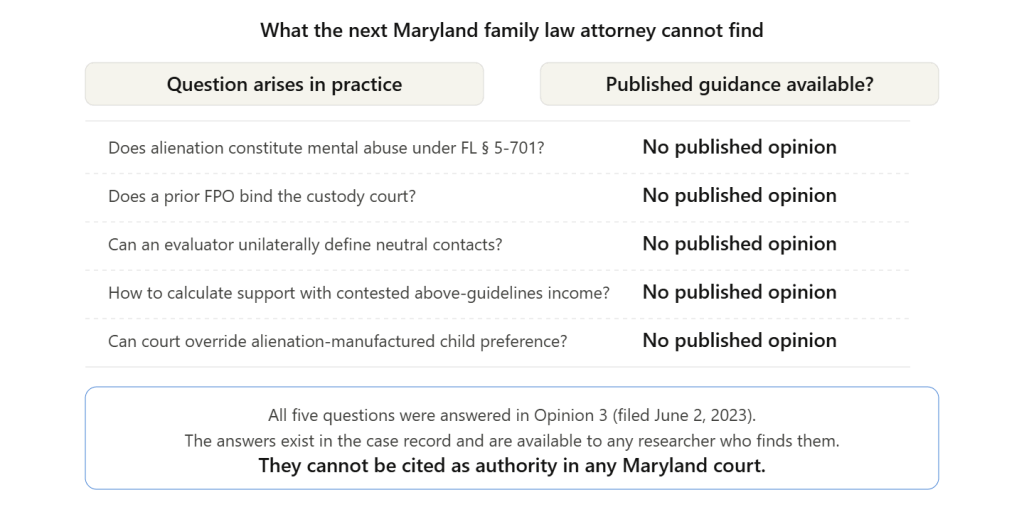
Opinion 3 could have been that opinion. It has everything the publication standard requires: substantial legal questions, detailed analysis, extensive findings from a judge who had presided over the case for years, and a fact pattern that is not so idiosyncratic as to limit its guidance to this one case. Parental alienation, contested custody evaluators, above-guidelines income, the child preference override — these are recurring features of Maryland family law, not exotic edge cases.
Instead, a Maryland family law attorney researching the § 5-701(b)(1) mental abuse standard today will find no reported appellate opinion applying it to parental alienating conduct. A judge considering whether to override a child’s custodial preference on alienation grounds will find no published authority for doing so. An attorney challenging a custody evaluator’s selection of collateral contacts will find no published guidance on the scope of evaluator discretion under Rule 9-205.3.
All of those answers exist. They are in Opinion 3, available to anyone who finds the case and knows where to look, treated as persuasive authority with a procedural asterisk. They are not law.
That is what it means for an opinion of this magnitude to be unreported. Not that the result is wrong — the appellate court affirmed it, and appellate courts affirm cases every day. But that the reasoning used to reach the result, applied to questions that will recur in the lives of Maryland families for years, is sealed from public view by a designation that was made at the moment the opinion was filed and can never be revisited.
The custody of G.R. was determined in eight days of trial, affirmed in twenty-seven pages of appellate opinion, and rendered invisible by a single word on the cover page.
Unreported.
Next in the series: Article 5 — “Filed in Baltimore, Decided in Annapolis: The Venue Question That Keeps Disappearing Into Unreported Opinions.” An examination of Opinion 4 (No. 159), where the appellate court upheld Anne Arundel County’s jurisdiction over a protective order case in which neither party lived there, the incident occurred in Baltimore County, and the case was originally filed in Baltimore County — in an unreported opinion that now governs venue consolidation in Maryland family court without being citable.
Opinion No. 1370, September Term 2022, was filed June 2, 2023, authored by Judge Kevin Shaw of the Appellate Court of Maryland, with Judges Wells and Friedman on the panel. It is available through the Maryland Judiciary Case Search. Background facts regarding Hornbeck’s 2018 arrest, the criminal proceedings against Reichert, and the circumstances of the 2020 modification filing are drawn from the federal civil rights complaint in Reichert v. Hornbeck et al., Case No. 1:24-cv-01865-JMC (D. Md.), which survived a motion to dismiss, from Hornbeck’s February 27, 2026, deposition, and from the master case timeline published at freegrantreichert.com.

Need help reviewing or organizing court or formal documents?
Father & Co. offers non-legal document review and organization for people representing themselves. This includes clarity, structure, neutral tone, and timeline organization — not legal advice or representation.
Have a story, experience, or resource to share?
Submissions are reviewed with care and discretion. We respect privacy and handle sensitive information responsibly.
The New Diagnostic And Statistical Manual (DSM-V) Helps Our Children!
Posted on May 20, 2013. Filed under: Parental Alienation Syndrome | Tags: Bill Bernet, PAAO, parental alienation, SDM 5 |
Dr. Bill Bernet, of Vanderbilt University, lead a group of interested professionals in encouraging the DSM 5 editing group to include Parental Alienation Disorder. The new DSM 5 was published on May 18, 2013 and is the reference book for psychiatrists, psychologists and other mental health providers Here is Dr. Bernet’s unedited analysis of the result.
The DSM-5 Task Force told us 2 or 3 years ago that they did not want parental alienation to be a separate diagnosis in DSM-5, but they thought that parental alienation could be considered an example of other diagnoses that are in DSM-5.
The actual words “parental alienation” are not in DSM-5, but there are several diagnoses that can be used in these cases. I would say the “spirit” of parental alienation is in DSM-5, even if the words are not.
Parent-child relational problem now has a discussion in DSM-5, not just a label. The discussion explains that cognitive problems in parent-child relational problem “may include negative attributions of the other’s intentions, hostility toward or scapegoating of the other, and unwarranted feelings of estrangement.” That is a pretty good description of a child’s view of the alienated parent, although it is an unfortunate use of the word “estrangement.”
Child psychological abuse is a new diagnosis in DSM-5. It is defined as “nonaccidental verbal or symbolic acts by a child’s parent or caregiver that result, or have reasonable potential to result, in significant psychological harm to the child.” In many instances, the behavior of the alienating parent constitutes child psychological abuse.
Child affected by parental relationship distress is another new diagnosis in DSM-5. It should be used “when the focus of clinical attention if the negative effects of parental relationship discord (e.g., high levels of conflict, distress, or disparagement) on a child in the family, including effects on the child’s mental or other physical disorders.” That is also a good description of how parental alienation comes about.
Factitious disorder imposed on another is the DSM-5 terminology for factitious disorder by proxy or Munchausen disorder by proxy. Its definition is “falsification of physical or psychological signs or symptoms, or induction of injury or disease, in another, associated with identified deception.” In some cases, that would describe the behavior of the alienating parent.
Delusional symptoms in partner of individual with delusional disorder is the DSM-5 terminology for shared psychotic disorder or folie a deux. The definition is: “In the context of a relationship, the delusional material from the dominant partner provides content for delusional belief by the individual who may not otherwise entirely meet criteria for delusional disorder.”
The concept of parental alienation is clearly in DSM-5, although the actual words are not. This is a great improvement over DSM-IV-TR, especially with the addition of the new diagnoses, child psychological abuse and child affected by parental relationship distress.
INTERMITTENT EXPLOSIVE DISORDER (“IED”) --Plaintiff Mother is Bi-Polar and had Intermittent Explosive Disorder (“IED”).
(IED also is the abbreviation for IMPROVISED EXPLOSIVE DEVICE used by terrorists). Intermittent Explosive Disorder involves repeated, sudden episodes of impulsive, aggressive, violent behavior or angry verbal outbursts in which one reacts grossly out of proportion to the situation. In fact, when the report was submitted to the Court and Dr. XXXX was concerned about the safety of me and the children being with Plaintiff, Plaintiff told her now deceased father about the report. Her father threatened Dr. XXXX with physical harm.
According to the literature, IED has a genetic component and occurs in families, involves a history of mental health disorders, antisocial behavior, uncontrolled violent outbursts, road rage, substance abuse, and borderline personality disorders. Symptoms are temper tantrums, shouting, being argumentative, getting into fights, threatening others, damaging property and assaulting animals and people. This is why custody of the children must be reversed from Plaintiff Mother to Defendant Father.
(“IED” also means IMPROVISED EXPLOSIVE DEVICE like those used in Afghanistan)
LEGAL ABUSE SYNDROME A SEPARATE DIAGNOSIS IN DSM-5.
Legal Abuse Syndrome (LAS) is now a separate diagnosis in DSM -5 (Diagnostic and Statistical Manual of Mental Disorders version 5). It is a Post-Traumatic Stress Disorder ("PTSD").
"PTSD" acquired through prolonged exposure to Crooked Lawyers & Courts
LAS is when a person is repeatedly dragged back into court on false allegations or other misinformation. The court system is so aggressive and draining that in the case of PAS, where it is often dragged out for years, the person is in constantly emotionally and mental turmoil. They feel like they are constantly fighting for their life, or rights. They feel abuse, and taken advantage of. And they have all the same signs and symptoms as someone who has PTSD, i.e. reoccurring dreams, flashbacks, avoidance behaviors and hyperarousal symptoms.
As for Legal Abuse Syndrome, Synopsis of Legal Abuse Syndrome:
* If you are deeply disillusioned and feeling oppressed as an American Citizen, resulting from experience with our justice system, you may be suffering from Legal Abuse Syndrome.
* If you’ve been a litigant in court and justice was not to be obtained at any price, you may be suffering from Legal Abuse Syndrome.
* If you fantasize an act of vigilante vengeance because it seems like the only recourse, you may be suffering from Legal Abuse Syndrome.
* If you’ve reported a crime and found that you were punished instead of the criminal, you may be suffering from Legal Abuse Syndrome.
* If creativity and dreams have been left in the past because their development was ripped from you and torn to shreds by your protective systems, you may be suffering from Legal Abuse Syndrome.
* If you feel numb, disconnected, and vulnerable, you may be suffering from Legal Abuse Syndrome.
* If you feel that you have been victimized twice, once by a perpetrator and then by your protective system, you may be suffering from Legal Abuse Syndrome.
Some good resources:
http://www. equalaccessadvocates.com/ order_legal_abuse_syndrome.htm
http://www.traumacenter.org/
http://saynotopas.com/ category/legal-abuse-syndrome/
Some will deny that Legal Abuse Syndrome (LAS) exists. They will remind us that we have an adversarial system of justice. Abuses will be written off as adversaries battling for their clients. Victims will be nothing more than casualties of a “fight for justice.” Others will worry that victims of LAS will want compensation for their psychological injuries. Skeptics will ask, “Aren’t LAS victims just malingerers wanting more from the syste