

The System Let Her Down First
What the Aaron Spencer dismissal reveals — and what it doesn’t resolve.

On Thursday, an Arkansas judge dismissed the second-degree murder charge against Aaron Spencer, the Lonoke County Army veteran and farmer who shot and killed Michael Fosler in the early hours of October 8, 2024, after finding his 13-year-old daughter in Fosler’s truck past midnight. The dismissal came not on grounds of self-defense or justified use of force — but because Lonoke County Sheriff’s deputies failed to preserve a dash camera memory card from Fosler’s vehicle, evidence that Spencer’s attorneys argued could have cleared him.
Special Circuit Court Judge Ralph Wilson Jr. called the evidence handling an “egregious” due process violation. The failure to preserve the card, he wrote, “was so egregious that dismissal of this case is warranted.”
The story went viral. It will continue to circulate as a vindication narrative — a father who acted when the system wouldn’t, ultimately cleared by a court that recognized he’d been wronged. That framing isn’t false. But it’s incomplete. And the part it leaves out is the part that matters most.
What the system actually did
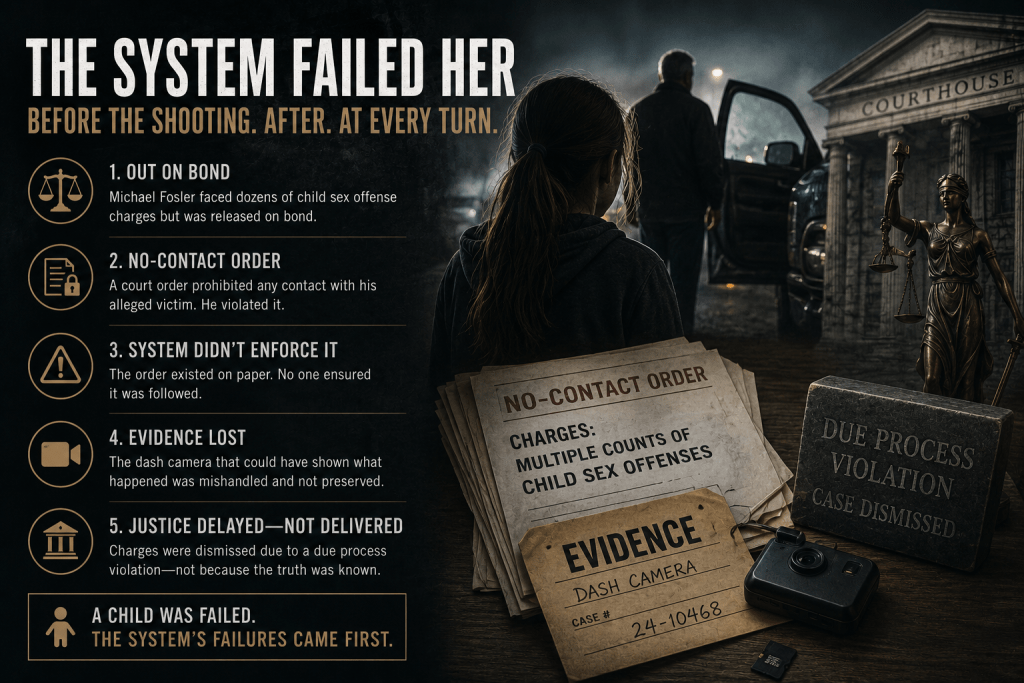
Before October 8, Michael Fosler had already been charged with dozens of offenses against Spencer’s daughter — among them internet stalking of a child and sexual assault. He was out on bond. He was under a no-contact order. He violated it. Spencer’s daughter was the only witness to the underlying sexual assault charges. Fosler’s criminal trial on those charges was set to begin three months later.
Read that sequence carefully. A 67-year-old man, already arraigned on dozens of child sex offenses, was released pretrial. He was legally prohibited from contacting his alleged victim. He found her anyway — in the middle of the night — and she ended up in his truck. The protective order existed on paper. It did not exist in practice.
This is not unusual. It is the ordinary failure mode of a system that treats risk assessment as a clerical function. Bond conditions are issued. Compliance is assumed. Enforcement follows only when something goes wrong — which, by definition, means a child has already been harmed again.
Spencer woke up at some point that night and found his daughter gone. He searched for her. He found her in Fosler’s vehicle. What happened in the minutes that followed remains, in part, legally unresolved — the dash camera evidence that might have documented the altercation was mishandled by the very agency that later arrested Spencer for murder.
Evidence and the system’s second failure
The dismissal rests on a specific due process violation: a detective with the Lonoke County Sheriff’s Office removed the dash camera from Fosler’s truck at the scene and failed to preserve it according to standard evidence protocols. The memory card — which could have recorded the encounter that led to the shooting — was not handled as evidence. The court found this constituted a violation of Spencer’s constitutional rights serious enough to warrant dismissal of the entire case.
That finding carries weight beyond this case. It documents that the same institutional apparatus, which failed to enforce Fosler’s no-contact order, also failed, at the scene of Fosler’s death, to handle evidence in a way that would protect Spencer’s ability to mount a defense. Whether that reflects incompetence, indifference, or something more deliberate, the court did not say. What the court did say is that the consequence fell entirely on Spencer — and that the remedy had to be dismissal.
There is a bitter irony in this: the evidence that might have shown a father acting to protect his child was lost by the sheriff’s office, whose job was to protect that child in the first place.
The original trial judge — before being replaced on the case — appeared, by the Arkansas Times’ reporting, to have leaned toward the prosecution. She imposed a gag order that the Arkansas Supreme Court later rescinded, calling it a “plain, manifest, clear, and gross abuse of discretion.” She also attempted to limit public access to the proceedings. The institutional machinery, in other words, was not passive. It actively worked to constrain Spencer’s ability to defend himself publicly while the case moved forward.
What the viral frame misses
The dominant public narrative around the Spencer case — father acts, system finally concedes — resolves into a satisfying arc. But it papers over the structural questions that should drive the harder conversation.
Why was Fosler out on bond, facing dozens of child sex offense charges? What pretrial risk assessment determined he was not a flight risk and not a danger to the child whose testimony he needed to suppress? Who made that call, and under what standard? Were there prior violations of the no-contact order before October 8 that went unreported or unenforced? The record, as publicly available, does not answer these questions. The viral attention the case has received has not generated reporting that answers them either.
Spencer has now won the Republican nomination for Lonoke County sheriff — defeating the incumbent whose office arrested him. He has pledged to build a dedicated unit focused on child sex crimes. His candidacy is, in the most literal sense, a direct response to institutional failure. Voters in a heavily Republican county have ratified that response by wide margins.
Whether Spencer becomes sheriff is a separate question from whether the structural conditions that produced this case get examined. The two outcomes are not the same thing. A system that produces Aaron Spencer cases and then produces Aaron Spencer sheriffs has shifted accountability from institutions to individuals. That may feel like justice. It is not the same as reform.
The child in this story
Spencer has made his daughter’s experience a central element of his public campaign. He has spoken about the criminal justice system’s failure to protect her and has named combating child sex crimes as the organizing principle of his candidacy. She was, by his telling and by the record, failed at every protective stage: by the system that let her alleged abuser out on bond, by the enforcement mechanism that could not hold a no-contact order, and by the investigative apparatus that lost the evidence at the scene.
She was also the only witness to the underlying charges against Fosler. With Fosler dead and Spencer’s case now dismissed, those charges will never be adjudicated. The record will show that Fosler was accused and that Spencer was charged and cleared. It will not show a conviction. For the daughter at the center of this story — now 15 — the institutional account of what happened to her ends without a verdict.
That is not Spencer’s fault. It may be the most important fact in the entire case, and it is the one least discussed in the coverage that followed Thursday’s ruling.
What accountability requires
The Spencer dismissal is, procedurally, a clean result. The state lost the evidence it needed to prosecute the case. The defendant’s rights were violated. The case was dismissed. That is the system working as designed — belatedly, and only after an extraordinary intervention by a substitute judge willing to call the original misconduct by its name.
But accountability journalism on family court and child protection systems is not satisfied by outcomes. It asks about the decisions upstream of the outcome. It asks who set Fosler’s bond and on what basis. It asks whether the no-contact order had been violated before. It asks what protocol the detective was supposed to follow with the dash camera — and whether that detective faced any consequence for failing to follow it.
It asks, most fundamentally: how many children are in the position Spencer’s daughter was in — with an alleged abuser out on bond, with a protective order that exists only on paper, with no one monitoring the gap between what the court ordered and what is actually happening?
Aaron Spencer’s case got national attention because it ended in a shooting, a murder charge, a sheriff’s race win, and a dramatic dismissal. The cases that don’t end that way — where the order is violated, the child is harmed again, and nothing changes — don’t make the timeline at all.
That’s the story. Not the dismissal. The dismissal is just where it becomes visible.