



Father absence is the most consistent predictor of juvenile crime in America. Almost no one in power wants to say so plainly.
The footage from city after city is familiar by now. Packs of teenagers, coordinated through social media, flooding a convenience store or a downtown corridor, overwhelming staff, taking what they want, and scattering before police arrive. In Los Angeles, a bicycle crew of 20 to 40 juveniles hit 14 convenience stores over a single summer, hurling merchandise at employees and filming themselves doing it. In Sacramento, a swarm of teens turned a gas station into a scene of chaos in minutes, leaving a lone clerk to fend for himself. In Illinois, 300 teenagers descended on a shopping center pool, shut it down, and set off fireworks when officers arrived.
The FBI has now formally documented the trend. Its December 2025 report on flash mob shoplifting incidents — analyzing five years of data from 2020 through 2024 — confirmed that more incidents were reported in 2024 than when the trend began, with participants stealing more than $8 million in goods and destroying more than $51,000 in property over that period. Those are the cases that made it into federal data. The footage suggests the problem is considerably wider.
Commentators argue about root causes — smartphones, social media, lenient prosecutors, a generation raised without consequences. All of those things are real contributing factors. But one variable appears in the research with a consistency that should settle the conversation, and it is almost never named plainly in polite coverage.
These are mostly fatherless kids.
The research is not subtle. It is not new. And the institutions responsible for addressing it have, for the most part, spent the last generation looking the other way.
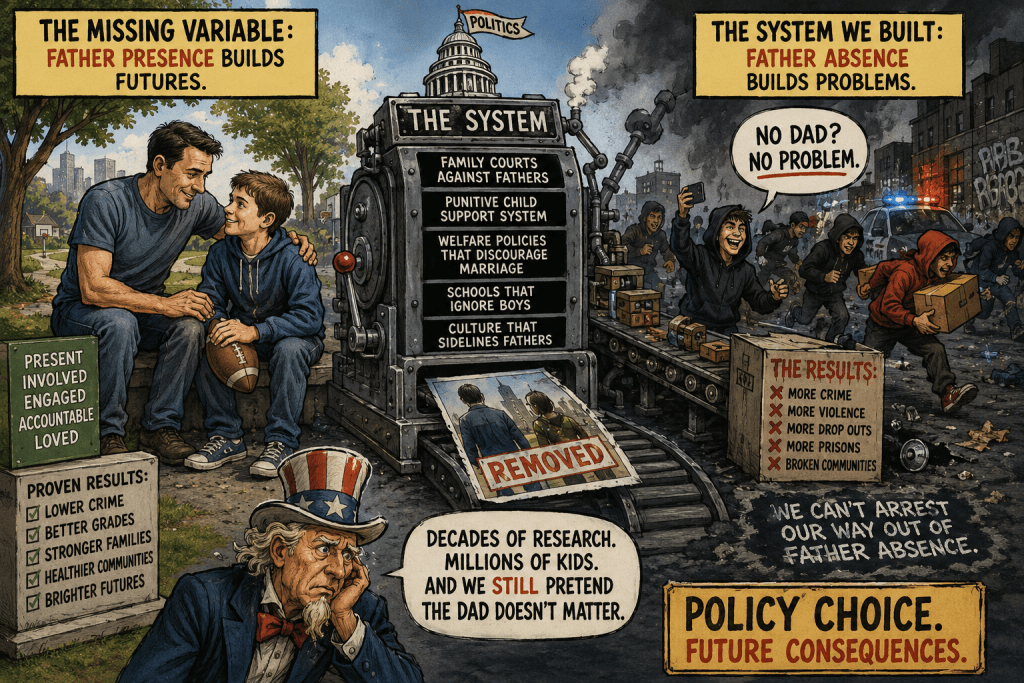
That is not a political statement. It is a finding replicated across four decades of social science research, across income levels, across racial categories, across geographic regions. Boys raised without fathers present are statistically overrepresented in virtually every index of behavioral crisis: juvenile arrests, gang involvement, school discipline incidents, substance abuse, early dropout. The research is not subtle. It is not new. And the institutions responsible for addressing it have, for the most part, spent the last generation looking the other way.
What the Numbers Say
Millions of boys raised without fathers become responsible adults. But the risk profile changes substantially.
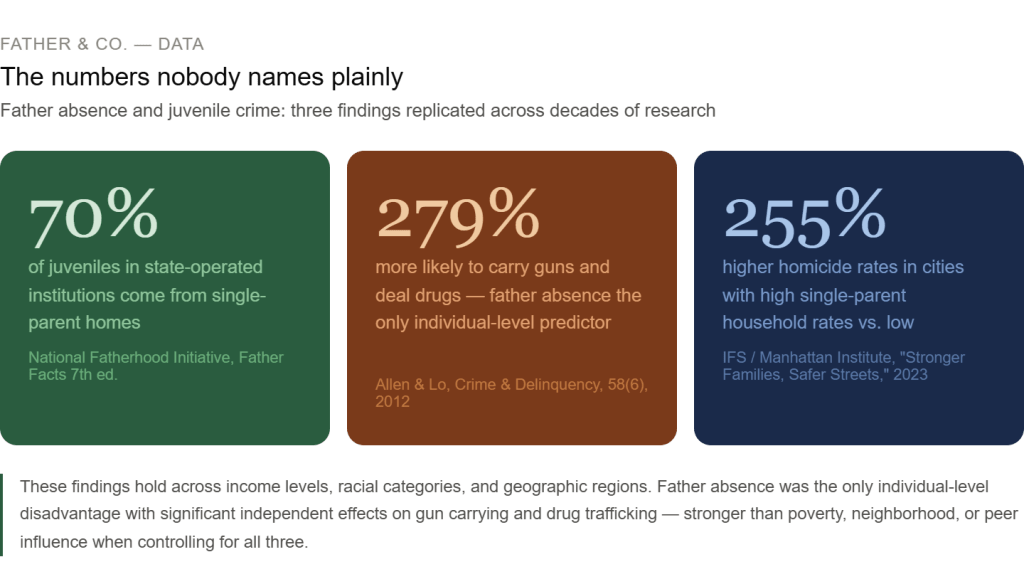
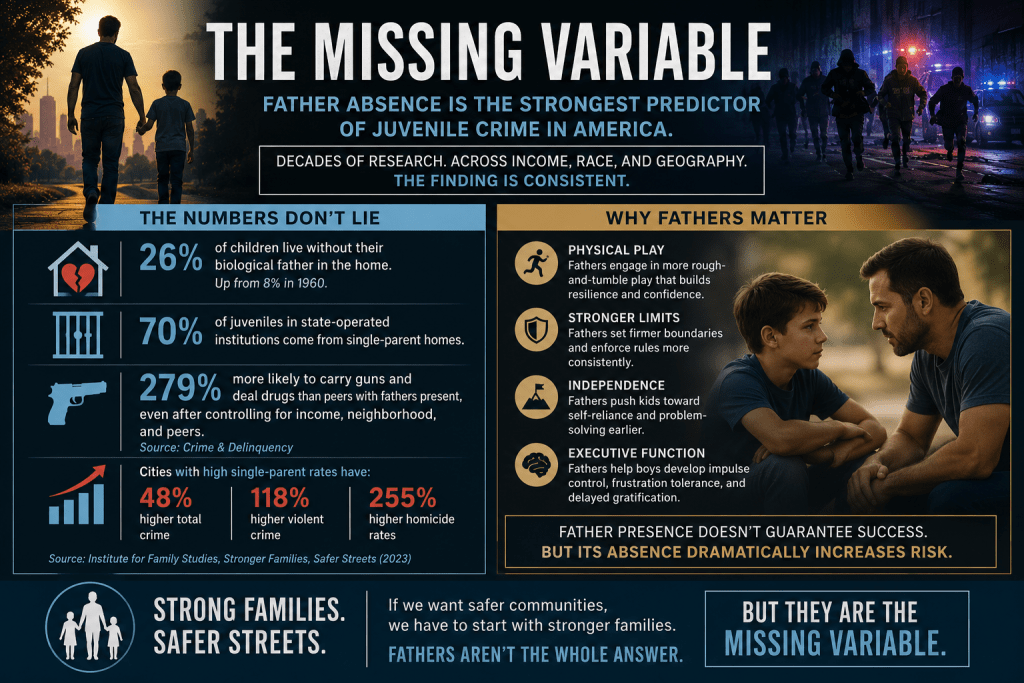
In 1960, approximately 8 percent of American children lived without their biological father in the home. By 2024, that figure had risen to roughly 26 percent — more than 18 million children. The United States now has one of the highest rates of single-parent households in the developed world.
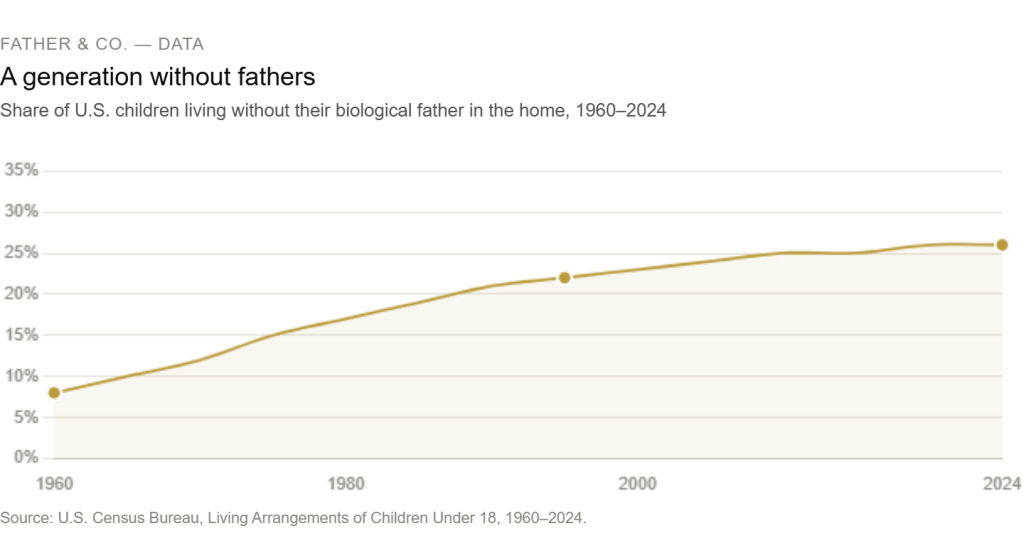
Seventy percent of juveniles in state-operated institutions come from single-parent homes. In a study of 75 juvenile delinquents, 66 percent had experienced fatherlessness. Individuals from father-absent homes are 279 percent more likely to carry guns and deal drugs than peers who lived with their fathers, according to research published in Crime & Delinquency — and that finding held even after controlling for income, neighborhood, and peer influence. Father absence, the researchers found, was the only individual-level disadvantage with significant independent effects on both gun carrying and drug trafficking.
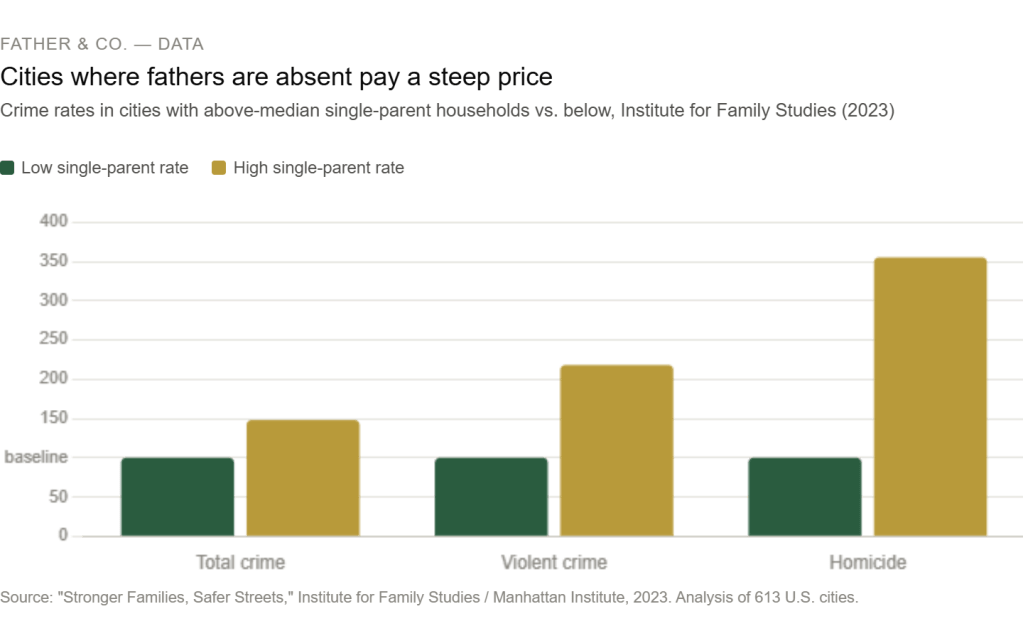
The city-level data is equally unambiguous. The Institute for Family Studies’ 2023 report, “Stronger Families, Safer Streets,” analyzed census and crime data from 613 American cities. It found that total crime rates in cities with high levels of single parenthood were 48 percent higher than in cities with low levels. Violent crime rates were 118 percent higher. Homicide rates were 255 percent higher. Harvard sociologist Robert Sampson, whose work on this link spans decades, has observed that family structure is “one of the strongest, if not the strongest, predictors of violence across cities in the United States.”
Boys are particularly affected. Fathers parent differently than mothers in ways that are not deficiencies on either side — research consistently finds that fathers engage in more physical play, set harder limits, push children toward independence earlier, and model frustration tolerance and delayed gratification in distinct ways. For boys specifically, a father’s presence appears to anchor the development of what researchers call executive function — the capacity to regulate impulse, tolerate frustration, and anticipate consequences. The teenage boy who floods a convenience store and films it for social media is, among other things, a boy whose impulsivity has never been shaped by a consistent male presence who required something of him.
The absence of that presence does not make violence inevitable. Millions of boys raised without fathers become functional, responsible adults. But the risk profile changes substantially — and it does not change equally across communities.
Who Bears the Heaviest Burden
Any honest accounting of the fatherlessness crisis has to confront where it lands hardest.
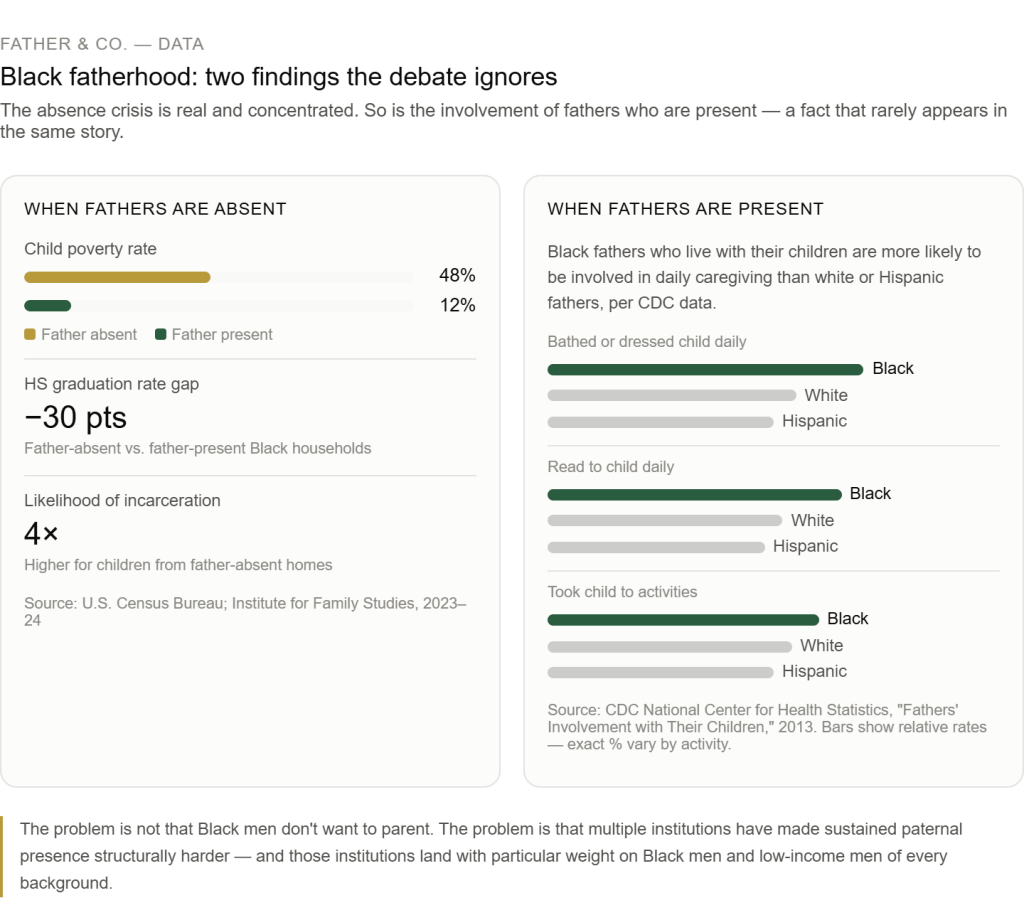
The problem is disproportionately concentrated in Black communities and in low-income households across all races. In Black families specifically, the rate of father-absent households has risen dramatically over the past half century — driven by a combination of forces that deserve more honesty than the public debate usually allows. Black children in father-absent homes face a poverty rate of 48 percent, compared to 12 percent in two-parent Black households. Their high school graduation rates drop by 30 percentage points. Their likelihood of incarceration rises by a factor of four.
It is worth noting — because the stereotype distorts the policy conversation — that Black fathers who are present in their children’s lives are, by CDC data, more likely to be involved in daily caregiving than white or Hispanic fathers. The problem is not that Black men do not want to parent. The problem is that a series of institutional forces — described in more detail below — have made sustained paternal presence structurally harder, and those forces land with particular weight on Black men and low-income men of every background.
Acknowledging that is not a concession to any particular political narrative. It is a prerequisite for understanding the problem clearly enough to do anything about it.
How the System Removes Fathers
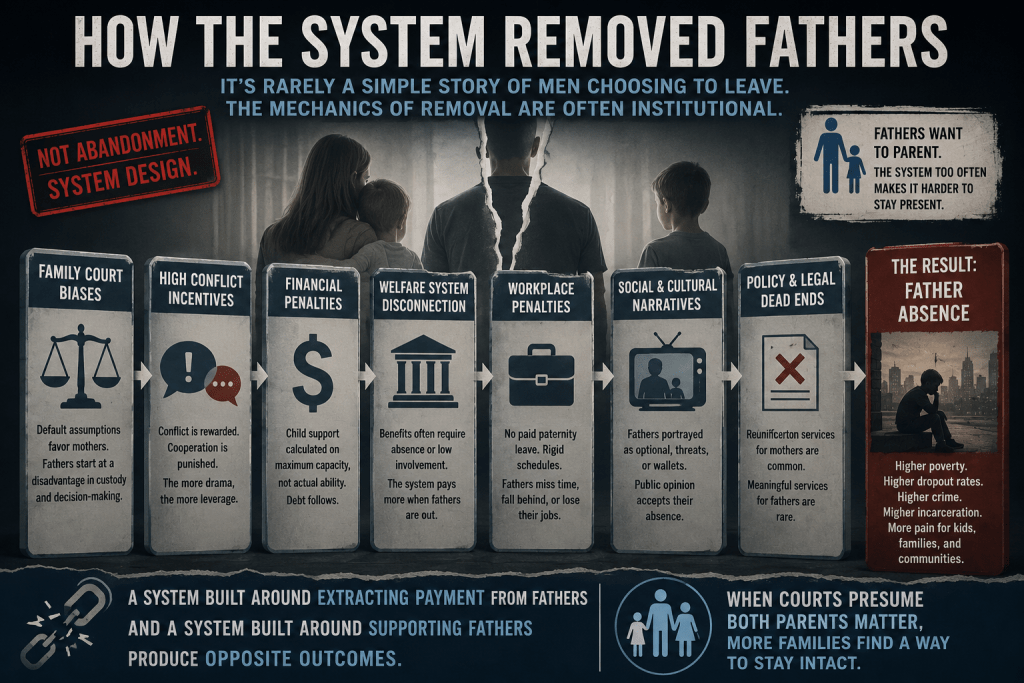
Father absence is rarely a simple story of men choosing to leave. The mechanics of removal are often institutional.
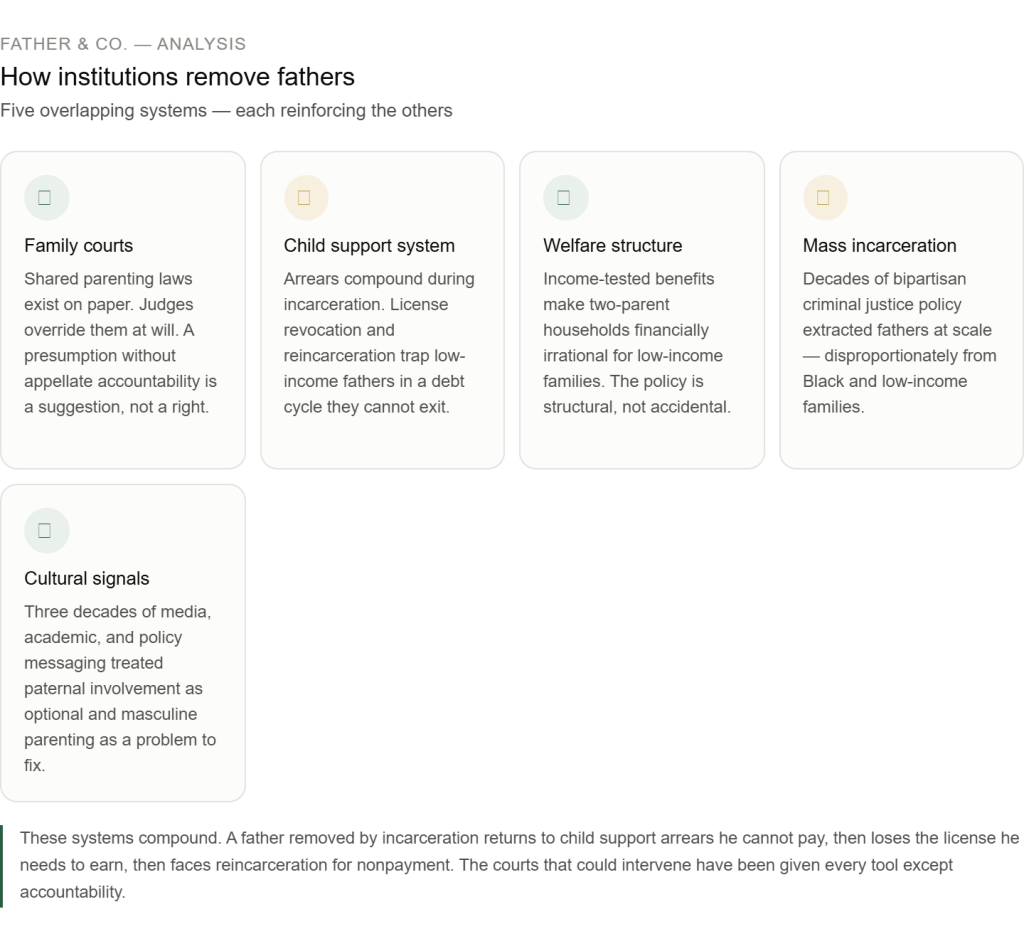
Father absence is rarely a simple story of men choosing to leave. The mechanics of removal are institutional, and they operate through several overlapping channels.
Family courts default to mother custody — and shared parenting laws have not fixed that. Most state family court systems continue to award primary physical custody to mothers in the majority of contested cases. The discretion afforded to judges — and the guardian ad litem and custody evaluator ecosystem that advises them — creates a system in which a father’s removal from daily life can be achieved through procedural maneuvering rather than evidence of unfitness. Protective orders filed at low evidentiary thresholds can remove a father from a shared home overnight on allegations that may never be fully adjudicated. Parental alienation — a documented pattern in which one parent systematically undermines a child’s relationship with the other — is rarely addressed with the seriousness its developmental consequences warrant.
The shared parenting movement has spent a decade and a half winning legislative victories that look better on paper than they perform in courtrooms. Ten states have now enacted some form of shared parenting presumption, according to the National Parents Organization’s 2025 Report Card. Kentucky’s 2018 law — the first of its kind in the country — is the most cited success story, and there is real evidence behind it: its divorce rate fell 25 percent between 2016 and 2023, outpacing the national decline of 18 percent. The presumption appears to change behavior before cases reach a judge, which matters.
But even Kentucky’s law — the strongest in the country — preserves full judicial discretion to override the presumption whenever a judge determines it is not in the child’s best interest. Every state that followed built the same escape hatch in. Maryland passed shared parenting legislation that took effect October 1, 2025 — but the stronger bill, which would have required approximately equal parenting time, did not pass. What became law is a presumption that courts consider substantial time with both parents, paired with broad discretion to deviate without meaningful appellate accountability. Fathers in Maryland’s family court system already know what broad judicial discretion produces in practice.
The structural problem isn’t unique to Maryland. It is the defining weakness of shared parenting reform as a strategy. A presumption a judge can override without documenting a compelling reason isn’t a legal standard — it’s a suggestion. And suggestions, as any father who has watched a judge wave off a statute can tell you, are not the same as rights. The Kentucky Law Journal noted shortly after that state’s law passed that attorneys would need to track case law as judges determined what circumstances could overcome the presumption — which is an academic way of saying: watch how courts quietly hollow out the statute through practice. Bar associations and family law attorneys have opposed shared parenting bills in nearly every state that has considered them, and their interest in preserving judicial discretion is not difficult to identify.
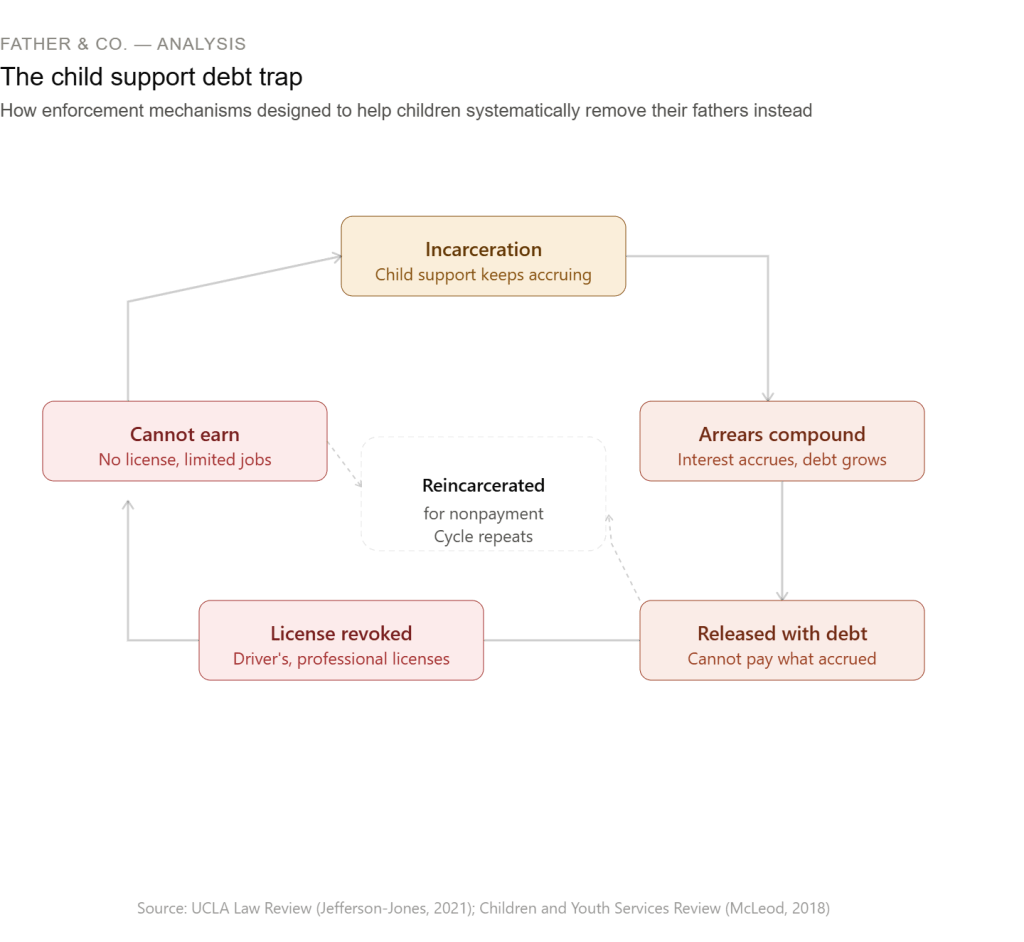
The child support system traps low-income fathers in a cycle that makes presence harder. This is the piece of the fatherlessness puzzle that almost no one discusses in either political camp, because it implicates a program that is supposed to help children. In practice, aggressive child support enforcement — designed around middle-income earners — can destroy the conditions for a low-income father’s involvement rather than support them.
When a father is incarcerated, child support arrears continue to accrue. When he is released and cannot immediately find work, the debt compounds, often at interest. The enforcement mechanisms available to states — license revocation, passport denial, additional incarceration for nonpayment — systematically remove the tools a man needs to earn a living and pay what he owes. A father who cannot legally drive cannot hold most jobs. A man reincarcerated for arrears he cannot pay accrues more arrears. The UCLA Law Review has described this as a cyclical model in which socially constructed enforcement structures perpetuate the very absence they purport to address.
This is not an argument against child support. It is an observation that a system designed around compliance without capacity is a system that punishes children by removing their fathers twice.
Public assistance structures create economic incentives against two-parent households. The Temporary Assistance for Needy Families program, along with housing assistance and other means-tested benefits, functions as what Brookings Institution researchers have called a disincentive structure: because welfare is income-tested, it creates pressure for fathers with earnings and mothers without earnings to live apart — or to feign living apart — to maximize benefit eligibility. Heritage Foundation research presented to Congress in 2025 put the point more directly: for most low- and moderate-income families, the welfare system has made marriage economically irrational by cutting benefits sharply when parents combine households. The policy consequences were largely unintentional. The family consequences were not.
Economic displacement removed the floor under working-class fatherhood. Beginning in the 1970s and accelerating through the 1990s and 2000s, deindustrialization eliminated the category of employment that had made working-class male partnership viable: stable, wage-earning labor that did not require a college credential. The factory job that supported a family of four ceased to exist at scale. Men who could not replace that income lost the economic footing that, fairly or not, made them viable household partners. The downstream consequences took a generation to manifest fully.
Mass incarceration extracted fathers from families at scale. The criminal justice policies of the 1980s and 1990s, pursued by both parties, imprisoned men — and imprisoned Black men in numbers wildly disproportionate to their share of the population. A father in prison is, functionally, a father removed. His children face elevated risk of behavioral and developmental problems. When he returns, he is often saddled with arrears he cannot pay and a record that limits his employment options. The cycle, as the data makes clear, tends to repeat.
Cultural signals devalued paternal presence over decades. This is the piece that generates the most political friction, but it belongs in the accounting. Over the past three decades, a body of cultural messaging — in media, in some academic frameworks, in certain strands of advocacy — has treated paternal involvement as optional, fathers as peripheral, and masculine parenting as something to be reformed rather than supported. This is not the entirety of any single movement’s agenda, and characterizing it as such would be reductive. But the cumulative effect on how institutions and individuals understood the value of fathers was real. A school system that treats Father’s Day as an optional observance is not a neutral actor. Neither is a custody evaluation framework that interprets a father’s traditional breadwinner role as evidence of emotional unavailability.
The Policy Gap
A system built around extracting payment from fathers and a system built around supporting fathers produce opposite outcomes.
The United States has no coherent national fatherhood policy. What exists is a patchwork of under-resourced fatherhood engagement programs, mostly attached to child support enforcement mechanisms that frame fathers primarily as financial obligations rather than developmental resources. The distinction matters enormously. A system built around extracting payment from noncustodial fathers and a system built around supporting paternal involvement produce opposite outcomes, and the United States has built the former while gesturing at the latter.
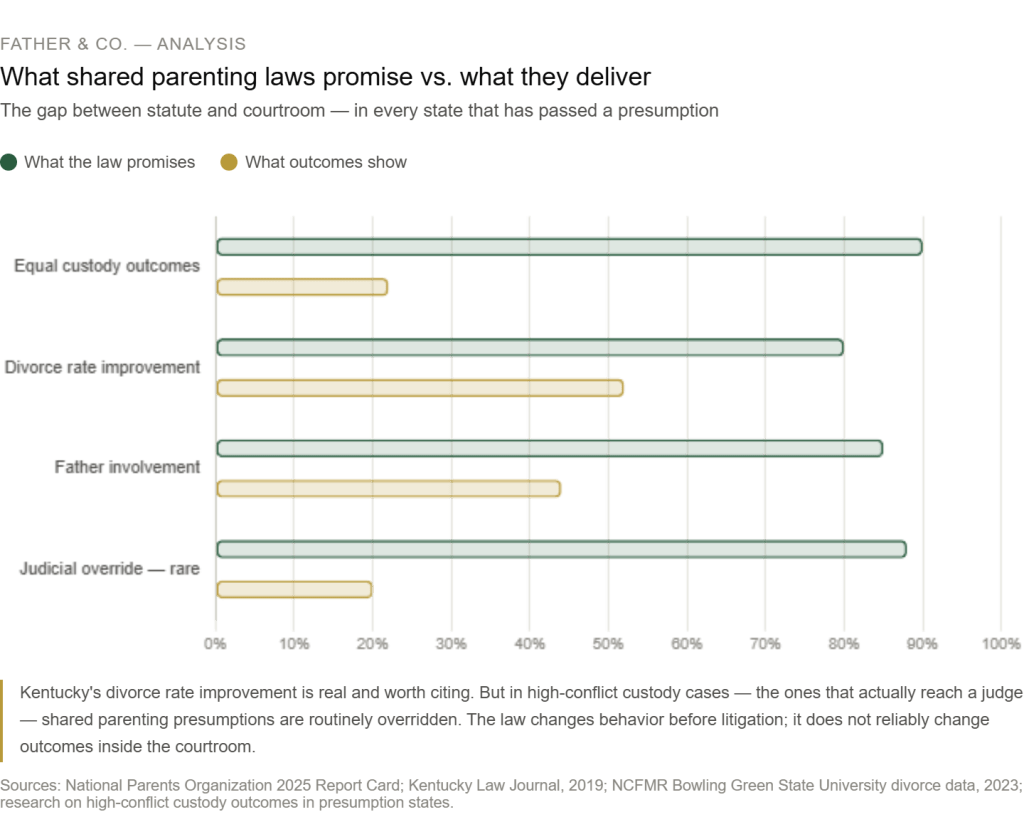
The shared parenting movement has made real legislative progress, and that progress is not nothing. But legislation without enforcement architecture is advocacy, not law. The gap between what shared parenting statutes say and what happens in individual courtrooms remains wide enough to lose a father in — and fathers are being lost in it, in Kentucky, in Maryland, in every state that has passed a presumption and called it reform.
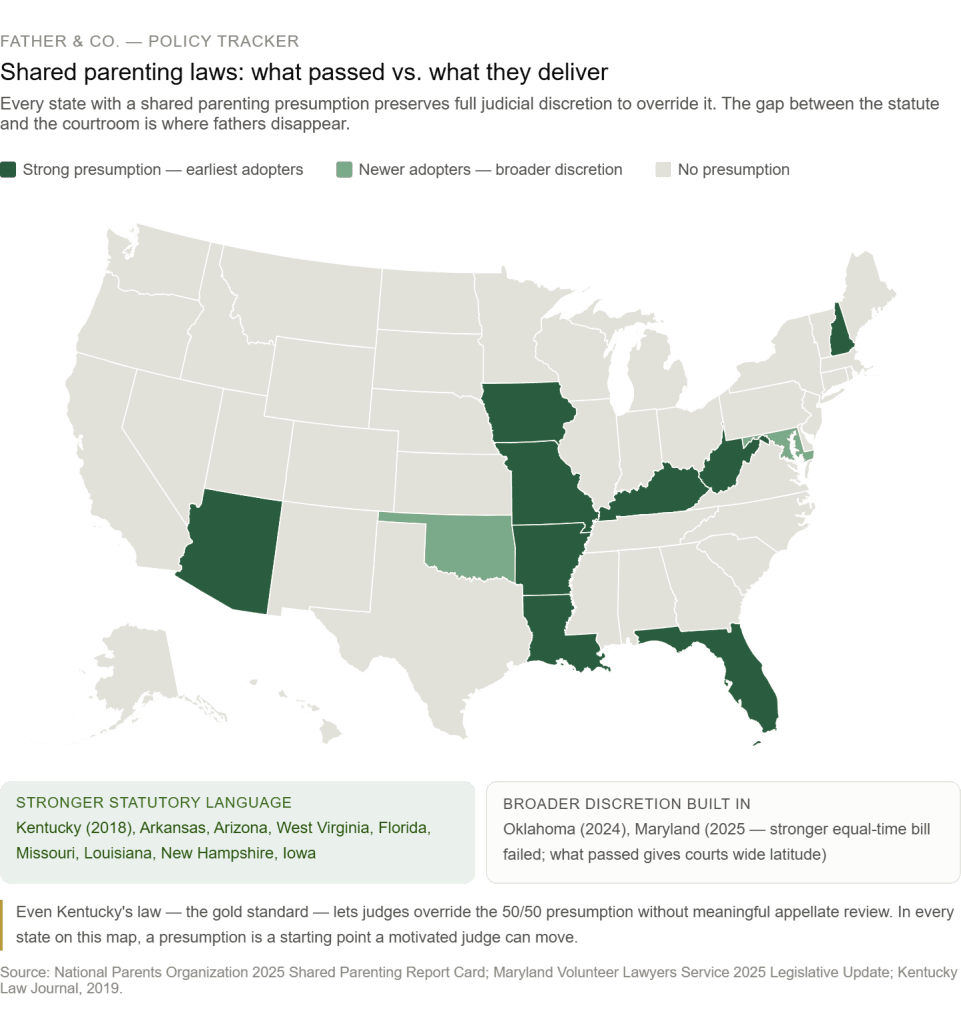
When courts presume both parents matter, more families find a way to stay intact.
What would a coherent fatherhood policy actually require? At minimum: custody law that presumes both parents are necessary, with appellate teeth that make deviation from that presumption genuinely accountable rather than discretionary; child support enforcement designed around a noncustodial father’s actual capacity rather than an idealized income; and welfare structures that stop penalizing household formation among low-income families. None of those things is radical. None of them currently exists at scale.
The Argument Worth Making
The teen flash mob is not a simple story. Neither is the fatherlessness epidemic that underlies it. Assigning it to a single political movement, a single policy failure, or a single cultural shift produces an argument that feels clean and explains less than it claims.
American institutions made a series of decisions that collectively made it harder for fathers to remain present in their children’s lives.
What the evidence supports is this: American institutions, across decades and across party lines, made a series of decisions — in courts, in welfare policy, in criminal justice, in economic policy, in cultural production — that collectively made it harder for fathers to remain present in their children’s lives, and in some cases actively facilitated their removal.
There is no footage of those decisions being made. But there is footage of what followed.
There is no footage of those decisions being made. But there is footage of what followed: a group of teenagers on bicycles, flooding a store on a Friday night, answering to no one.
The question of what to do about it is a policy debate worth having. The question of whether it matters is not.
Sources: Flash mob shoplifting data from FBI Uniform Crime Reporting Program, “Reported Flash Mob Shoplifting Incidents: 2020–2024,” released December 3, 2025 (fbi.gov). Teen flash mob incidents: LAPD press statements and ABC7 Los Angeles reporting on the LA bicycle crew robberies, July–October 2024; Fox News reporting on the Glen Ellyn, Illinois pool incident, July 2025. Father-absence household rate (8% to 26%) from U.S. Census Bureau, Current Population Survey, Living Arrangements of Children, 1960–2024. Seventy percent of juveniles in state-operated institutions from fatherless homes: National Fatherhood Initiative, “The Proof Is In: Father Facts,” 7th ed. The 66 percent figure from a study of 75 juvenile delinquents: Dewey Cornell and colleagues, cited in Cynthia Harper and Sara McLanahan, “Father Absence and Youth Incarceration,” Journal of Research on Adolescence, 2004. The 279 percent gun-carrying and drug-trafficking finding: Allen, A.N. and Lo, C.C., “Drugs, Guns, and Disadvantaged Youths: Co-occurring Behavior and the Code of the Street,” Crime & Delinquency, 58(6), 932–953, 2012. Study used secondary data from 835 juvenile male inmates drawn from the Interuniversity Consortium for Political and Social Research. City-level crime data: Brad Wilcox and Wendy Wang, “Stronger Families, Safer Streets,” Institute for Family Studies and Manhattan Institute, 2023. Robert Sampson quote on family structure as a predictor of violence: Sampson, R.J., “Crime in Cities: The Effects of Formal and Informal Social Control,” Crime and Justice, Vol. 8, University of Chicago Press, 1986; updated in Sampson, “Collective Efficacy Theory,” 2012. Black father-absence poverty and graduation statistics: U.S. Census Bureau and National Center for Education Statistics, compiled in Institute for Family Studies data series, 2023–2024. CDC finding on Black fathers’ caregiving involvement: CDC National Center for Health Statistics, “Fathers’ Involvement with Their Children,” 2013 (still the most comprehensive federal dataset on this question). Child support and incarceration arrears: Branden McLeod, “Examining the Relationship Between Incarceration and Child Support Arrears Among Low-Income Fathers,” Children and Youth Services Review, 2018. Cyclical fatherlessness model: Jamila Jefferson-Jones, “The Absent Black Father: Race, the Welfare-Child Support System, and the Cyclical Nature of Fatherlessness,” UCLA Law Review, 2021. TANF marriage penalty and welfare disincentive structure: Isabel Sawhill and Ron Haskins, Brookings Institution, “Work and Marriage: The Way to End Poverty and Welfare,” 2003; updated in Robert Rector, “How Welfare Undermines Marriage and What to Do About It,” Heritage Foundation, 2014. Kentucky shared parenting law (HB 528) and divorce rate data: National Center for Family and Marriage Research, Bowling Green State University, cited in Wall Street Journal, September 2025; original law text at Kentucky Revised Statutes § 403.270. Kentucky Law Journal judicial discretion analysis: Angela Marie Caulley, “Equal Isn’t Always Equitable: Reforming the Use of Joint Custody Presumptions,” B.U. Public Interest Law Journal, 2018, as discussed in Kentucky Law Journal blog, February 2019. Maryland SB521 and HB1191: Maryland General Assembly, 2025 Regular Session, effective October 1, 2025; summary at Maryland Volunteer Lawyers Service 2025 Legislative Update (mvlslaw.org). National Parents Organization 2025 Shared Parenting Report Card: sharedparenting.org.

Need help reviewing or organizing court or formal documents?
Father & Co. offers non-legal document review and organization for people representing themselves. This includes clarity, structure, neutral tone, and timeline organization — not legal advice or representation.
Have a story, experience, or resource to share?
Submissions are reviewed with care and discretion. We respect privacy and handle sensitive information responsibly.