


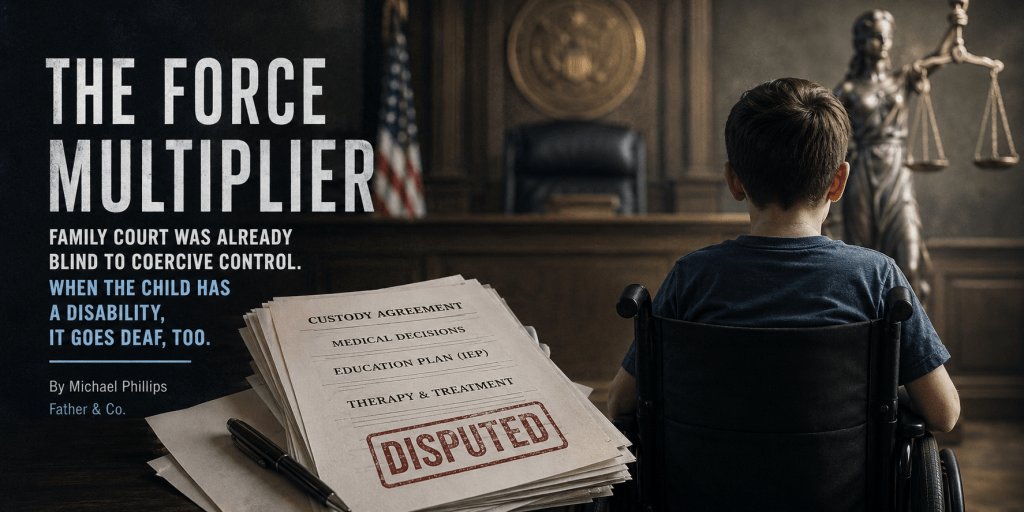
Family Court Was Already Blind to Coercive Control. When the Child Has a Disability, It Goes Deaf, Too.
July is Disability Pride Month. It exists because of a signature — President George H.W. Bush signing the Americans with Disabilities Act on July 26, 1990 — and it endures because a law is not the same thing as a culture. Thirty-six years later, the ADA covers nearly every public institution in American life, and the Supreme Court confirmed in Tennessee v. Lane (2004) that state courthouses are no exception. A person with a disability has a constitutional and statutory right of access to the courts.
Here is what no statute has yet managed to guarantee: that when the person with the disability is a child, and the courtroom is a family courtroom, and the two adults fighting over that child have unequal commitments to the truth, anyone in the building will be equipped to tell the difference.
Everything gets worse, for everyone, in ways the system is structurally incapable of seeing.
In May, Father & Co. published “The Same Tools” — an investigation into how the tactics of coercive control migrate, intact, from a marriage into the litigation that ends it. False allegations. Institutional weaponization. Financial attrition. The transformation of a targeted parent’s own history into evidence against them. Five parents, four jurisdictions, one architecture.
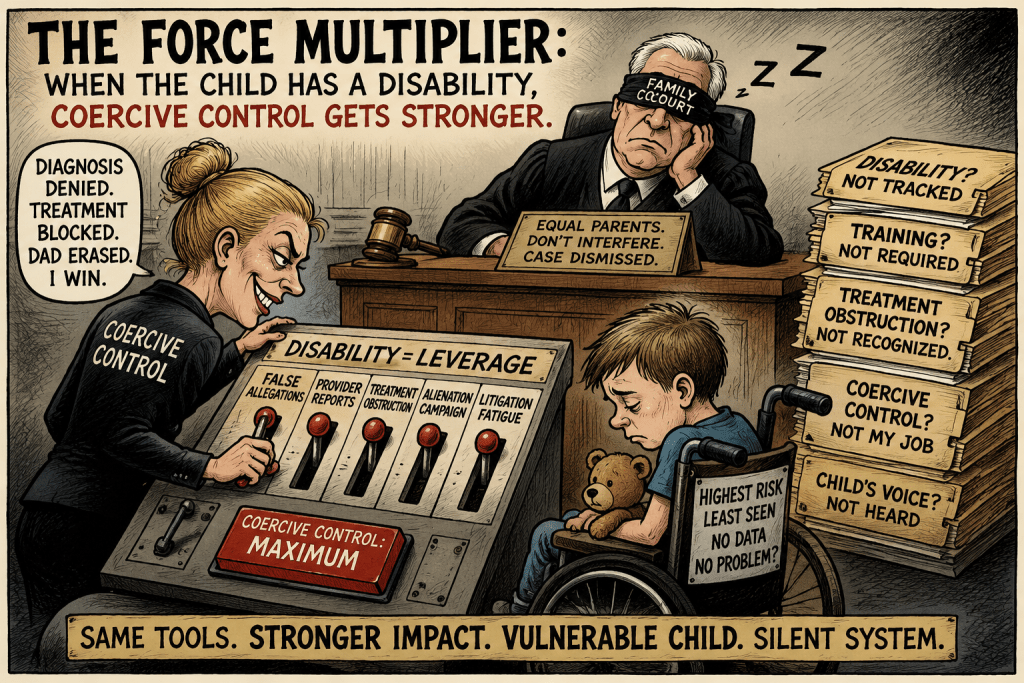
A child’s disability does not change the coercive controller’s toolkit. It multiplies it.
This piece is about what happens when you add a disabled child to that architecture.
The short answer: everything gets worse, for everyone, in ways the system is structurally incapable of seeing. A child’s disability does not change the coercive controller’s toolkit. It multiplies it.
The Numbers Nobody Collects
Start with what we know, because it is damning enough.
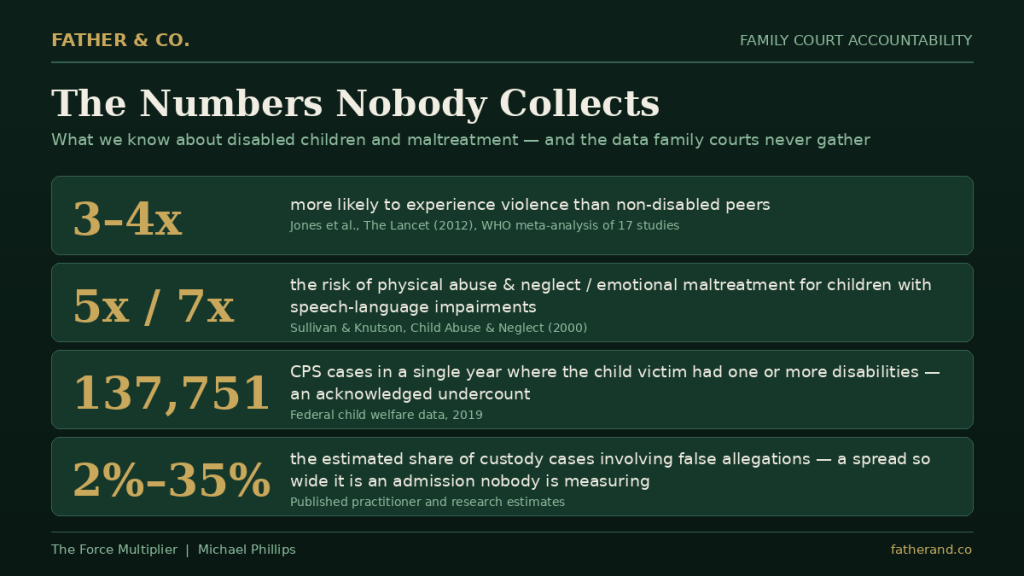
Children with disabilities are among the most abused children in the world. A landmark 2012 meta-analysis published in The Lancet — pooling seventeen studies for the World Health Organization — found that children with disabilities are three to four times more likely to experience violence than their non-disabled peers, with a pooled prevalence of victimization above one in four. The classic population-based work by Sullivan and Knutson put finer numbers on it: children with speech and language impairments face roughly five times the risk of neglect and physical abuse and nearly seven times the risk of emotional maltreatment. In 2019 alone, federal child welfare data recorded more than 137,000 CPS cases in which the child victim had one or more disabilities — and researchers agree that figure is an undercount, because disability status is inconsistently assessed and inconsistently recorded.
The population of children at the highest documented risk of maltreatment passes through the forum with the lowest evidentiary standards and the least specialized training, and no one is counting.
Now ask the follow-up question: how do children with disabilities fare in contested custody litigation? How often are they the subject of abuse allegations — true or false? How often does the parent who obstructs their treatment win decision-making authority over it? How do their outcomes compare to non-disabled children in the same courts?
Nobody knows. There is no national dataset. There is no state dataset. Family courts do not systematically track the disability status of the children whose lives they are dividing. The population of children at the highest documented risk of maltreatment passes through the forum with the lowest evidentiary standards and the least specialized training, and no one is counting.
The research community has quietly conceded the gap. The family court literature on autism — the single best-studied condition — acknowledges that there are limited guidelines and few published studies directing how court professionals should account for these families, and warns that without that knowledge, evaluators may misinterpret a child’s or a parent’s behavior. That is the state of the art for the most-studied diagnosis. For the medically complex child, the child with an intellectual disability, the child with a rare disease — the professional literature thins toward nothing.
A measurement that runs from ‘rare’ to ‘more than one in three’ is not a measurement. It is an admission that the system deciding these children’s fates has never seriously tried to find out.
Meanwhile, the estimates for how often custody litigation involves false allegations range from 2 percent to 35 percent of cases. Sit with that spread for a moment. A measurement that runs from “rare” to “more than one in three” is not a measurement. It is an admission that the system deciding these children’s fates has never seriously tried to find out.
The Toolkit, Expanded
“The Same Tools” documented how coercive control operates in litigation: isolate, exhaust, discredit, outspend. Every one of those tools gets an upgrade when the child has a disability.
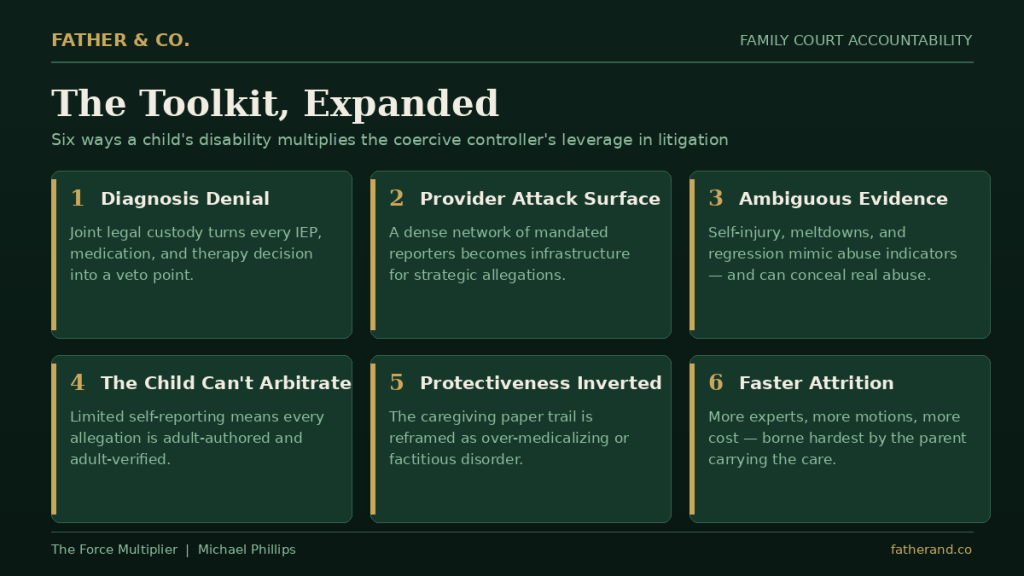
Diagnosis denial becomes a veto. A disabled child’s life runs on decisions — the IEP, the 504 plan, the medication, the therapy schedule, the specialist referral. Joint legal custody hands each parent a veto over every one of them. A parent who refuses to acknowledge the diagnosis can block the education plan. A parent who “doesn’t believe in medication” can override the psychiatrist. Family law practitioners know this pattern so well that when the Center for Divorce Education surveyed attorneys on the hallmarks of high-conflict cases, one answer read, verbatim: “Special Needs Kids (denial of diagnosis or obstruction of treatment)” — listed right alongside coercive control and domestic violence history. Treatment obstruction is not a side effect of these cases. It is a recognized weapon in them. And unlike a missed visitation exchange, it does its damage silently, in the gap between an evaluation that should have happened and one that never did.
Treatment obstruction is not a side effect of these cases. It is a recognized weapon in them.
The provider footprint becomes an attack surface. A disabled child’s world is dense with professionals — therapists, aides, nurses, case managers, special educators — and nearly all of them are mandated reporters. For a protective parent, that network is a safety net. For a coercively controlling one, it is infrastructure: a distributed system of trigger points, each one capable of launching an investigation on the strength of a well-placed narrative. Every new provider is a new audience for the campaign, a new file to seed, a new report that will land in the docket stripped of its origin story.
A disabled child’s world is dense with professionals… For a coercively controlling parent, it is infrastructure.
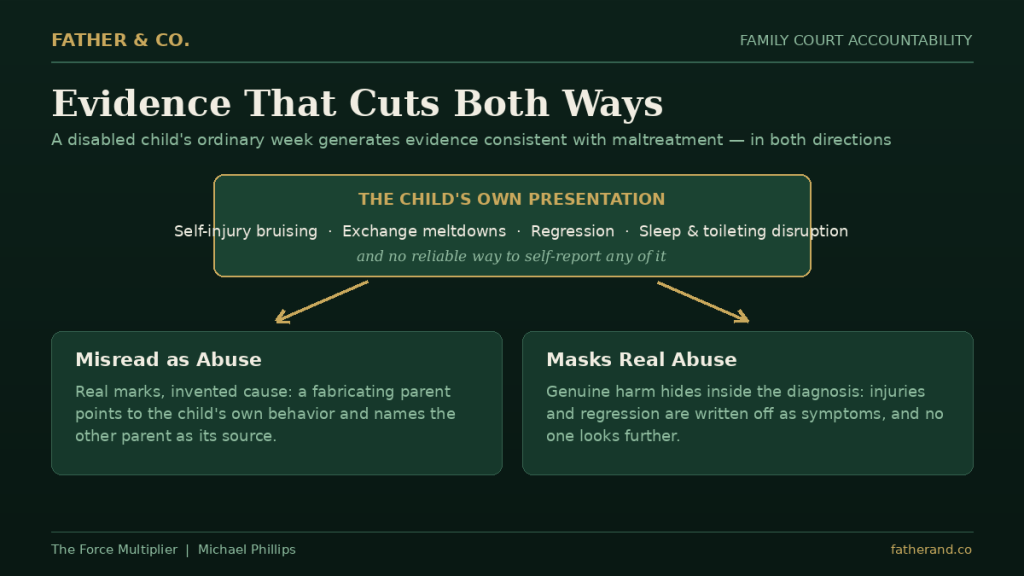
The child’s own body becomes ambiguous evidence. Self-injurious behavior leaves bruises. Meltdowns during custody exchanges look, to an untrained eye, like fear of a parent. Regression, sleep disruption, and toileting setbacks are textbook responses to household disruption — and also textbook indicators of abuse. A child’s disability generates, in the ordinary course of an ordinary week, physical and behavioral evidence consistent with maltreatment. That ambiguity cuts in both directions with equal cruelty: it lets a fabricating parent point to real marks and invent their cause, and it lets a genuinely abusive parent hide real harm inside the diagnosis. The evaluator who cannot tell a sensory meltdown from a trauma response — and most have never been trained to — is guessing, with a child’s safety as the stake.
The child cannot arbitrate. In a conventional high-conflict case, the child’s own voice — imperfect, coached, conflicted as it may be — is at least available. Many disabled children cannot reliably self-report at all. A nonverbal child, a child with limited expressive language, a child whose communication runs through a device or a parent’s interpretation: their reality reaches the court exclusively through adult narrators. Which means every allegation about what happens in the other household is adult-authored and adult-verified. The fabrication risk goes up. The detection-failure risk goes up. Both at once.
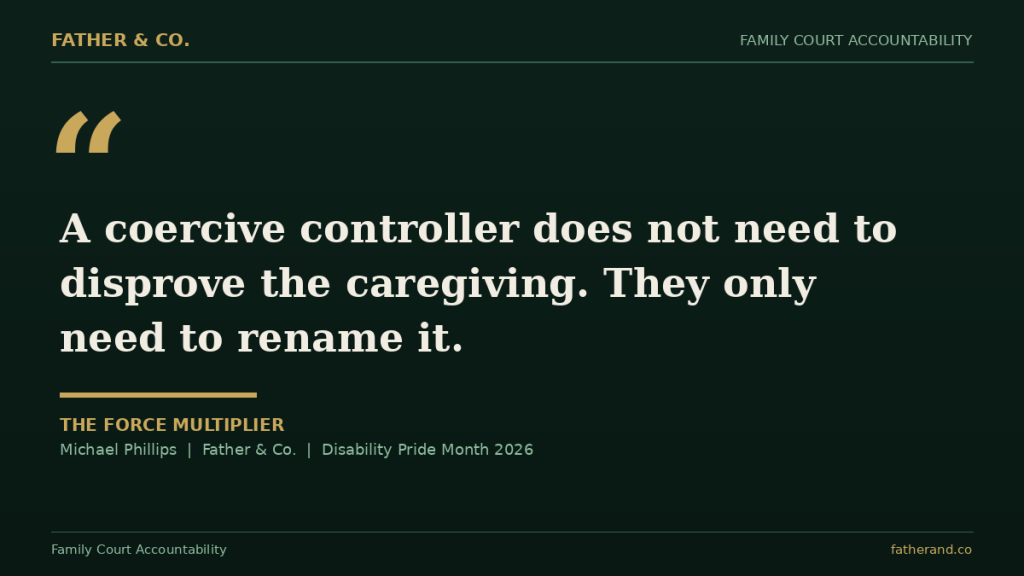
Protectiveness itself becomes the accusation. Here is the cruelest inversion in the entire architecture. The parent doing the work — booking the evaluations, documenting the symptoms, pushing the school district, keeping the binder — is generating exactly the paper trail that a skilled opposing counsel will reframe as pathology. Over-medicalizing. Doctor-shopping. Factitious disorder imposed on another. Munchausen by proxy, in the older vocabulary that still echoes through courtrooms. The behaviors that define a protective parent of a disabled child are, viewed through a hostile lens, indistinguishable from the behaviors alleged of a dangerous one. A coercive controller does not need to disprove the caregiving. They only need to rename it.
The parent doing the work is generating exactly the paper trail that a skilled opposing counsel will reframe as pathology.
The attrition runs faster. Special-needs litigation is more expensive litigation: more experts, more evaluations, more disputed decisions, more motions. The parent already carrying the caregiving load — the appointments, the reduced work hours, the therapies insurance won’t cover — is the parent with less money and less time to litigate. “The Same Tools” documented financial attrition as a control tactic. Add a disabled child, and the attrition is not a tactic anymore. It is the terrain.
When the Docket Floods
High-conflict litigation runs on allegations, and the research is blunt about the volume: roughly one in five high-conflict cases features repeated abuse allegations that are never substantiated. When a child has a disability, the flood carries more debris — because the provider network generates more reports, the child’s presentation generates more ambiguity, and the treatment disputes generate more filings.
The corrosive effect is symmetrical, and this is the point that partisans on every side of the family court wars refuse to hold simultaneously.
Unsubstantiated does not mean false. Child protection professionals have warned for years that “unsubstantiated” means only that the evidence was insufficient to confirm — and that each new report must be evaluated independently rather than dismissed on the strength of prior findings. A disabled child who cannot self-report is precisely the child whose genuine abuse is most likely to go unsubstantiated, over and over, until the file itself becomes the reason no one looks closely again.
And unsubstantiated does not mean true, either. A parent facing serial fabricated allegations watches each one consume the evaluative bandwidth, the money, and the parenting time that no exoneration ever fully restores — while the pattern of fabrication itself, spread across separate motions heard by separate judges, never comes into focus as the coercive conduct it is.
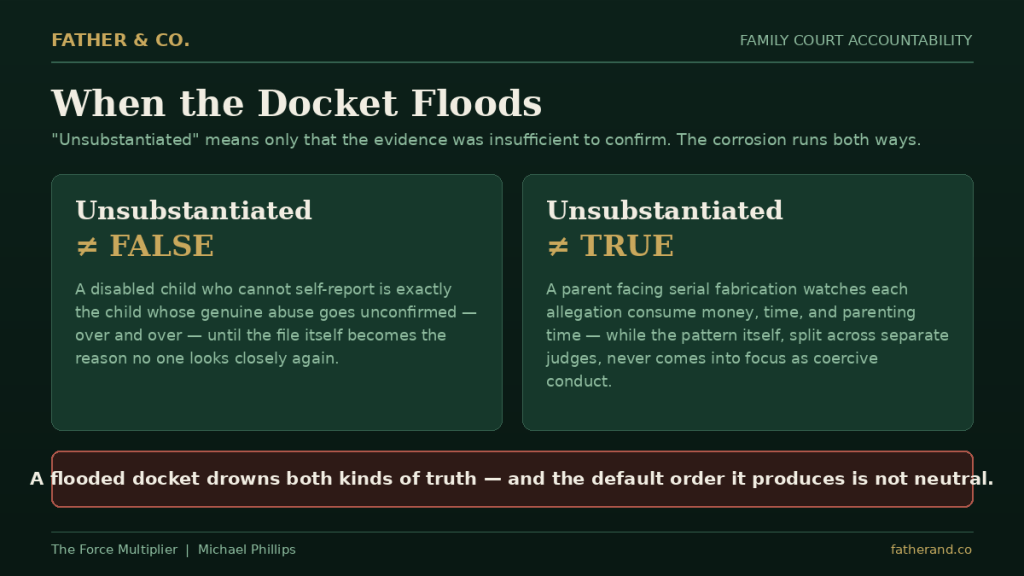
A flooded docket drowns both kinds of truth. The court, unable to distinguish signal from noise, defaults to what overwhelmed systems always default to: the path of least resistance, the split-the-difference order, the assumption that where there is this much smoke, both parents must be holding matches. For a disabled child, that default is not neutral. It hands the controlling parent exactly what the flooding was designed to produce — and it leaves the child’s actual safety unexamined in the one proceeding that existed to examine it.
The Law Is Moving. The Blind Spot Is Not.
Credit where due: the legal landscape has shifted more in four years than in the previous forty.
Kayden’s Law — the Keeping Children Safe from Family Violence Act, enacted in the 2022 reauthorization of the Violence Against Women Act — offers states federal grant money to reform custody practice: restricting unproven reunification programs, tightening evaluator qualifications, and mandating judicial training that explicitly includes coercive control. The states have been answering. Colorado went first and has since written a statutory definition of coercive control into its custody code. Pennsylvania’s Act 107 of 2024 expanded its custody factors from sixteen to twenty-three — seventeen of them safety-related, with coercive control named outright. California passed Piqui’s Law, Utah passed Om’s Law, and Tennessee passed Abrial’s Law. Maryland aligned its expert witness and abuse evaluation standards in 2024. This January, New Jersey rewrote its custody statute to make child safety the threshold inquiry — before the best-interests balancing even begins — with coercive or controlling conduct listed among the safety factors. In New York, Kyra’s Law has passed the legislature and sits on the governor’s desk.
Coercive control, in other words, is finally becoming legible to the law. That is a genuine achievement, and the advocates who spent a decade making it happen deserve the credit.
Now look for the word “disability” in any of it.
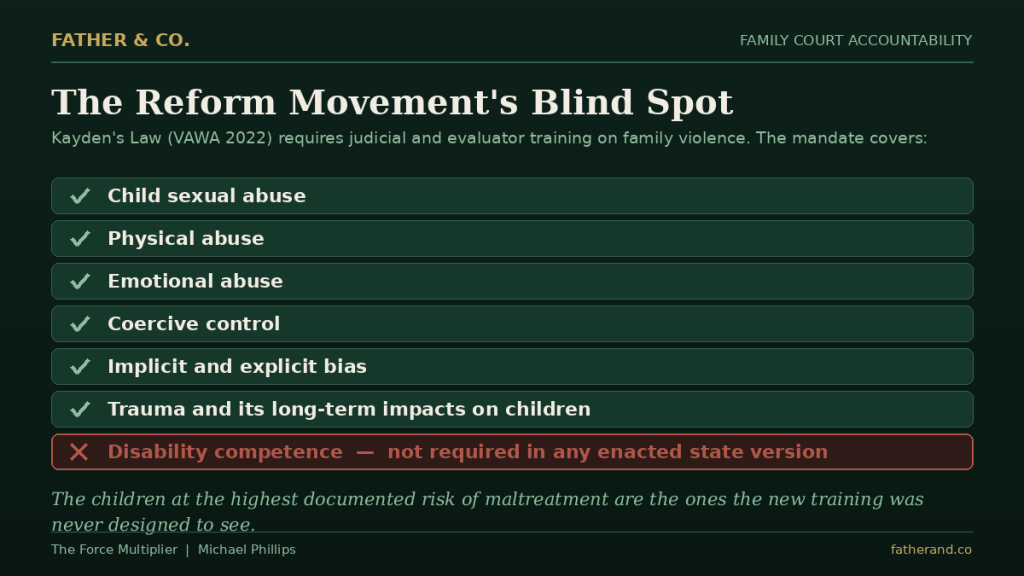
The judicial training mandates cover child sexual abuse, physical abuse, emotional abuse, coercive control, implicit bias, and trauma. Not one of the model provisions requires a judge, an evaluator, or a guardian ad litem to demonstrate competence in disability — in distinguishing a meltdown from a trauma response, in taking testimony from a child who communicates through a device, in recognizing treatment obstruction as the control tactic practitioners already know it to be. The new evaluator standards raise the floor on domestic violence expertise while leaving disability expertise exactly where it has always been: optional, unexamined, and assumed.
The reform movement built a sharper lens for seeing coercive control. It has not yet noticed that the children most exposed to it are the ones the lens was never focused on.
What Seeing Would Require
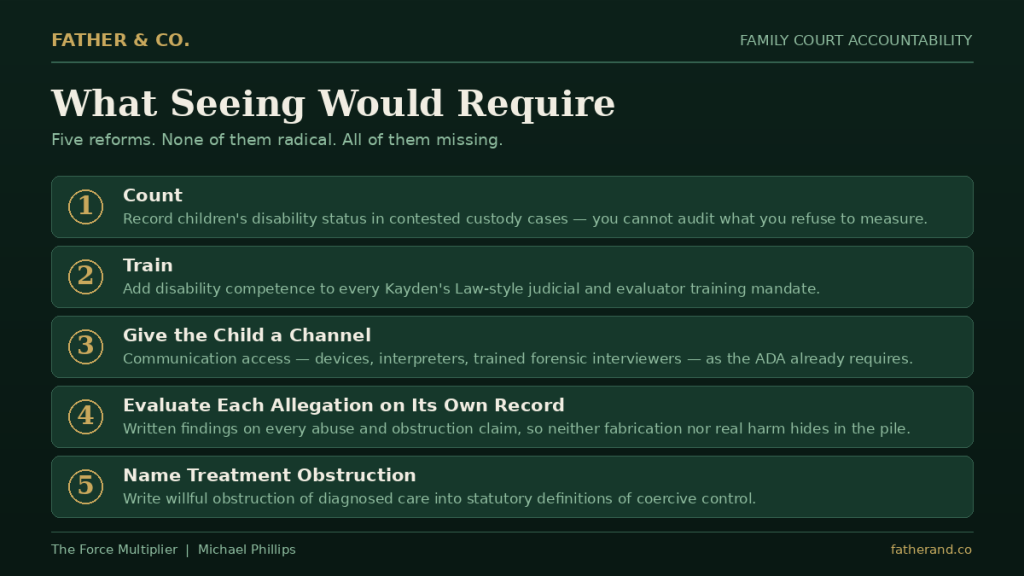
None of this is unfixable. All of it is unfixed. A serious reform agenda for disabled children in custody litigation would need five things, and not one of them is radical.
Count. Family courts should record the disability status of children in contested custody proceedings, the same way child welfare systems are supposed to. You cannot audit outcomes you refuse to measure. The 2-to-35-percent problem — the false-allegation estimate so wide it means nothing — persists because no institution has been forced to generate real numbers. Start generating them.
Train. Every state adopting Kayden’s Law-style evaluator and judicial training should add disability competence to the mandate: recognizing how common disabilities present, how they are mistaken for abuse indicators, how abuse hides inside them, and how treatment obstruction functions as coercive control. Pennsylvania found room for seventeen safety factors. There is room for this.
Give the child a channel. The ADA already obligates courts to provide access. For a child witness, access means communication: augmentative devices, qualified interpreters, forensic interviewers trained for developmental difference — not a guardian ad litem summarizing a child they spent forty minutes with. Tennessee v. Lane settled that the courthouse doors must open. For a nonverbal child at the center of a custody war, an open door is worthless if no one inside can hear them.
Evaluate each allegation on its own record. The professional guidance already says it: unsubstantiated is not false, and prior findings must not pre-decide new reports. Courts should be required to make written findings on abuse and treatment-obstruction allegations individually — the same written-findings discipline Pennsylvania and New Jersey now demand for safety factors generally — so that neither a fabrication campaign nor a genuine pattern of harm can hide inside an undifferentiated pile.
Name treatment obstruction for what it is. States are writing coercive control definitions into custody statutes right now. Those definitions should explicitly include the willful obstruction of a child’s diagnosed medical, therapeutic, and educational care. Practitioners already recognize it as a control tactic. The statutes should catch up to the people who watch it happen.
The Month We’re In
Disability Pride Month is built on a simple proposition: that disabled people are entitled to be visible — to exist in public, in policy, and in the institutions that decide the shape of their lives, on equal terms and in full view.
There is no American institution where disabled children are less visible than the family court.
There is no American institution where disabled children are less visible than the family court. Not because anyone decided to exclude them, but because no one ever decided to see them — and in an adversarial system, whatever the court cannot see becomes a weapon for whichever parent is willing to use it. The most abused population of children in the country, three to four times over, moves through the one forum with total power over their daily safety, and that forum does not train for them, does not count them, and cannot hear the ones who cannot speak.
Whatever the court cannot see becomes a weapon for whichever parent is willing to use it.
The parents in “The Same Tools” taught us that coercive control does not end at the courthouse door; it walks through it and files an appearance. The lesson of this piece is narrower and harder: when the child at the center of the case has a disability, the controller walks in carrying a bigger bag — and the court, thirty-six years after the ADA, still has not learned to search it.
Coercive control does not end at the courthouse door; it walks through it and files an appearance.
The child in these cases has one thing to say, and no reliable way to say it: someone in this building needs to figure out which parent is safe. Until family courts build the competence to answer that question for children with disabilities — deliberately, measurably, on the record — every July we spend celebrating visibility should come with an asterisk for the children these courts have chosen not to see.
Sources referenced in this piece include Jones et al., “Prevalence and Risk of Violence Against Children with Disabilities” (The Lancet, 2012); Sullivan & Knutson, “Maltreatment and Disabilities: A Population-Based Epidemiological Study” (Child Abuse & Neglect, 2000); federal NCANDS child welfare data; the Center for Divorce Education’s practitioner survey on high-conflict case indicators; the Keeping Children Safe from Family Violence Act (VAWA 2022); and enacted custody reform statutes in Colorado, Pennsylvania, California, Utah, Tennessee, Maryland, and New Jersey.

Need help reviewing or organizing court or formal documents?
Father & Co. offers non-legal document review and organization for people representing themselves. This includes clarity, structure, neutral tone, and timeline organization — not legal advice or representation.
Have a story, experience, or resource to share?
Submissions are reviewed with care and discretion. We respect privacy and handle sensitive information responsibly.