


A child who once loved you now looks at you with contempt, repeating words that aren’t their own. What do you do when the family court system and an alienating parent have done their work — and you’re left waiting on the other side of a door that may not open for years?
There is a particular kind of grief that has no funeral, no casseroles from neighbors, no socially legible moment of mourning. Your child is alive. They may live fifteen minutes away. And they hate you — or believe they do — with a certainty that feels to them like memory and to you like a wound that never closes.
This is the landscape of parental alienation after the damage is done. Not the early warning signs or the custody hearing strategies — but the aftermath. The silence. The returned letters. The birthday that passes without a call. The court that shrugged. The therapist who didn’t understand. The friends who think you must have done something to deserve it.
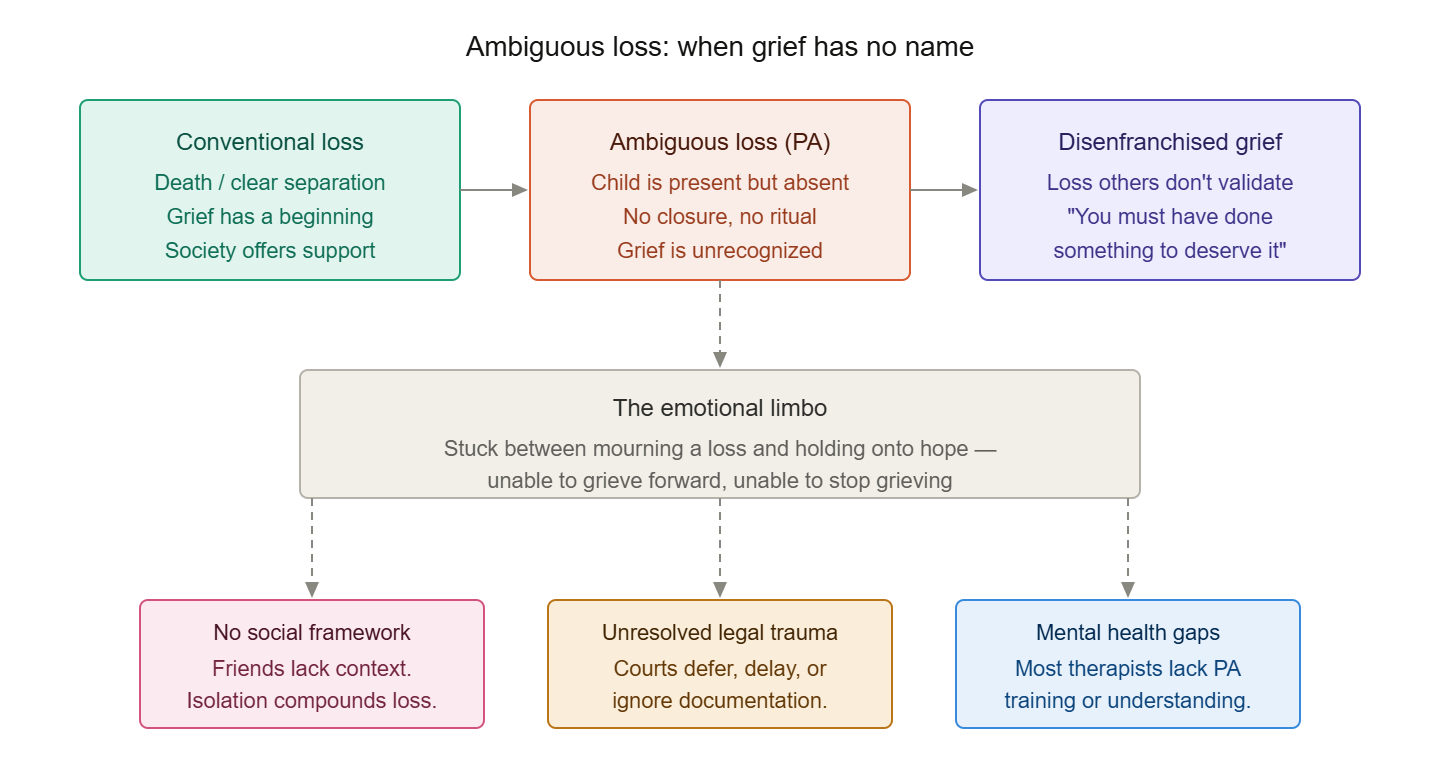
Researchers have a clinical term for what targeted parents experience: ambiguous loss. The concept, first developed by psychologist Pauline Boss, describes the particular anguish of losing someone who is still physically present — a child who is alive, breathing, perhaps living nearby, but emotionally and relationally gone. Unlike death, there is no closure. Unlike estrangement driven by your own behavior, there is no clear path to repair.
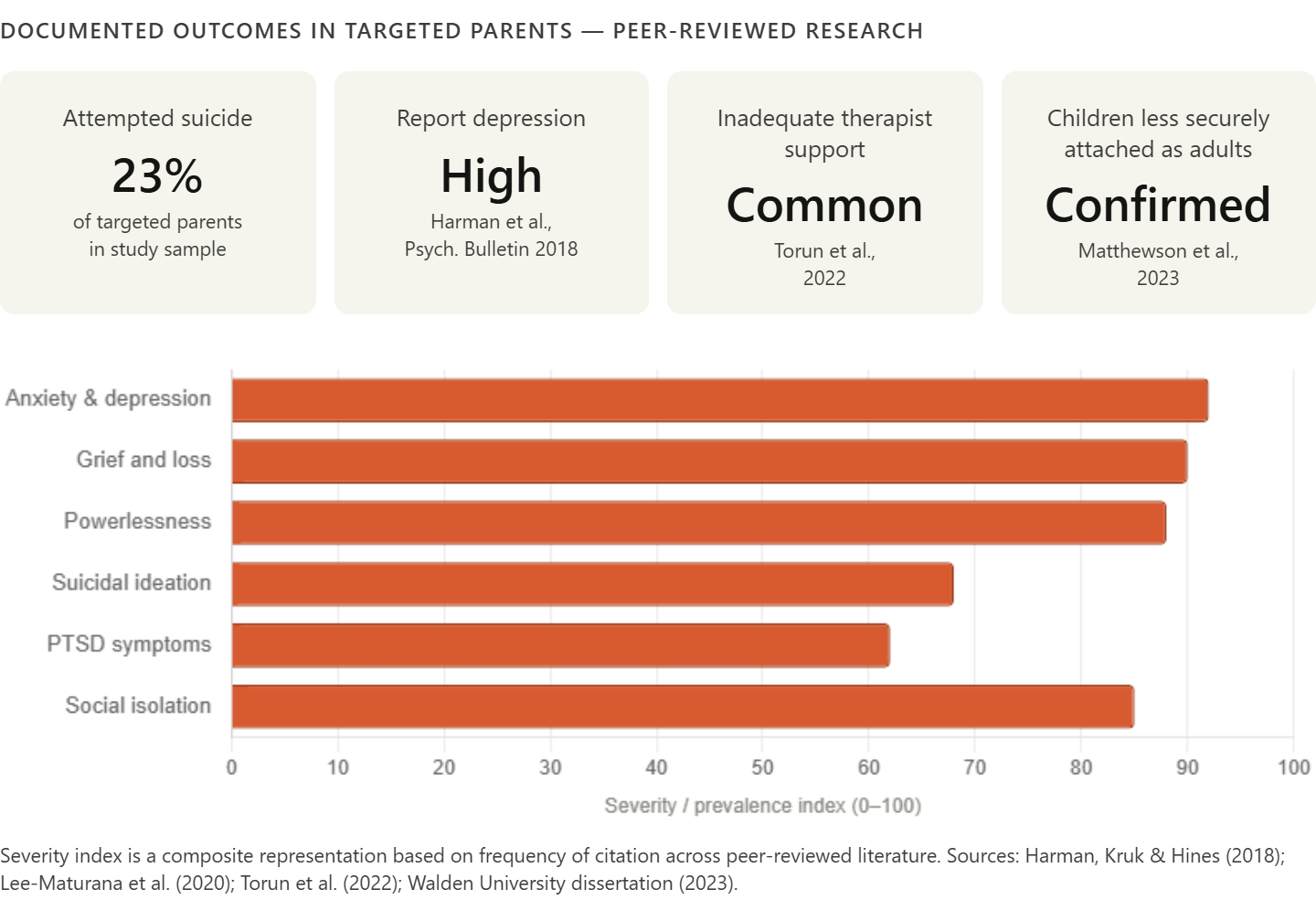
“Targeted parents experience depression, anxiety, and suicidal thoughts. Many report that therapists are ill-equipped to understand or support them.”
Harman et al., Psychological Bulletin (2018) / Torun et al. (2022)
The research is unambiguous about what targeted parents suffer. A 2023 doctoral study out of Walden University found that parental alienation “often goes undetected or is misdiagnosed due to a lack of understanding of the phenomenon.” A review published in a Springer psychology journal noted that targeted parents report grief, powerlessness, and frustration — and that depression, anxiety, and suicidal ideation are documented outcomes. One analysis of targeted parents found that 23 percent reported having attempted suicide. These are not outcomes of weakness. They are outcomes of a system that routinely fails the people it is supposed to protect.
The isolation compounds the injury. Most people have no frame of reference for what it means to have your child turned against you through sustained psychological manipulation — often with the courts enabling the process through inaction, misdiagnosis, or outright bias. Friends offer platitudes. Relatives grow tired of the fight. Society has a ready-made narrative about absent parents, and it is rarely flattering. The targeted parent learns quickly that explaining what actually happened is a losing effort in most rooms.
Why the Child Believes What They Believe
Before any conversation about reconnection can be useful, it helps to understand why the alienated child holds the views they do — not because this absolves anyone of responsibility, but because it reframes the goal. You are not trying to defeat a child’s beliefs in an argument. You are waiting for conditions under which those beliefs can evolve on their own.
Parental alienating behaviors — documented in peer-reviewed literature as a form of family violence — systematically alter a child’s beliefs, perceptions, and even memories of the targeted parent. The alienating parent may interrupt parenting time, denigrate the targeted parent in front of the child, encourage the child to spy or report, and create emotional conditions in which loving the other parent feels like a betrayal. Over time, the child’s critical thinking around this relationship is genuinely compromised. Research published in Frontiers in Psychology (Matthewson et al., 2023) notes that “the child’s critical thinking skills are compromised and their capacity to trust their own perceptions” is undermined.
This means the child is not simply being stubborn or difficult. They have been shaped by a sustained process. They have absorbed a narrative so completely that it functions as personal history. You cannot argue them out of it, and you cannot love them out of it quickly. Understanding this is not surrender — it is the foundation of any realistic path forward.
What the Research Says About Reconnection
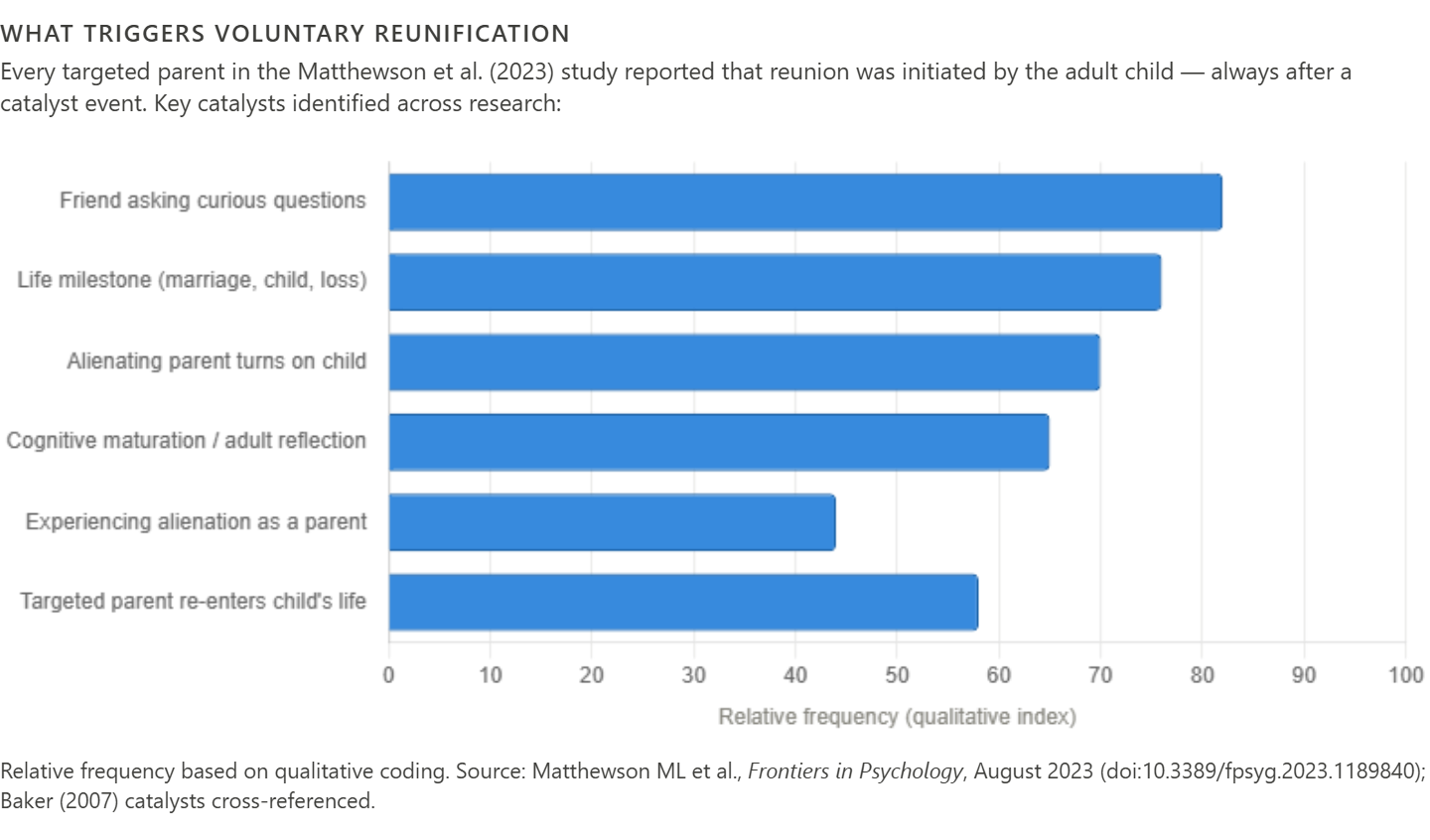
There is meaningful evidence that reconnection happens — often when least expected, and almost never on a timetable the targeted parent controls. A 2023 study published in Frontiers in Psychology by Mandy Louise Matthewson and colleagues at the University of Tasmania examined voluntary reunification from the perspectives of both adult alienated children and targeted parents. What the research found is both sobering and quietly hopeful.
Every targeted parent in the study reported that reunification was ultimately initiated by the adult child — and always following a catalyst event. Sometimes the trigger was another person in the child’s life: a friend who simply asked, “Why don’t you ever talk about your mom?” or “What’s the deal with your dad?” and planted a seed of curiosity. Sometimes it was a life milestone — a marriage, a pregnancy, a loss — that made the adult child feel the absence of the targeted parent with new acuity. Sometimes it was the alienating parent finally turning on the child, fracturing the alliance that had sustained the alienation for years.
What this tells targeted parents is both uncomfortable and actionable: you cannot force the door open. But you can make sure it is findable when the child eventually goes looking for it.
“Adult alienated children who reconnect often ask why that parent disappeared — and admit they were hoping to be rescued.”
Weinberger Law Group, citing Baker alienation research
Richard Warshak, one of the leading researchers on parental alienation and the author of Divorce Poison, has written that alienated children who reconcile with targeted parents as adults frequently ask why the rejected parent disappeared — and reveal that they were, somewhere beneath the hostility, hoping to be found. This is not always true, and it is not an invitation to ignore a child’s expressed boundaries. But it matters. The contempt that looks like a closed door may, in some cases, be a test of commitment.
Practical Strategies for the Long Wait
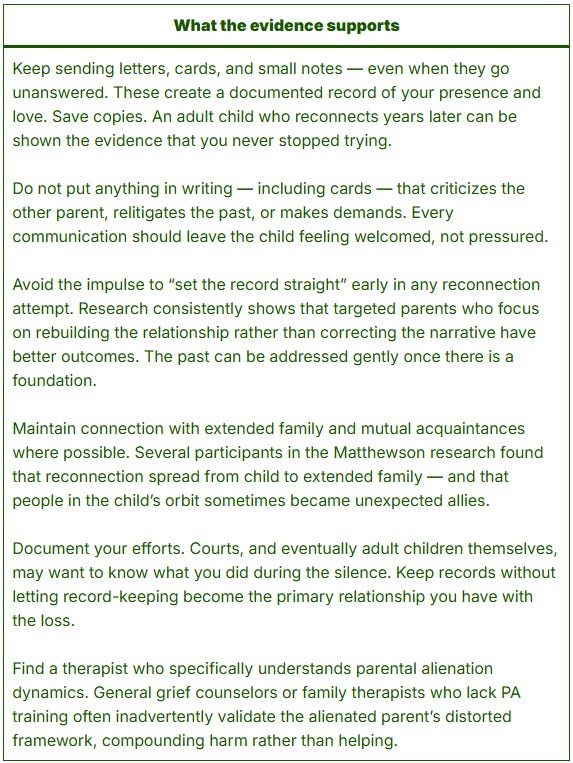
For parents in the active phase of alienation — where contact is limited or entirely severed — the clinical literature offers several consistent themes.
Traditional reunification therapy ordered by courts has a mixed evidence record. A July 2024 exploratory study found that adults who attended intensive, court-coerced reunification programs as children reported worse long-term parent-child relationships than those who went through voluntary, gradual approaches. The most respected clinical literature — including work summarized in Psychiatric Times — distinguishes between coercive programs that may retraumatize and child-centered, voluntary approaches that allow reconnection to proceed at the child’s pace. If reunification therapy is on the table, the format matters enormously.
The Grief You Are Not Allowed to Have
There is a concept in the bereavement literature called disenfranchised grief — grief that society does not recognize as legitimate, and therefore does not support. Alienated parents grieve in this space constantly. The loss is real. The love is real. But the mourning has no container, no ritual, no community that understands it. Most people around you have no map for what you are experiencing.
This isolation is itself a documented harm. Research notes that targeted parents are left “fighting a battle with limited armory” — the confusion and desolation making them particularly vulnerable to poor mental health outcomes. And yet the social architecture that might help them — community, acknowledgment, shared experience — barely exists. Support groups for targeted parents are scattered and often short-lived. The legal system’s processing time means some parents spend years in litigation rather than recovery. And the broader cultural conversation about family court failure has only recently begun to move into mainstream visibility.
Being fluent in what is happening to you — naming it, understanding its documented psychological architecture — is not nothing. It does not fix anything. But it changes the quality of what you carry. You are not losing your mind. You are not uniquely flawed. You are experiencing something that researchers have documented, that other parents have survived, and that in a meaningful number of cases eventually reverses — not because you forced it, but because the child, given enough time and enough catalyst, finds their own way back.
On the Long Horizon
The 2025 study by Rachel Birnbaum and Nicholas Bala — the most comprehensive longitudinal research to date on custody reversal outcomes in parental alienation cases — reviewed 67 Ontario cases from 2010 through 2022 in which a judicial finding of parental alienation had been made. In nearly half of those cases, custody was reversed. The findings document that custody reversal paired with reunification programs can restore healthy parent-child relationships in severe alienation cases — a data point that challenges the narrative that the damage is irreversible.
Even without custody reversal, the Matthewson research on voluntary reunification tells a consistent story: readiness comes from the child, not from the targeted parent. What targeted parents can control is whether they remain findable — emotionally, relationally, and literally — when that moment arrives. The door you keep open is not a metaphor for passivity. It is the work of maintaining yourself, maintaining your love, and refusing to let the system’s failures define the end of your relationship with your child.
Adults who reconnect with alienated parents often describe the experience of finally meeting their targeted parent as reclaiming a lost part of themselves. The alienation, it turns out, fragmented them too. What you are preserving, in the long wait, is not just a relationship. It is part of who your child will eventually need to become.
That may not make the wait easier. But it makes it mean something.
Sources: Matthewson ML, Bowring J, Hickey J, Ward S, Diercke P, Van Niekerk L. “A qualitative exploration of reunification post alienation from the perspective of adult alienated children and targeted parents.” Frontiers in Psychology, August 3, 2023. doi:10.3389/fpsyg.2023.1189840. Harman JJ, Kruk E, Hines DA. “Parental alienating behaviors: An unacknowledged form of family violence.” Psychological Bulletin, 144(12), 1275–1299, 2018. Lee-Maturana S, Matthewson M, Dwan C, Norris K. “Consequences of the Alienation and Coping Strategies.” Journal of Child and Family Studies, 2020. doi:10.1007/s10826-020-01725-1. Birnbaum R, Bala N. “A Retrospective Study of Outcomes of Custody Reversal in Parental Alienation Cases.” University of New Brunswick Law Journal, published April 10, 2025. Harman JJ, Matthewson ML, Baker AJL. “Losses experienced by children alienated from a parent.” Current Opinion in Psychology, 43:7–12, 2022. PMID: 34256247. Boss P. Ambiguous Loss: Learning to Live with Unresolved Grief. Harvard University Press, 1999. Cited in Warshak (2006) and multiple PA research reviews. Warshak RA. “Reuniting Alienated Children and Parents.” warshak.com. Accessed May 2026. Walden University doctoral dissertation: “Anxiety and Depression Among Target Parents of Parental Alienation,” October 26, 2023. Tandfonline.com: “Countering Arguments Against Parental Alienation as A Form of Family Violence and Child Abuse.” Published September 16, 2024. doi:10.1080/01926187.2024.2396279. Toronto Psychological Services. “Parental Alienation and Reunification Therapy: An Evidence-Based Review.” Citing Matthewson et al. (2023), Andreopoulos and Wexler (2022), Harman, Kruk, and Hines (2024). Accessed May 2026. Psychiatric Times. “Treatment of Parental Alienation: Guidelines for Mental Health and Legal Practitioners.” Accessed May 2026.

Need help reviewing or organizing court or formal documents?
Father & Co. offers non-legal document review and organization for people representing themselves. This includes clarity, structure, neutral tone, and timeline organization — not legal advice or representation.
Have a story, experience, or resource to share?
Submissions are reviewed with care and discretion. We respect privacy and handle sensitive information responsibly.
Persist and maintain hope that situations with our kids will become better.
The Stockdale Paradox
James C. Collins related a conversation he had with James Stockdale regarding his coping strategy during his 7+ years in a Vietnamese POW camp. When Collins asked which prisoners didn't make it out of Vietnam, Stockdale replied:
"Oh, that's easy, the optimists. Oh, they were the ones who said, "We're going to be out by Christmas". And Christmas would come, and Christmas would go. Then they'd say, "We're going to be out by Easter". And Easter would come, and Easter would go. And then Thanksgiving, and then it would be Christmas again. And they died of a broken heart. This is a very important lesson. You must never confuse faith that you will prevail in the end—which you can never afford to lose—with the discipline to confront the most brutal facts of your current reality, whatever they might be."
You are a survivor. It is unconscionable that the courts remove parents without a legal basis and commonly without due process. How can we highlight the judges that are allowing this so that they do not? More and more people are realizing that 50 | 50 custody should be the legal standard so that will help.
I volunteer in my daughter's classroom. I attend her doctor appointments when I'm informed about them. A state health department family services manager told me that they could get me time with my daughter if I commit a crime. But, I've never committed a crime. Sharing and consolidating these acts may make them less common. Ou children will appreciate our efforts to be in their lives.
Why do we allow females to get away with this?!?!?!