


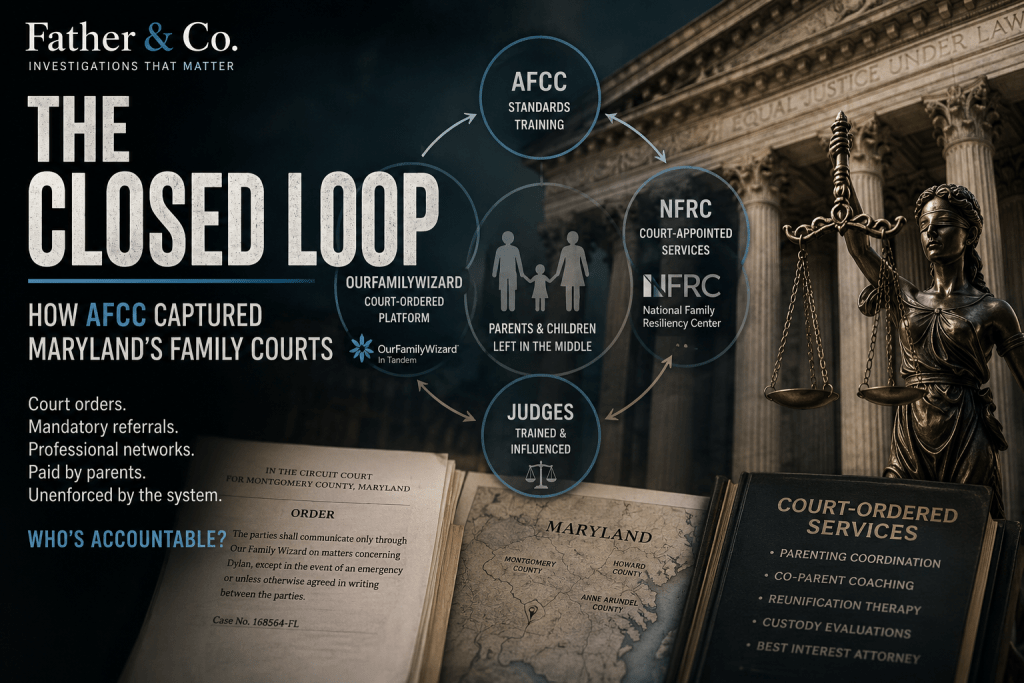
By Michael Phillips | Father & Co.
When the Montgomery County Circuit Court ordered me to communicate with my son Dylan’s mother, Christina Avgerinos, through OurFamilyWizard, the premise was straightforward: a tamper-proof, timestamped platform would create an unalterable record of co-parenting communications, reduce conflict, and give the court something reliable to consult when one party wasn’t following the order.
The order, filed under Case No. 168564-FL, stated plainly: “ORDERED, that the parties will communicate only through Our Family Wizard on matters concerning Dylan, except in the event of an emergency or unless otherwise agreed in writing between the parties.”
What followed was years of the opposing party doing what she did with the rest of the custody order — treating it selectively, when convenient, and ignoring it otherwise. Christina Avgerinos routinely declined to respond to messages documented as read by OFW’s own timestamp system. She redirected communications to exchanges and phone calls where nothing could be tracked. When I pushed for compliance, I was told, in OFW, “I use this app to share information about Dylan, in accordance with the court order,” — a reinterpretation of the order’s plain language that bore no relation to what the order actually said.
The Montgomery County Circuit Court, across years of documented non-compliance, declined to enforce the OFW order.
I paid for the subscription anyway. Dylan still doesn’t see his father the way the court order says he should. In fact, he doesn’t see him at all.
This is not a story about one family. It is a story about how a private professional association built an ecosystem of mandatory, fee-generating services into Maryland’s family court system — and why that system is structurally incapable of enforcing the orders it produces.
The Product and the Pipeline
OurFamilyWizard is a for-profit co-parenting communication platform owned by a Minneapolis company, now operating under the name In Tandem. It markets itself as “the leading co-parenting app,” and claims to be used by over one million parents. Courts in all fifty states have ordered parents to use it.
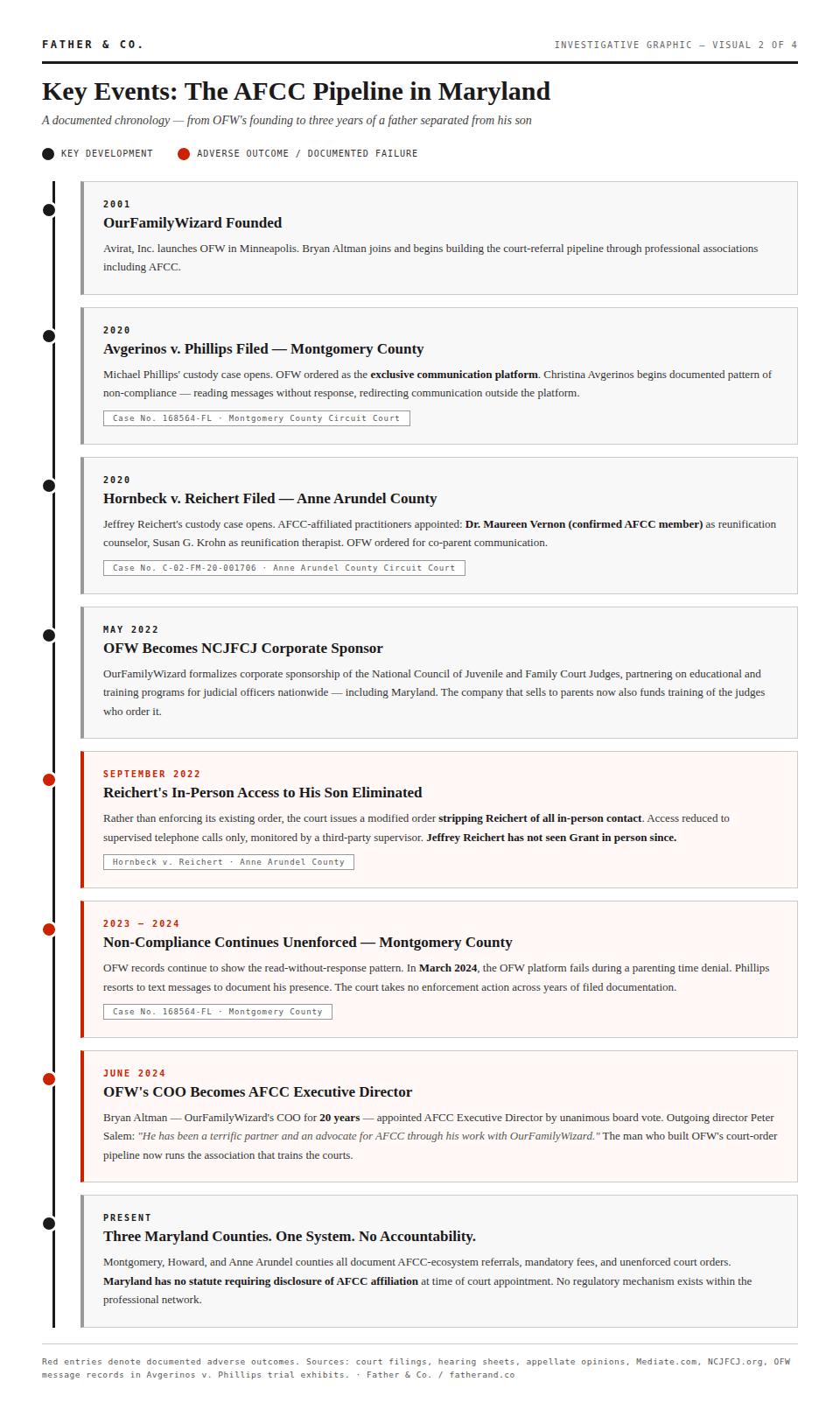
The product costs each parent roughly $110 per year, billed annually, under penalty of contempt. More with add-ons.
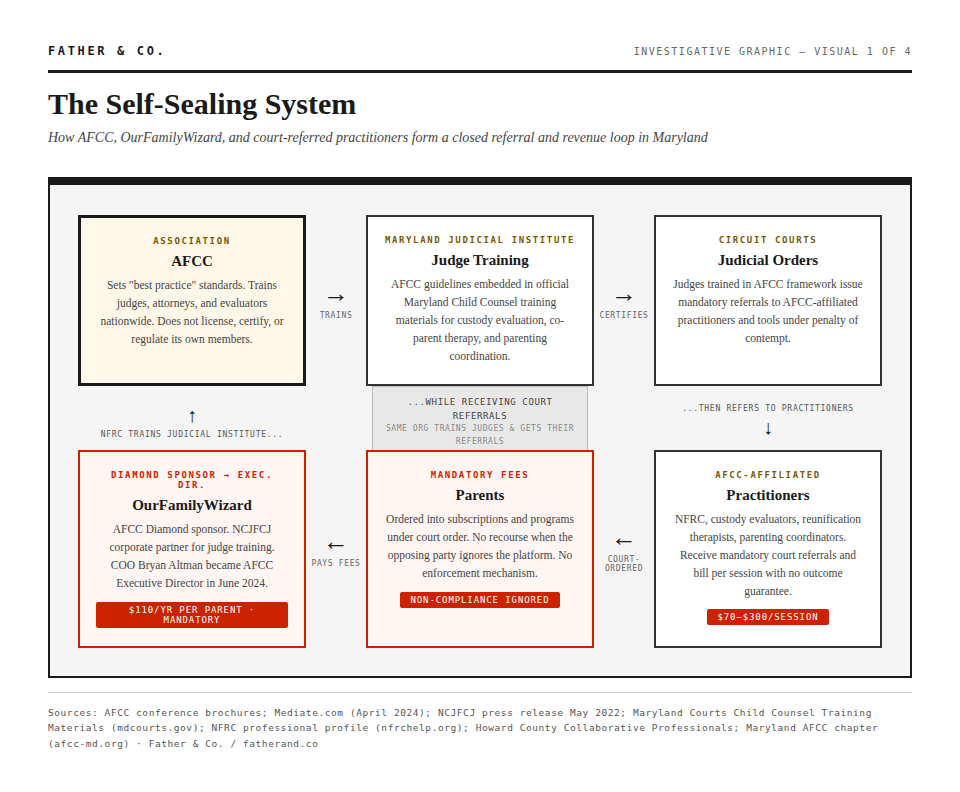
The company’s relationship with the Association of Family and Conciliation Courts — the private professional association that trains and certifies the practitioners who dominate family court nationwide — is not incidental. It is structural, and it is documented.
OurFamilyWizard served as a Diamond-level sponsor of the AFCC’s 59th Annual Conference, the highest sponsorship tier available. It became a corporate sponsor of the National Council of Juvenile and Family Court Judges, the organization that provides continuing education to the judges who issue court orders — including OFW orders. Through that sponsorship, OurFamilyWizard and NCJFCJ partnered to develop educational and training programs for judicial officers and court professionals on a national level.
The arrangement produced exactly what it was designed to produce: judges trained by an organization sponsored by OFW ordering parents into OFW subscriptions, at mandatory cost, regardless of whether the opposing party complies.
Then, in June 2024, the pipeline closed on itself entirely.
Bryan Altman, who had served as OurFamilyWizard’s Chief Operating Officer for twenty years and was, in the words of AFCC’s outgoing executive director Peter Salem, “the point person for OurFamilyWizard’s partnership with AFCC,” left OFW to become AFCC’s Executive Director. Salem called him “a terrific partner and an advocate for AFCC through his work with OurFamilyWizard.” The AFCC Board voted unanimously for his appointment.
The man who spent two decades building OurFamilyWizard’s court-order pipeline by embedding the company into the professional association that shapes family court practice now runs that professional association.
This matters because it illustrates how the relationship between OFW and AFCC was never an arm’s-length professional endorsement. It was a sustained, deliberate commercial strategy — one that moved from product placement at conferences, to Diamond sponsorships, to judge training partnerships, to the placement of the company’s own operator at the helm of the governing body. The revolving door did not swing once. It was built into the architecture from the start.
Family psychologist Dr. Rebecca Bailey, herself an active AFCC member and described in her biography as “a regular consultant to judicial entities,” publishes content directly on the OurFamilyWizard platform. The same practitioner ecosystem that benefits from court referrals in the AFCC model also generates the educational content that reinforces OFW’s credibility as a court-endorsed tool.
NFRC: The Organization That Trains the Judges Who Refer to It
My case involved not only OurFamilyWizard but another institution embedded in the same ecosystem: the National Family Resiliency Center, headquartered in Columbia, Maryland, in Howard County.
NFRC has been operational since 1983, originally founded as Children of Separation and Divorce. It is led by co-founder and Executive Director Risa Garon, who holds a licensed clinical social worker credential and serves on the Maryland Chapter of AFCC’s Board of Directors. Garon is simultaneously a member of both the national AFCC and the Maryland chapter.
The co-parent coach assigned to my case, Gina DeLeonardis, was an NFRC staff member. Over multiple individual and joint sessions conducted through 2020 and into 2021, the sessions produced no enforceable outcomes. DeLeonardis was explicit about her role’s limitations: she described herself as a coach, not a counselor, and stated her function was to help with planning — not to resolve the underlying issues between the parties.
Those underlying issues were the systematic denial of my court-ordered parenting time with Dylan and the refusal of Christina Avgerinos to communicate or co-parent in good faith.
Christina Avgerinos eventually stopped attending joint sessions entirely, while separately consulting a different NFRC counselor for “individual co-parenting support” — using NFRC’s own service structure to obtain one-sided counsel while avoiding bilateral accountability. She later cited the failure of prior NFRC sessions as grounds for refusing future engagement, while simultaneously proposing mediation. The pattern was consistent: use the process when it serves a deflection purpose, abandon it when it might require accountability.
The court did nothing to enforce co-parent coaching compliance, and referred no consequences from the documented pattern to any subsequent hearing.
This experience is not unique to Montgomery County, and NFRC’s relationship to the courts that refer to it is not accidental. It is institutionally constructed.
NFRC has presented programs to the Maryland Judicial Institute — the body responsible for continuing legal education of Maryland’s judges. It has presented to AFCC nationally and to the National Council of Juvenile and Family Court Judges. It served on the Maryland Family Law Commission’s Statutes Committee, the body that reviews and recommends the statutory standards governing the very custody cases NFRC is then appointed to serve. It developed curriculum for family law students at the University of Baltimore’s Center for Families, Children and the Courts — itself described as training judges in AFCC’s “problem-solving, therapeutic, and holistic family justice system.”
Prince George’s County and Howard County courts issue mandatory NFRC referrals for court-ordered parenting classes at $70 per session. The organization that helped write the custody standards in Maryland statute now collects mandatory fees from the parents those standards govern.
Risa Garon sits on the board of the organization that trains and certifies the practitioners those courts refer to — and that same organization shapes the standards courts apply when deciding who to refer.
Anne Arundel County: The Network in One Case
The pattern documented in my case in Montgomery County appears in a more severe form in Anne Arundel County, in the case of Hornbeck v. Reichert, Case No. C-02-FM-20-1706.
Jeff Reichert has not seen his son Grant in person since 2022. Not because a court found him unfit. Not because he stopped trying. Because the Circuit Court for Anne Arundel County, when faced with documented non-compliance with its own custody order, did not enforce the order. It changed it — reducing Reichert’s access to supervised telephone calls only, monitored by a third-party supervisor, with all other contact prohibited. The court’s instrument for addressing a father’s exclusion from his son’s life was to formalize that exclusion in the order itself.
By September 2022, Judge Alison L. Asti’s order specified that contact between Reichert and Grant was limited to scheduled telephone calls monitored by visitation supervisor Gena Caruana, that Caruana would terminate any call in which Reichert discussed the legal case or said anything negative about the mother’s household, and that no other electronic communication between father and son was permitted. The order also directed Reichert to undergo a follow-up psychological examination and a neurological examination, and to follow all treatment recommendations, including dialectical behavioral therapy.
Reichert filed contempt motions. He documented violations. The court did not restore his access. The case was reassigned to Judge Elizabeth S. Morris in July 2024. As of this writing, Jeff Reichert has not seen Grant since 2022.
This is the outcome the AFCC model produces when one party refuses to comply, and the court declines to enforce: not restoration of the violated order, but a modified order that treats the documented non-compliance as a new baseline.
OurFamilyWizard was ordered in Reichert’s case as well, with the court directing that co-parent communication occur via the platform. The record documents the same pattern found in mine: the platform ordered, the compliant party using it, the opposing party largely ignoring it. The unalterable record accumulated. The court did not act on it.
The practitioners appointed by that court form a documented network of AFCC-adjacent professionals — some with confirmed AFCC membership, others operating within the same referral ecosystem.
The custody evaluator in the case, Helen Laird, M.S., operates from within the Anne Arundel County Circuit Court’s own Custody Evaluation Unit — a county employee, not an independent private practitioner. She conducted two full evaluations across the litigation and testified at multiple hearings. Reichert filed two separate motions to remove her on the grounds of bias and failure to contact neutral collateral sources he provided. Both motions were denied by Judge Asti. The Appellate Court of Maryland upheld those denials on appeal.
The reunification therapist appointed by court order in November 2021 was Susan G. Krohn, LCSW-C, of Annapolis. Krohn’s professional profile identifies her as providing “court certified custody and visitation mediation,” parent coordination, and “parent/child reunification.” She testified as a court witness at the May 2022 hearing.
The first reunification counselor selected in the case — before being replaced by Krohn — was Dr. Maureen Vernon, PhD, also of Annapolis. Dr. Vernon’s own practice website lists her professional memberships explicitly, and among them is the Association of Family and Conciliation Courts. She provides custody evaluations, mediation, and parenting coordination, and is described as “often called upon as an expert witness by Court Systems.”
The child’s court-appointed Best Interest Attorney was Evan Koslow of the Koslow Law Firm in Annapolis. Court-appointed visitation supervisors were Gena Caruana and Robin Shilkret of Professional Visitation Monitors, a Maryland-based supervised visitation company. Caruana was later named in the court order itself as the monitor who would control when and whether Reichert could speak to his son.
The AFCC’s reach into Anne Arundel’s family court apparatus extends beyond the practitioners in individual cases. A retired Anne Arundel County Circuit Court judge, Philip T. Caroom, lists the Association of Family and Conciliation Courts among the institutions where he served as an instructor for judges and attorneys — alongside the Maryland Judicial Institute and the Anne Arundel Bar Association. AFCC was not somewhere Judge Caroom attended. It was somewhere he taught.
How the Standards Became the System
Maryland’s own court apparatus has made AFCC’s influence official.
The Maryland Courts’ Child Counsel Training Materials — the reference documents used to train court-appointed attorneys statewide — list AFCC guidelines as the authoritative standard for at least three distinct practice areas: court-involved therapy, parenting coordination, and custody evaluations. These are not suggested resources. They are the governing framework embedded in the official Maryland court training curriculum.
The Maryland Chapter of AFCC describes itself as bringing together “judicial officers, attorneys, court administrators and service providers” — its membership explicitly includes the people who issue court orders, not only those who carry them out.
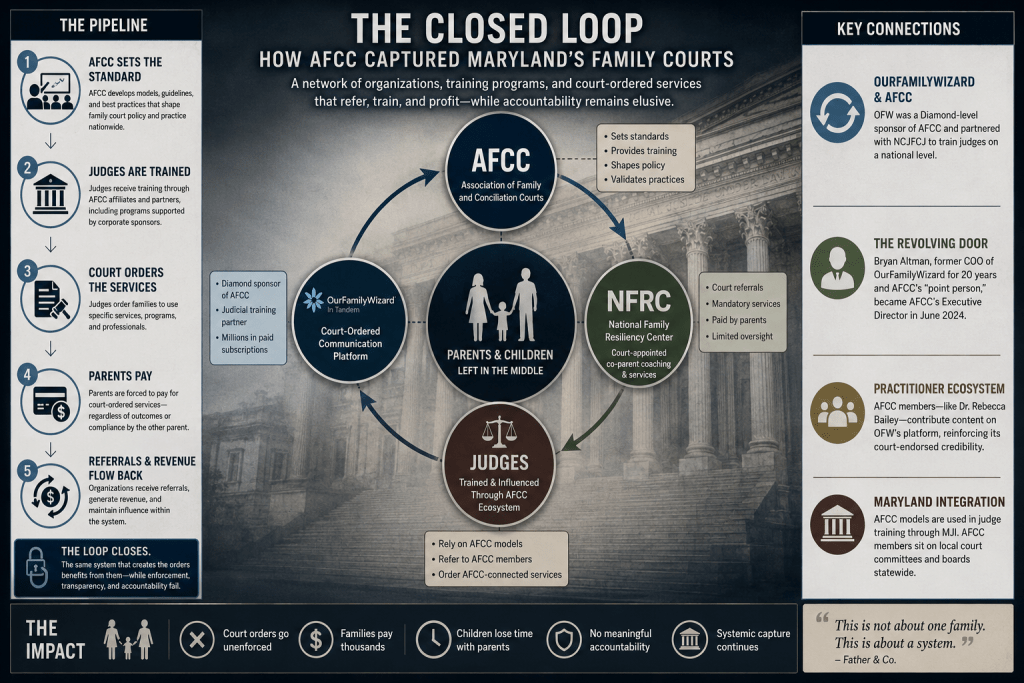
NFRC, whose director sits on that chapter’s board, has trained the Maryland Judicial Institute directly. The Judicial Institute trains judges. The judges refer cases to NFRC.
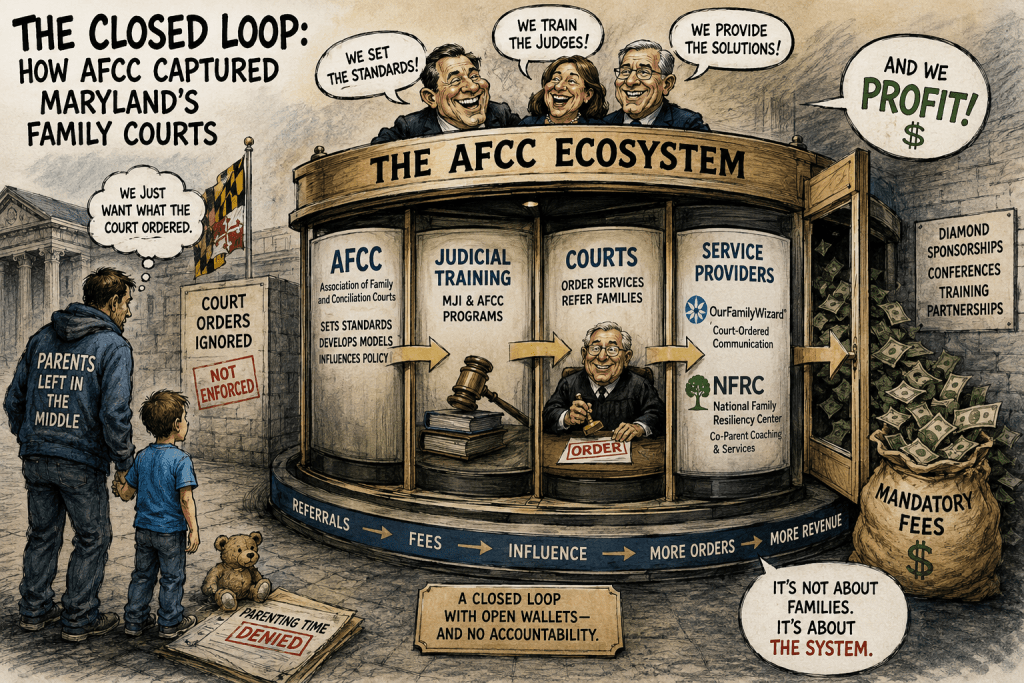
This loop — AFCC sets standards, Maryland courts adopt them as official training curriculum, AFCC-affiliated practitioners train judges who refer to AFCC-affiliated practitioners who collect fees — is not a conspiracy theory. It is a documented institutional structure, traceable through court filings, published organizational profiles, official court training materials, and the public statements of the organizations themselves.
What the loop lacks is any accountability mechanism. AFCC, by its own stated policy, “provides training and education, and does not license, certify, or regulate the practice of its members.” The organization that shapes how Maryland judges think about family law cases, trains the practitioners those judges appoint, and sponsors the communication platforms those judges order parents to pay for — takes no responsibility for outcomes in any individual case.
When a parent is ordered into a co-parent coaching program that fails to address documented alienating behavior, there is no recourse within the system that created the referral. When a parent is ordered onto a communication platform that the opposing party largely ignores, and the court declines to enforce its own order, there is no accountability within the professional network that endorsed and profited from the platform.
The Structural Blind Spot
The co-parenting model exported by AFCC and implemented by organizations like NFRC is built on a foundational assumption: that family conflict is bilateral. That both parties are, at some level, contributing to the breakdown. That the appropriate intervention is collaborative — coaching, mediation, joint sessions, therapeutic frameworks.
That assumption is the product. It is what generates referrals, justifies fees, and sustains the professional network. It is also, in cases where one party is systematically withholding court-ordered parenting time and the other is trying to comply with the order, a structural lie.
The AFCC model has no mechanism for naming unilateral bad actors. Doing so would require abandoning the bilateral-conflict framework that justifies the entire enterprise. A co-parent coach whose function is planning — not resolving underlying issues, as Gina DeLeonardis described her own role — is structurally incapable of addressing a pattern of documented parenting time denial. A communication platform whose value proposition is the unalterable record is worthless when the court treats that record as irrelevant to enforcement.
In my case, on March 20, 2024, Christina Avgerinos denied me midweek parenting time with Dylan. I arrived at the Jasmine Drive address in Rockville at the appointed time. The shutters were closed. The lights were off. When I attempted to communicate via OurFamilyWizard to document my arrival, the application failed to load. I used text messages to document the denial in real time. I was on the street, not on the property, for every minute of the wait.
I left without seeing my son. The platform that was supposed to prevent this kind of denial — and document it when it happened — was unavailable at the moment I needed it. The court order that was supposed to guarantee my parenting time remained unenforced.
The AFCC-ecosystem model had produced its characteristic outcome: documentation of a failure the system was designed to create, in a format no one with authority was prepared to act on.
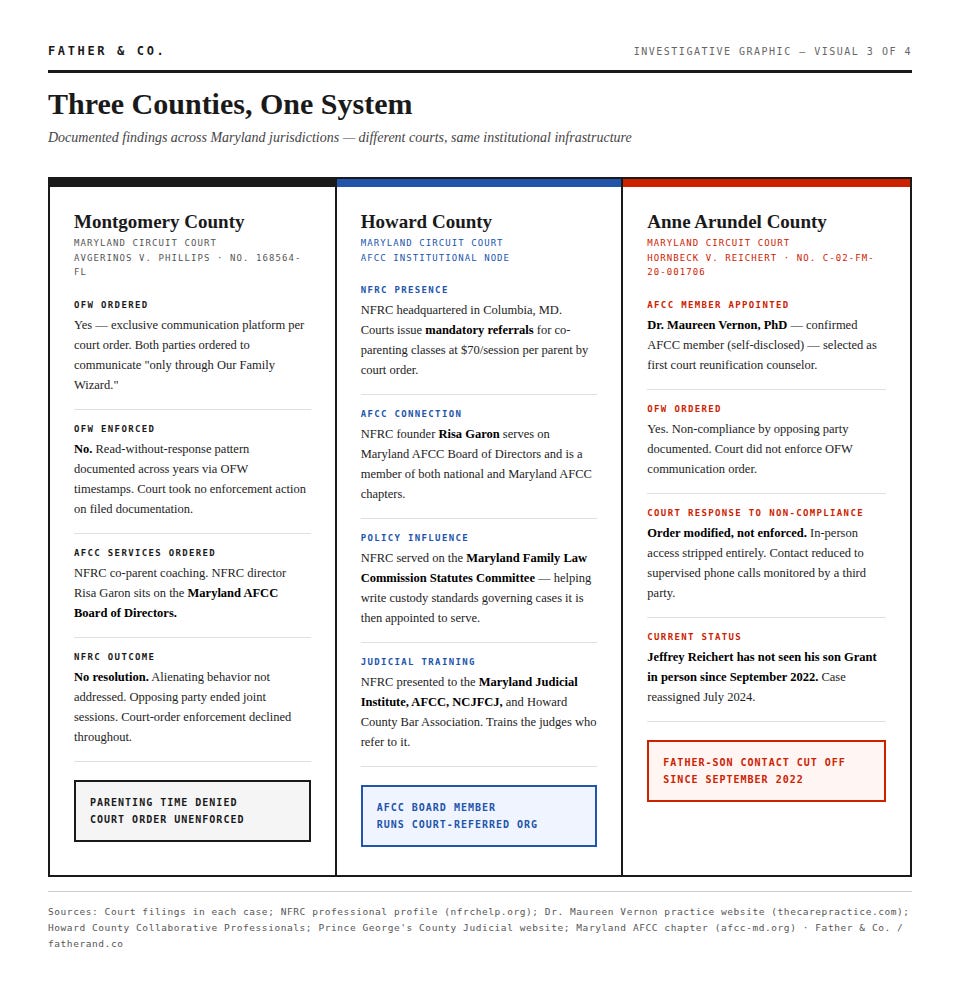
Three Counties, One System
The cases documented in this article span three Maryland counties — Montgomery, Howard, and Anne Arundel. They involve different judges, different practitioners, and different fact patterns. What they share is the same institutional infrastructure: AFCC-trained practitioners, AFCC-affiliated organizations receiving court referrals, AFCC-endorsed tools ordered by courts that decline to enforce their own orders, and a professional network that profits from the process regardless of outcome.
In Montgomery County, Avgerinos v. Phillips: OFW ordered, not enforced. NFRC engaged, ineffective. Court-ordered parenting time denied across years of litigation. I have not seen my son Dylan since 2024. Case No. 168564-FL.
In Howard and Prince George’s counties, and jurisdictions statewide: NFRC — whose director sits on the Maryland AFCC board, who helped write the statutory standards governing custody cases, and who trained the judges those cases are assigned to — receives mandatory court referrals at $70 per session.
In Anne Arundel County, Hornbeck v. Reichert: OFW ordered. A confirmed AFCC member appointed as reunification counselor. An in-house county evaluator shielded from two removal motions. A retired circuit court judge who taught at AFCC. The court’s response to documented non-compliance was not enforcement — it was a modified order stripping in-person access entirely. Jeff Reichert has not seen his son Grant since 2022. Case No. C-02-FM-20-1706.
The pattern is not coincidence. It is infrastructure.
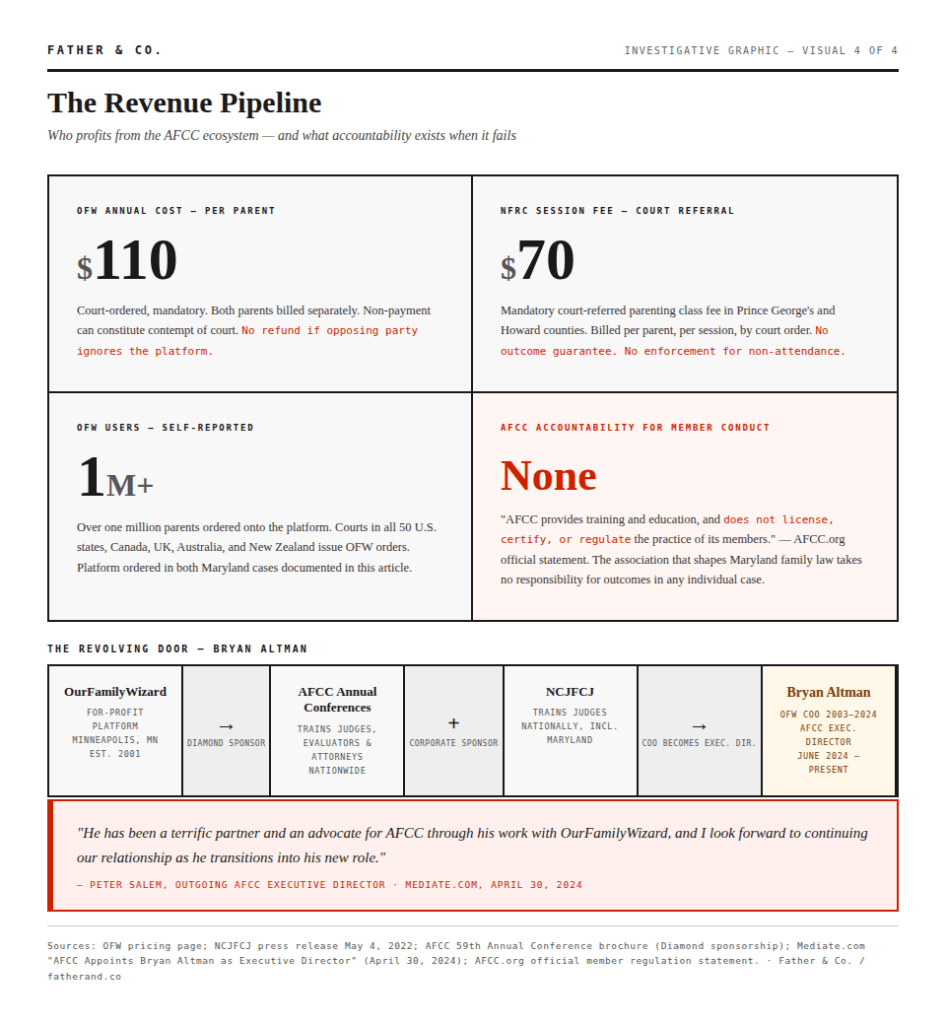
What Accountability Would Look Like
The questions this reporting raises are specific and answerable.
Does Maryland law require disclosure of AFCC affiliation when a practitioner is appointed by a family court to serve as custody evaluator, parenting coordinator, reunification therapist, or Best Interest Attorney? It does not.
Does the Maryland Judicial Institute’s curriculum disclose when its training materials are sourced from or developed by AFCC — an organization whose corporate sponsors include companies whose products judges are trained to order? It has not done so publicly.
Have the parties in any Maryland family court case been informed, at the time of a court-ordered referral to an AFCC-affiliated practitioner or program, that the organization training the judge who issued that referral is the same organization certifying the practitioner receiving it? No such disclosure requirement exists.
Does any Maryland court currently review whether the practitioners it appoints have financial or organizational relationships with the professional associations whose standards govern their appointment criteria? There is no such review mechanism on the public record.
These are not abstract policy questions. They are the product of a specific documented institutional arrangement, affecting specific families, in specific courtrooms, in Maryland.
Dylan Phillips has not had the relationship with his father that the Montgomery County Circuit Court ordered him to have. Grant Reichert has spent years in a supervised visitation structure that the Anne Arundel County Circuit Court built and sustained. Both fathers paid for the tools, attended the programs, and complied with the orders. Both courts looked at the documentation that those tools produced and declined to act on it.
The professional network that built, endorsed, and profited from every stage of that process has faced no accountability of any kind.
That is the closed loop. And it runs through every county in Maryland.
Reporting on Avgerinos v. Phillips, Case No. 168564-FL, Montgomery County Circuit Court, is drawn from court filings, OFW message records, and contemporaneous documentation. Prior published coverage of this case is available at Father & Co. and on Substack. Jeff Reichert contributed documentation from Hornbeck v. Reichert, Case No. C-02-FM-20-1706, Anne Arundel County Circuit Court.
This article is part of an ongoing series on the AFCC ecosystem.

Need help reviewing or organizing court or formal documents?
Father & Co. offers non-legal document review and organization for people representing themselves. This includes clarity, structure, neutral tone, and timeline organization — not legal advice or representation.
Have a story, experience, or resource to share?
Submissions are reviewed with care and discretion. We respect privacy and handle sensitive information responsibly.
A court cannot restrict custody because of disability, perceived disability, diagnosis, treatment status, or assumptions about impairment without an individualized, evidence-based assessment of the parent’s actual ability to safely parent. DOJ guidance says courts must conduct an individualized assessment of a disabled parent’s ability to provide for the child’s needs and must not rely on stereotypes or generalizations.
If the court says Jeff needs psychological/neurological exams or treatment compliance before exercising custody, then the court is at least treating medical/mental/neurological status as relevant. Once disability or perceived disability is part of the restriction, Title II requires individualized treatment and objective evidence—not assumptions.
The burden should not be placed on the parent to prove “my disability is not being used against me” when the order itself ties custody to medical/psychological conditions. The court should be able to show:
what specific parenting conduct creates risk;
how that risk is tied to actual evidence, not diagnosis;
why less restrictive measures or ADA modifications would not address it;
why the restriction is necessary.
A refusal to provide any individualized assessment can be framed as evidence that the restriction may be disability-based discrimination, especially if the court relied on generalized concerns, compelled treatment, or speculative future harm rather than concrete findings. DOJ/HHS guidance states Title II and §504 require fact-specific assessments based on objective evidence, personal circumstances, and demonstrated capabilities, separated from stereotypes.
So, yes: without an individualized assessment, it is hard for the court to prove the disability was not being used as a proxy for unfitness.