


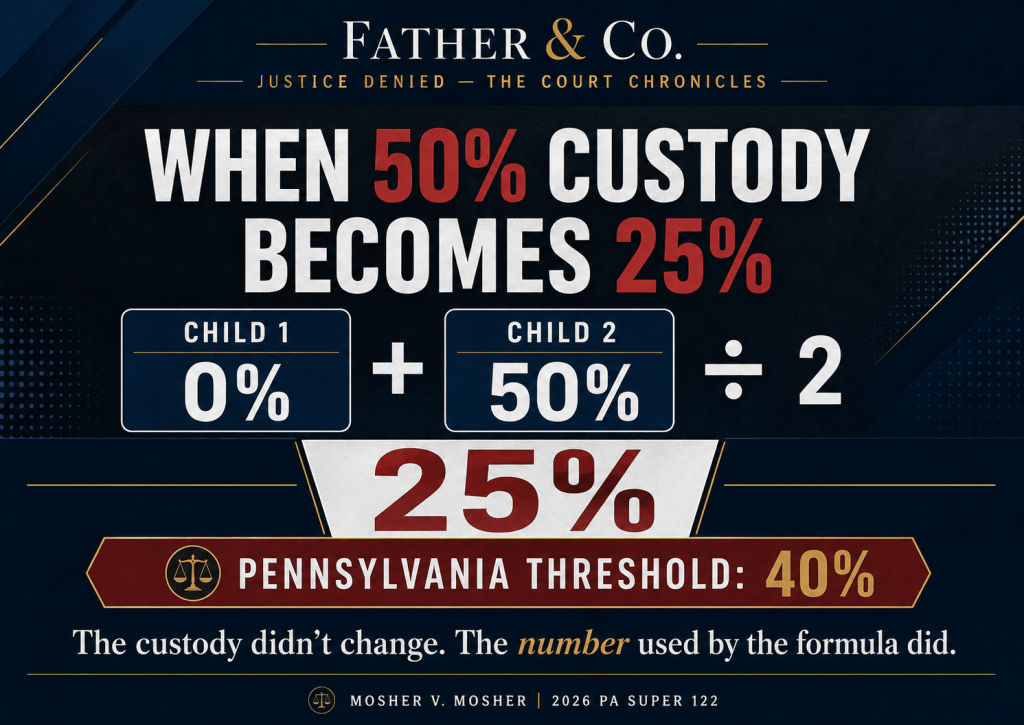
Pennsylvania’s child support formula asks a simple question when a parent wants credit for the time they actually spend with their kids: does that time cross 40%? Clear the bar, and a rebuttable presumption kicks in that you’re entitled to a reduction, because the rules assume — reasonably — that a parent who has a child close to half the time is also paying for that child close to half the time.
But what happens when a parent has one child 50% of the time and another child 0% of the time?
According to the Pennsylvania Superior Court’s June 2026 decision in Mosher v. Mosher, the answer is: average it. Add the two percentages, divide by two, and the parent who spends every other week fully responsible for one child is treated, for support purposes, as though he spends roughly a quarter of his time parenting at all.
The Facts, Stripped of Sympathy
Corey and Aleisha Mosher have two children. Mother has full-time primary custody of Child 1 — Father has no custodial time with that child whatsoever. Child 2 is split 50/50. Father earns more than Mother, so under Pa.R.Civ.P. 1910.3(b), he’s the designated obligor for Child 2 as well as Child 1: primary-custody rules make him the obligor for the child he never sees, and the higher-income rule makes him the obligor for the child he sees half the time.
A hearing officer’s original order applied subsection (c) — the individualized, per-child test — and offset Father’s obligation because he cleared 40% custodial time with Child 2. Mother filed exceptions, arguing the court had to weigh Father’s custodial time across both children, not just the one he shared. The trial court agreed and ordered the case reapplied under subsection (d)(2), the “varied partial or shared custodial schedule” provision that averages a parent’s time across all the children they owe support for. Recalculated that way, Father’s obligation rose to $1,528.92 a month. Father excepted; the trial court denied the exceptions. On appeal, Father argued the case should instead have been governed by subsection (d)(1) — the split-custody provision that offsets each parent’s obligations separately — a position distinct from what the hearing officer had originally applied. The Superior Court rejected that argument and affirmed.
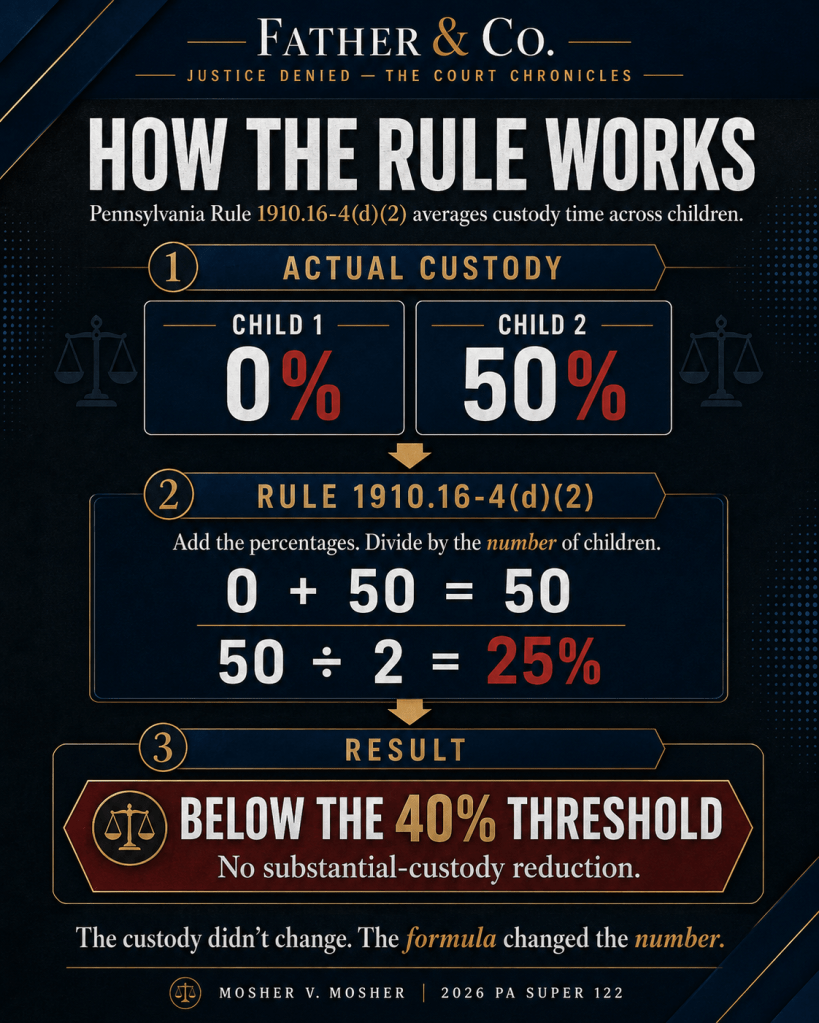
The mechanism that decided the case is buried in the rule’s arithmetic. Subsection (d)(2) doesn’t ask how much time a parent spends with the child he actually shares custody of. It asks the average across all the children he owes support for — including the one he has zero time with. Zero plus fifty, divided by two, comes out under the 40% threshold that triggers a reduction. The formula doesn’t fail to notice Father’s custodial time with Child 2. It dilutes it into irrelevance by yoking it to a completely separate custody arrangement involving a different child.
The formula doesn’t fail to notice Father’s custodial time with Child 2. It dilutes it into irrelevance.
A Neutral Rule, an Unevenly Distributed Population
Subsection (d)(2) doesn’t name a gender. Read on its own, it applies identically to any parent whose custodial arrangements aren’t uniform across their children — the rule’s language is symmetric. But the two conditions that stack to create Father’s outcome in Mosher — being the non-primary-custody parent on one child, and being the higher earner on the other — are not evenly distributed between mothers and fathers to begin with, at least at the national level. Pennsylvania-specific custody and income breakdowns weren’t available for this piece, but national data gives a useful baseline: in 2022, mothers made up 78.2% of the nation’s custodial parents and fathers made up 21.8% — a share that has grown from about 16% in 1994 but still leaves fathers well outnumbered as the custodial parent. Layer in the persistent gender pay gap, and the two variables driving subsection (d)(2)’s “double obligor” trap — non-primary custody and higher income — correlate, and they correlate toward fathers.
A facially neutral averaging formula lands on an unevenly distributed population.
That means a facially neutral averaging formula lands on an unevenly distributed population. The rule doesn’t say “fathers.” It doesn’t have to. If the parent who is statistically more likely to be the non-primary-custody parent is also statistically more likely to be the higher earner, then the mechanism that dilutes real custodial time into an irrelevant average will, in aggregate, fall more often on one side of the jersey than the other — even though nothing in the text points that way. This is a case where the honest structural critique isn’t “the rule treats both parents identically” — it does, on paper — but “identical treatment of a formula does not produce identical impact when the inputs to that formula are not evenly distributed.”
The Superior Court didn’t invent this outcome. It applied the rule as written, and the rule as written was built around an administrative convenience: courts don’t want to run parallel calculations for each child in a household, because the basic support schedule already has “incremental increases” baked in for multiple children, and separate math would double-count. That’s a legitimate technical concern. But the guideline drafters chose to solve it by treating custodial time as fungible across children who may have nothing to do with each other — different schedules, different needs, potentially different other parents entirely if this were a blended family. The child a parent sees every day and the child a parent never sees get flattened into a single average, and that average, not either actual arrangement, decides who counts as a full-time custodial parent under the law.
The child a parent sees every day and the child a parent never sees get flattened into a single average.
The Standard That Isn’t There
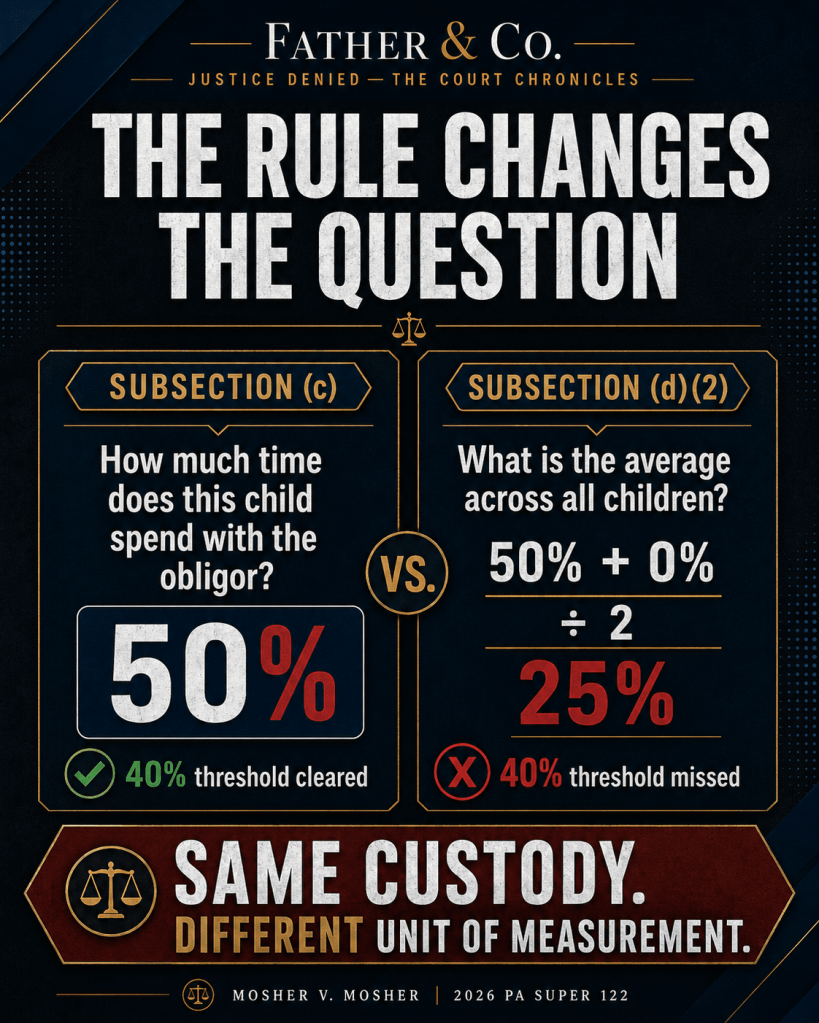
Mosher affirms a formula, not a case-specific injustice — which is precisely the problem. Subsection (c) sets a bright-line, individualized test: does this child spend 40% or more of overnights with the obligor? Subsection (d)(2) discards that individualized test the moment a second child with a different arrangement enters the picture, replacing it with a blended number that no single child’s actual living situation reflects. There is no threshold in the rule for how disparate two custodial arrangements can be before averaging them together stops making sense. A parent with 50/50 on one child and 39% on another gets averaged the same way as a parent with 50/50 on one child and 0% on another — the formula doesn’t distinguish between “slightly different schedules” and “no relationship with this child at all.”
That’s a structural gap dressed up as settled math.
That’s a structural gap dressed up as settled math. Pennsylvania’s guidelines exist, by statute, “so that persons similarly situated shall be treated similarly.” Mosher is a reminder that the guidelines’ own averaging mechanism can make two parents in very different custodial realities look identical on paper — and that whichever parent ends up on the wrong side of that average has no rule to point to that asks whether the average was ever a fair description of their actual time with their kids.
Case: Mosher v. Mosher, 2026 PA Super 122 (No. 1189 MDA 2025), Superior Court of Pennsylvania, decided June 15, 2026. Father proceeded pro se. Custody statistics cited are national figures from the U.S. Census Bureau’s Custodial Parents and Their Child Support: 2022 report, not Pennsylvania-specific, and are presented as context rather than a claim about outcomes in this case.

Need help reviewing or organizing court or formal documents?
Father & Co. offers non-legal document review and organization for people representing themselves. This includes clarity, structure, neutral tone, and timeline organization — not legal advice or representation.
Have a story, experience, or resource to share?
Submissions are reviewed with care and discretion. We respect privacy and handle sensitive information responsibly.
Under "patriarchy" the children get a family with two parents 100%.
They specialise in gender roles so it's not just 200% but far more.
Under feminist jurisprudence, which enshrines female perversion, the children are narcissistic objects of the mother, who uses them sadistically to externalize her war with her inner terrible mother.