


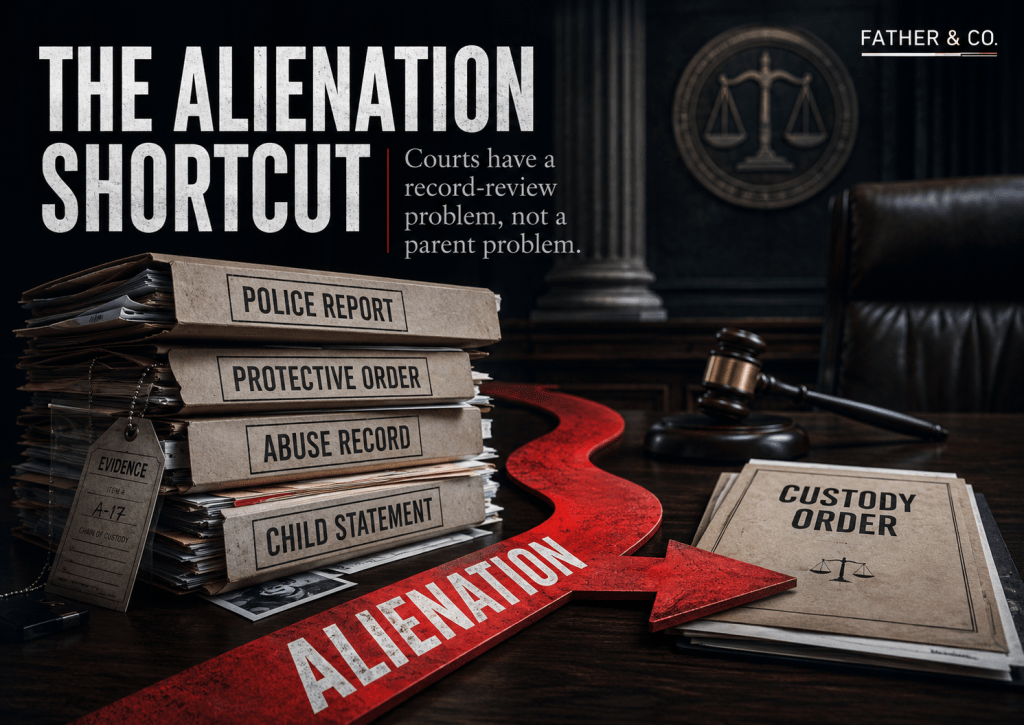
Courts have a record-review problem, not a parent problem — and nobody is auditing the judges who skip it
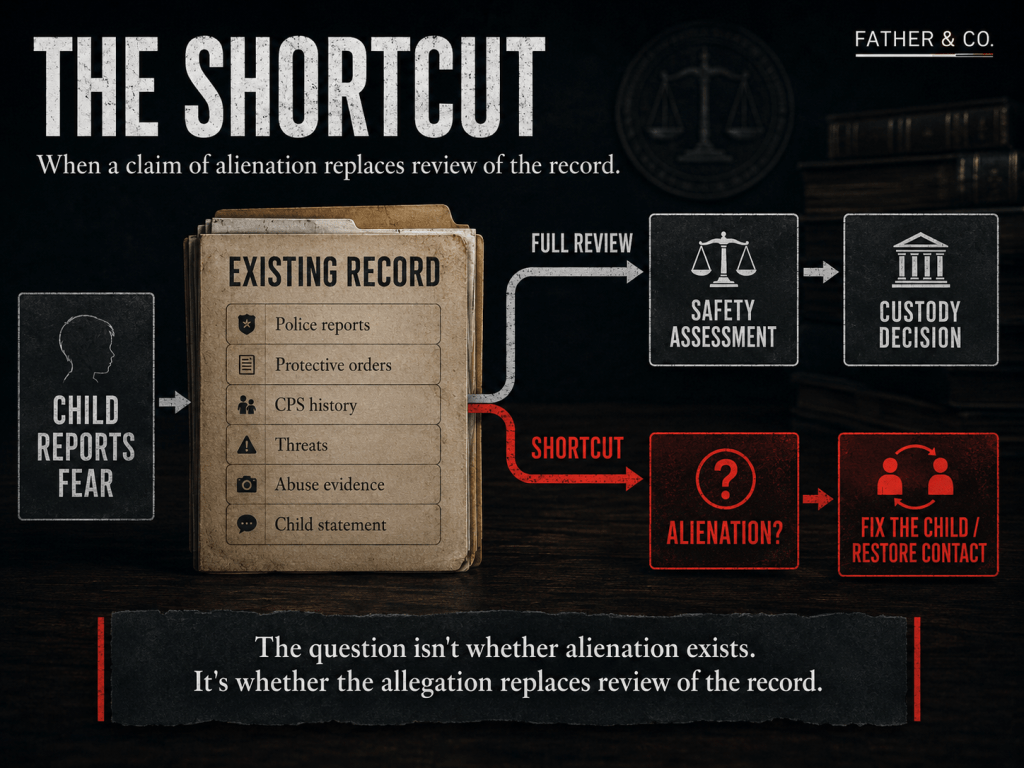
A child tells a court they’re afraid of a parent. The court has a police report. Maybe a protective order. Maybe a prior finding of abuse. And the court sends the child anyway — because the other parent’s lawyer has offered a simpler story: this isn’t fear, it’s alienation. The favored parent poisoned the child. Fix the child’s attitude, not the visitation order.
That shortcut is the subject of a recent City Journal piece by Naomi Schaefer Riley, and it deserves more scrutiny than a single op-ed can give it, because the pattern it describes isn’t about which parent is more sympathetic. It’s about what courts do — or don’t do — with a record that’s already sitting in front of them.
The pattern, not the headline cases
Riley opens with two cases that resist easy narrative: Lindsay Clancy, whose postpartum psychosis diagnosis complicates any simple account of the killing of her three children, and Kristopher Karolkiewicz, whose murder of his wife and six children followed alleged marital breakdown rather than a documented court record of prior violence. Neither is a clean example of a court ignoring a paper trail — and to her credit, Riley doesn’t pretend otherwise.
The real evidence is quieter. Research from the Association of Professionals Solving the Abuse of Children found that filicides have followed court-ordered contact with a parent the child had already named as someone they feared — contact courts approved after concluding the child’s fear was the product of the other parent’s alienating behavior rather than a legitimate response to danger. A tracking project called Lives Cut Short, cited in the piece, has compiled roughly 5,000 child-maltreatment fatalities from 2022 through 2026 and found domestic violence histories in close to a fifth of them, with more than 1,400 of those cases already known to some authority — law enforcement, a school, a shelter — before the child died.
That’s the structural finding worth sitting with: these aren’t cases where nobody knew. They’re cases where a record existed, and a court had a plausible, lower-effort alternative to acting on it.
These aren’t cases where nobody knew. They’re cases where a record existed and a court had a plausible, lower-effort alternative to acting on it.
Alienation claims cut both ways — and that’s the point
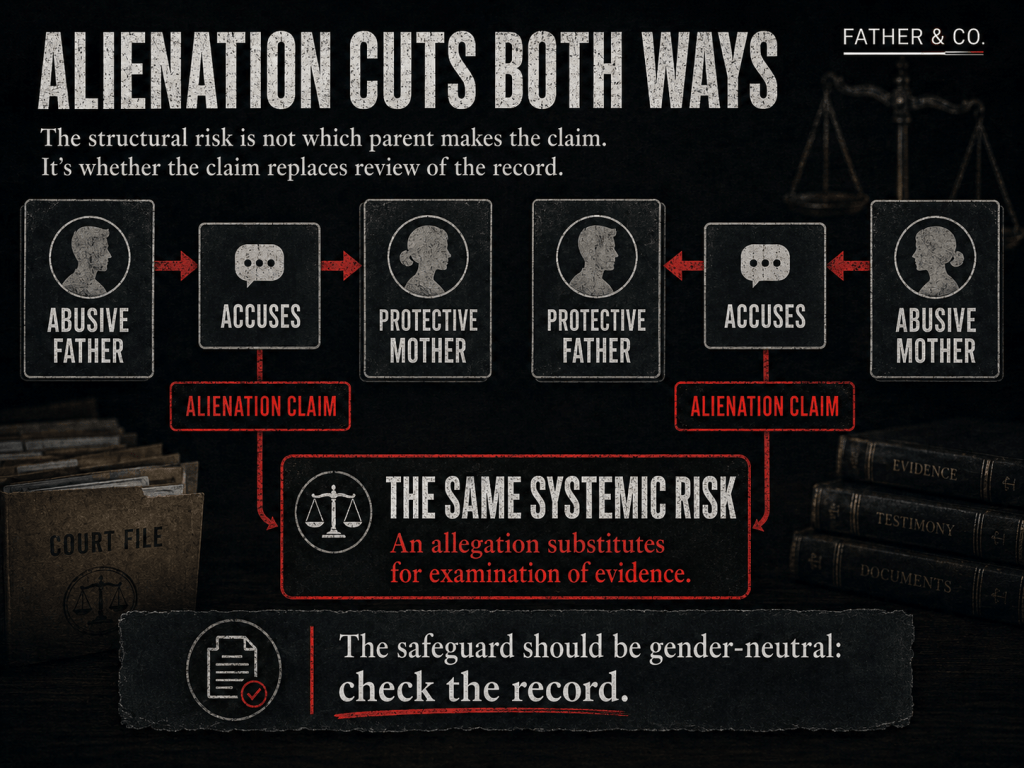
The mechanism that lets a court skip the record doesn’t care which parent is deploying it.
Father & Co. does its best not to take a side on any individual custody dispute, and this piece will do the same to not start now. Parental alienation, as a concept, is not inherently illegitimate — some parents genuinely do coach children against the other, and family courts see real cases of it. The APSAC researchers Riley cites aren’t arguing courts should stop taking alienation claims seriously. They’re arguing courts shouldn’t take them at face value instead of the underlying safety record — and that when a documented history of violence exists, the burden should run the other way: a court’s default response to a child’s stated fear should be that the fear might be well-founded, not that it needs correcting.
A court’s default response to a child’s stated fear should be that the fear might be well-founded, not that it needs correcting.
That standard is gender-neutral by design, even though the coverage around it often isn’t. An alienation claim is just as available to an abusive mother facing a father’s custody petition as it is to an abusive father facing a mother’s. The mechanism that lets a court skip the record — treat the child’s account as the product of manipulation rather than evidence — doesn’t care which parent is deploying it. What matters structurally is whether the court is required to look at what’s already in the file before it credits either story.
The record can lie too
None of this works, though, if “the record” is treated as self-authenticating. A police report, a protective order, a CPS finding — these are not neutral facts deposited into a file by the universe. They’re generated by a process, and that process can be worked. A parent who understands how the system responds to documented allegations can generate the documentation: calling in a welfare check that goes nowhere, filing for an ex parte protective order on a hearing date timed to a custody exchange, coaching a child before an interview with a caseworker. None of that requires the underlying danger to be real. It only requires the record-keeping apparatus to do what it’s built to do, which is take an allegation seriously and write it down.
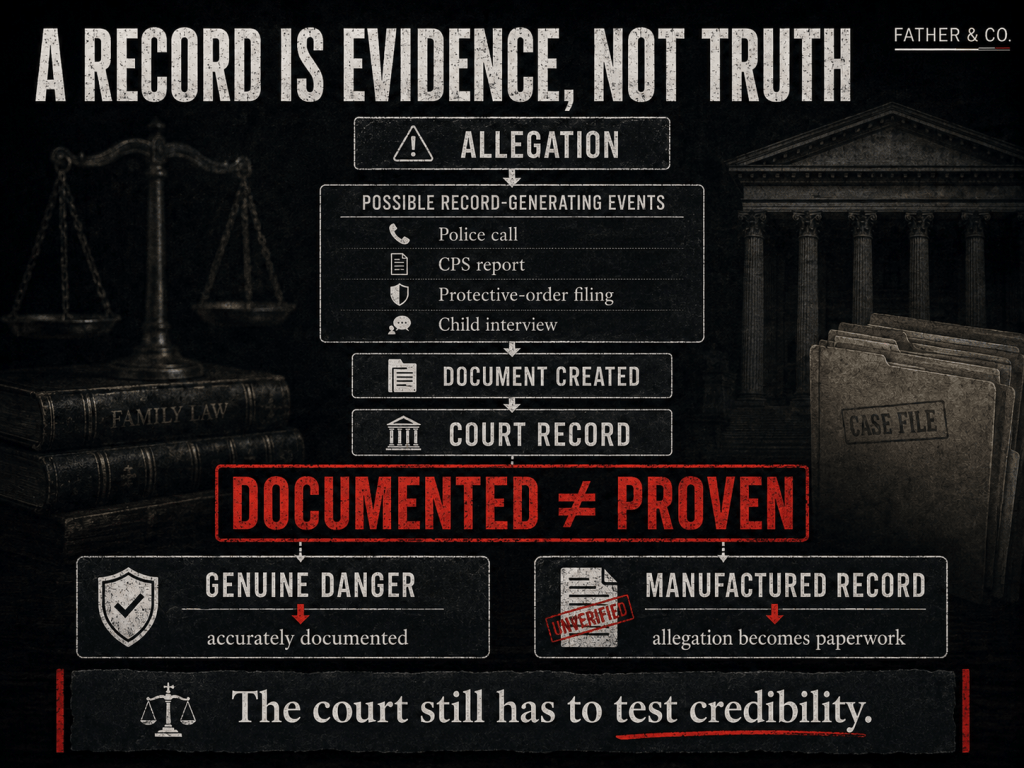
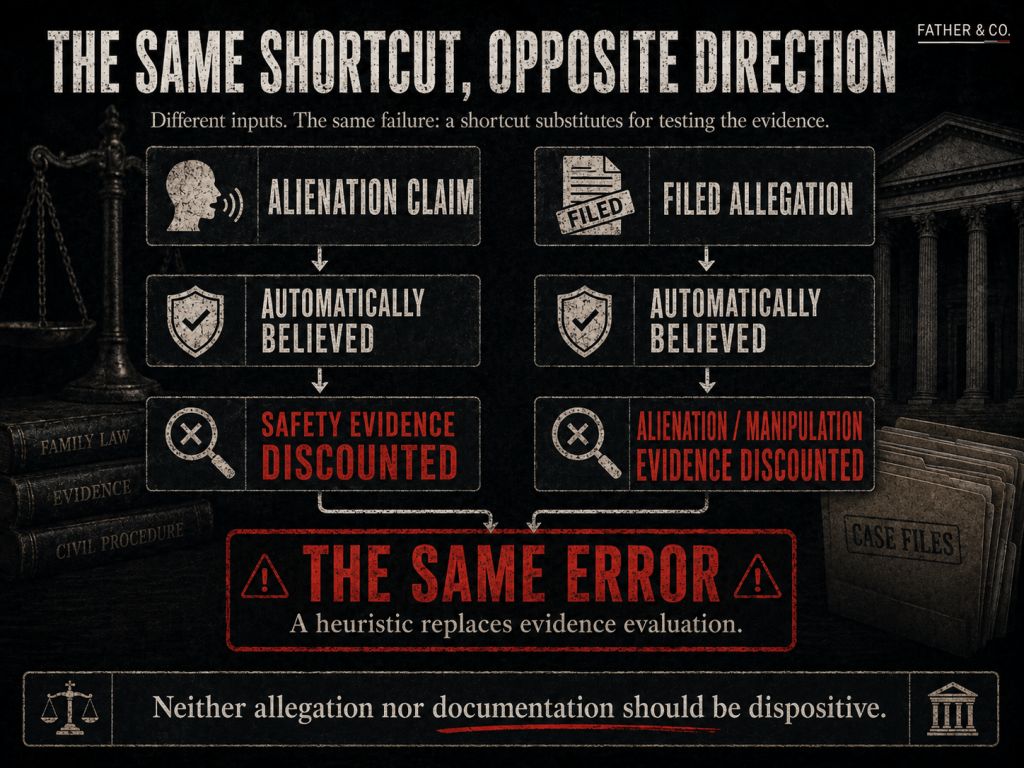
Riley’s piece nods at this exactly once — a passing reference to the 1980s daycare-abuse panic, where children gave outlandish, adult-coached testimony that sent people to prison for crimes that hadn’t happened — and then moves on without connecting it to anything else in the argument. That’s a real omission, not a minor one, because it means the piece’s central prescription (default to believing the record over the alienation claim) is only as sound as the record itself. A court that reflexively credits a filed allegation because credibility is safer than skepticism is making the same category of error as a court that reflexively credits an alienation defense because skepticism is easier than digging into the record — just pointed the other direction. Both are a court substituting a heuristic for the actual work of evaluating evidence.
A court that reflexively credits a filed allegation is making the same category of error as a court that reflexively credits an alienation defense: both substitute a heuristic for evaluating evidence.
This cuts against both “sides” of the custody-court debate in ways neither side likes to sit with. It means a court can’t treat a protective order as dispositive any more than it can treat an alienation claim as dispositive — both are just where the analysis starts. And it means that when a jurisdiction builds a “believe the record” statute without also building scrutiny of how records get made, it hasn’t closed the loophole. It’s moved it. The parent who wants to manufacture a favorable outcome now has a cleaner incentive to generate paper, not less of one.
What the statutes are actually trying to fix
Two live legislative efforts show what closing that gap looks like in practice.
New York’s Kyra’s Law (A.6194-C), named for two-year-old Kyra Franchetti, killed by her father during a court-ordered unsupervised visit in 2016, passed both chambers in June 2026 and remains on Governor Hochul’s desk as of this writing, with a signing deadline at year’s end. The bill would amend Domestic Relations Law § 240 to make documented domestic violence or child abuse history a threshold question — something the court has to resolve before it moves on to the broader best-interests analysis, not a factor weighed loosely alongside a dozen others. It would also require courts to document that reasoning, which matters more than it sounds: a threshold finding that isn’t written down is hard to appeal and impossible to audit.
A threshold finding that isn’t written down is hard to appeal and impossible to audit.
Utah’s Om’s Law (H.B. 272), passed in 2024 after the murder of sixteen-year-old Om Gandhi, took a related but distinct approach. It requires courts to consider evidence of domestic violence and abuse in custody determinations, restricts who can testify as an abuse expert to people with actual demonstrated experience in the field, and — notably — states that a parent found competent, protective, and non-abusive should not lose custody based on alienation theory alone. It doesn’t create a presumption toward either joint or sole custody. It just narrows the room for a court to treat a safety record as optional.
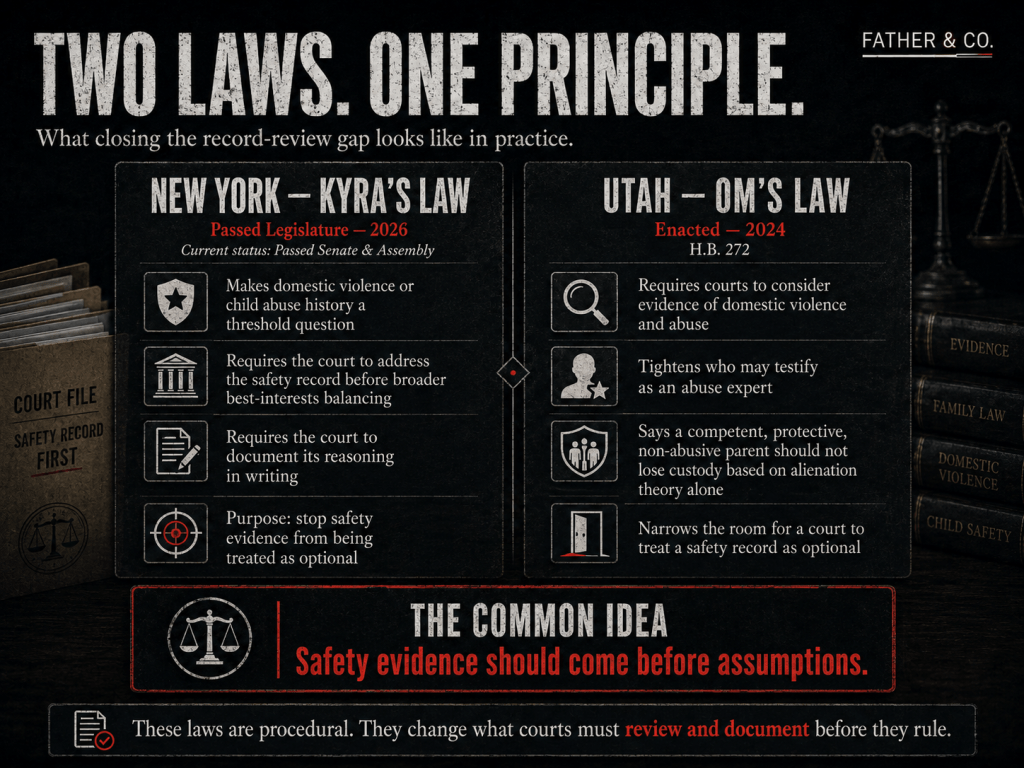
Neither law guarantees an outcome. Both are procedural: they change what a court has to look at and document before it can rule, not what the ruling has to be. That’s a modest ask, and the fact that it required a dead child’s name attached to the bill in both states says something about how far outside normal practice “review the record you already have” apparently sits.
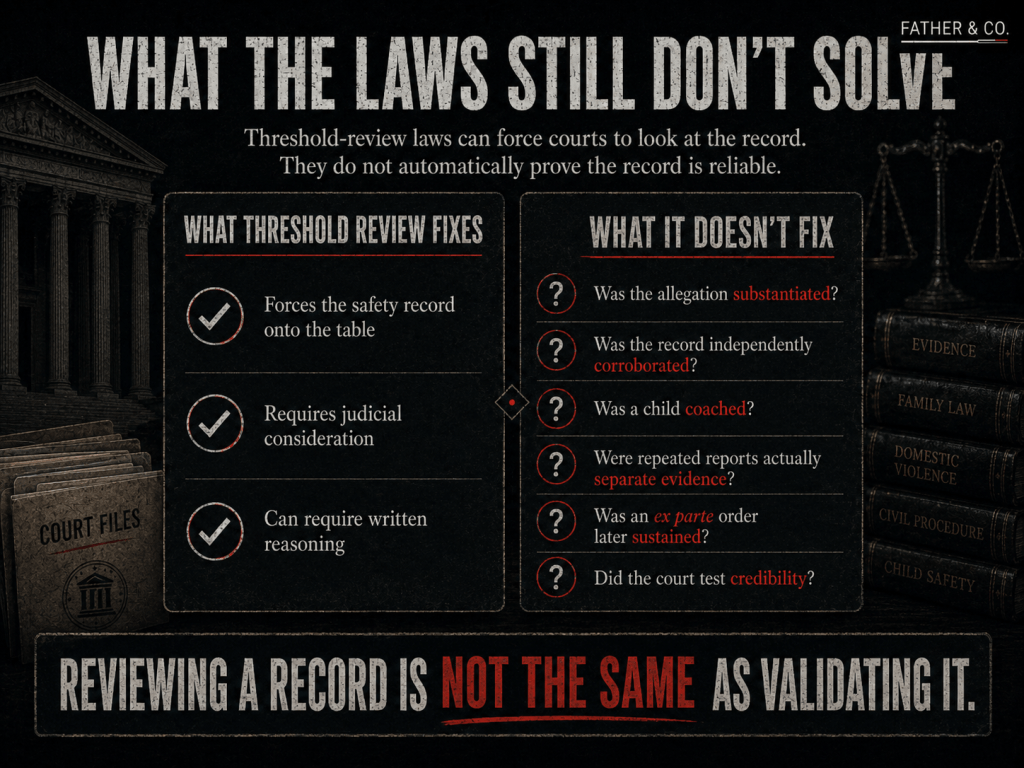
Notably, neither statute does anything to address the record’s own reliability. Om’s Law comes closest — it restricts abuse-expert testimony to professionals with demonstrated experience in the field, which at least raises the bar on who gets to characterize a record for the court. But nothing in either bill gives a judge a defined process for distinguishing a documented history of real danger from a documented history someone built. Both statutes assume the underlying record-generation systems — police, CPS, the protective-order docket — are already sound enough to trust once surfaced. That assumption is exactly what’s contested in the hardest custody cases, and it’s the gap a “threshold review” mandate doesn’t close.
The accountability gap nobody’s bill fixes
The record can be reviewed perfectly and the ruling can still be wrong, and right now almost nothing downstream of that ruling holds anyone accountable for it.
Here’s the harder structural problem, and the one Riley’s piece gets right in its final lines: family court decisions are almost never overturned. Appellate courts defer to trial judges on custody because trial judges are assumed to know the family better. Child welfare agencies take the public blame when a child dies after a custody order goes wrong — but the agency didn’t write the order. The court approved it.
The court approved it.
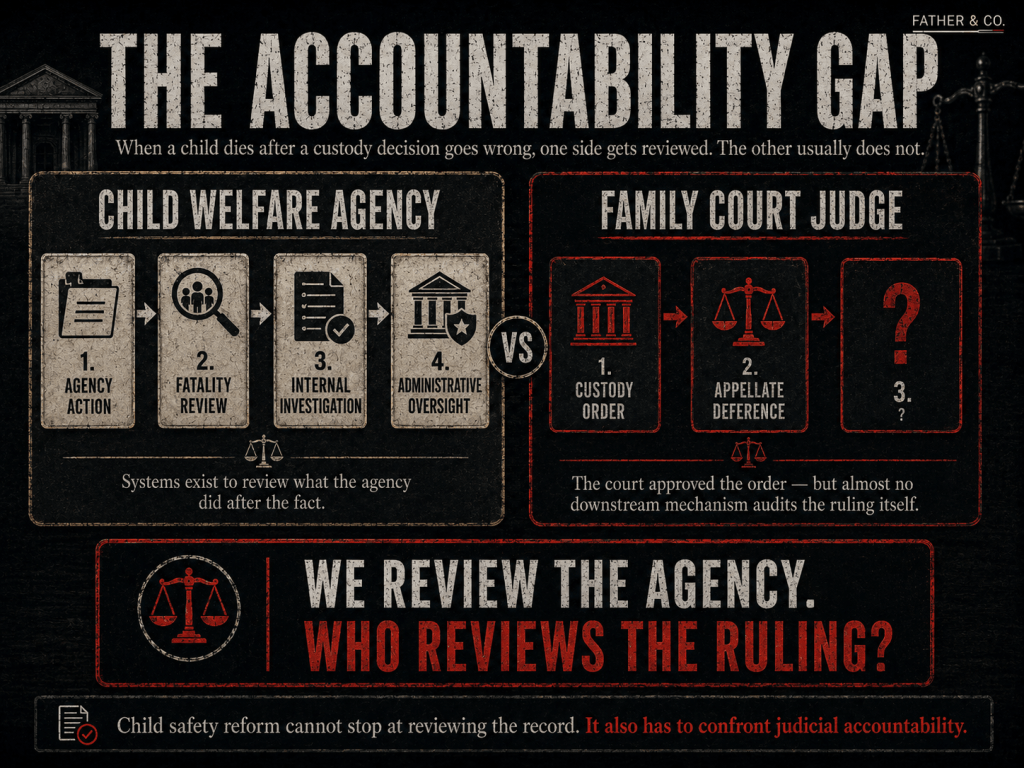
A threshold-review statute like Kyra’s Law changes the inputs a judge has to consider. It does nothing to change what happens when a judge considers them and gets it wrong anyway — in either direction. There’s no equivalent mechanism forcing a review of the judge’s reasoning after the fact — no public accounting comparable to the child-fatality reviews that welfare agencies undergo, and no process for catching the case where a court credited a fabricated record instead of a genuine one. If the goal is actually catching the next Kyra Franchetti or Om Gandhi before the fact, threshold-review language is necessary. It isn’t sufficient. A court can review the record exactly as the statute requires, get the read on that record wrong — credulous or dismissive — and the ruling stands, unexamined, either way.
That’s the piece worth watching as Kyra’s Law sits on Hochul’s desk: not just whether she signs it, but whether anyone in Albany is willing to build the second half — a mechanism for reviewing both what courts do with the record once they have it, and whether the record was worth believing in the first place.
Sources: Naomi Schaefer Riley, “Custody Courts’ Deadly Blind Spots,” City Journal, August 6, 2026; Association of Professionals Solving the Abuse of Children (APSAC), The Advisor 39.2, June 2026 (apsac.org); the Lives Cut Short database (livescutshort.org), tracking child-maltreatment fatalities 2022–2026; reporting on Kyra’s Law (A.6194-C) from Spectrum Local News (June 15, 2026), CBS News New York (June 12, 2026), the Long Island Press (July 27, 2026), and 13 WHAM (August 2026), alongside the bill’s text amending N.Y. Domestic Relations Law § 240 and N.Y. Family Court Act § 651/§ 842; and reporting on Om’s Law (H.B. 272) from KUER (February 7, 2024), KSL-TV (March 5, 2024), Deseret News (January 31, 2024), and Utah News Dispatch (February 8, 2024 and February 2, 2026), along with the bill’s statutory text.

Need help reviewing or organizing court or formal documents?
Father & Co. offers non-legal document review and organization for people representing themselves. This includes clarity, structure, neutral tone, and timeline organization — not legal advice or representation.
Have a story, experience, or resource to share?
Submissions are reviewed with care and discretion. We respect privacy and handle sensitive information responsibly.
Excellent points! Your discussion of the reliability of the underlying record and the accountability gap is important. There is existing precedent worth highlighting because it demonstrates that individuals who manufacture that record are not necessarily beyond accountability. In Hardwick v. Vreeken, 844 F.3d 1112 (9th Cir. 2017), the Ninth Circuit held that social workers were not entitled to absolute or qualified immunity from claims that they maliciously used perjured testimony and fabricated evidence to secure a child's removal from her mother. The court emphasized that government perjury and the knowing use of false evidence are fundamentally incompatible with due process, and it relied specifically on California Government Code § 820.21, which removes civil immunity from juvenile-court social workers and child-protection workers for malicious perjury, fabrication of evidence, suppression of known exculpatory evidence, and certain improperly obtained testimony.
Hardwick therefore provides an important complement to your point that courts must examine not merely whether a record exists, but whether that record is trustworthy and how it was created. It also demonstrates that at least one legal framework already recognizes personal consequences when government actors deliberately corrupt the evidentiary record used in dependency proceedings. I'm highlighting Hardwick and § 820.21 for your readers, because they provide a concrete example of accountability for precisely the fabrication problem your article identifies—and potentially a model for jurisdictions considering how to address the reliability of the records upon which family courts depend.