

The Alienation Accusation Loop
When “why the child refuses” replaces “why the child is afraid”

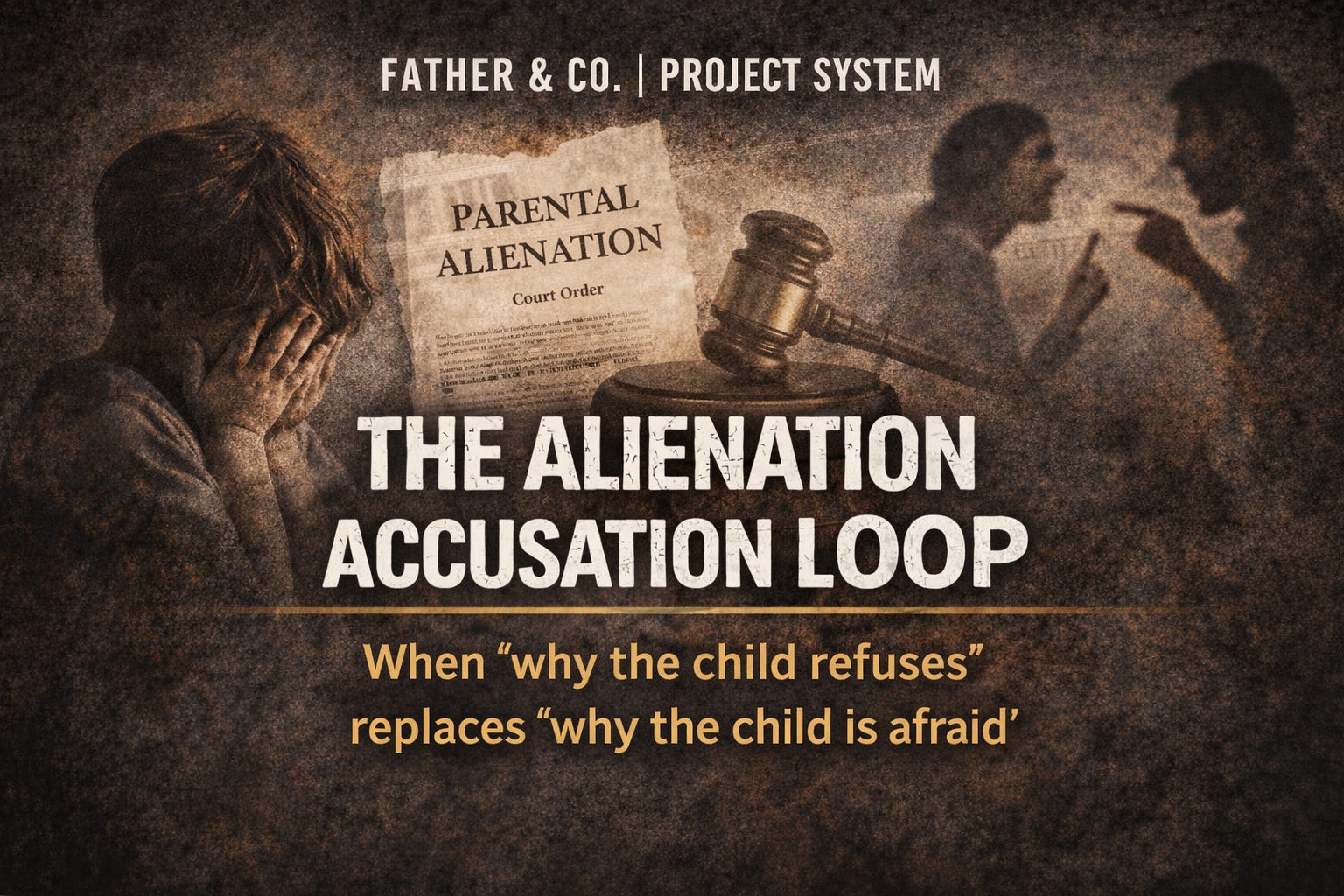
Once allegation meets counter-allegation, many family court cases slide into a third, more dangerous pattern: the alienation accusation loop.
This is the moment when the court stops asking whether a child is safe—and starts asking why the child is resistant.
It sounds subtle.
It is not.
This shift has reshaped custody outcomes across the country, often with irreversible consequences.
How the Loop Starts
The alienation accusation loop usually follows a predictable sequence:
A parent raises concerns about abuse, coercive control, or unsafe behavior.
The accused parent denies wrongdoing and counters with a claim of parental alienation.
The child shows fear, withdrawal, or resistance to contact.
The court reframes the child’s behavior as evidence of alienation rather than a possible response to harm.
At that point, the original allegation fades from view.
The case is no longer about safety.
It becomes about compliance.
Why Alienation Is So Powerful in Court
Alienation claims offer courts something they desperately want: an explanation that avoids making findings of abuse.
If a child’s distress can be attributed to manipulation by the other parent, the system doesn’t have to decide whether abuse occurred. It doesn’t have to assess power imbalance, coercive control, or trauma. It can focus on behavior correction instead.
Alienation becomes a procedural escape hatch.
The Problem With the Framework
Parental alienation can exist.
But the way it is deployed in court often ignores critical realities:
Children can reject contact due to fear or trauma without being coached.
Coercive control frequently produces withdrawal, not disclosure.
Younger children often lack the language to articulate harm.
Trauma responses are mistaken for manipulation.
Yet once alienation is alleged, the burden shifts—often onto the protective parent to prove a negative.
From Concern to Accusation
Protective behaviors are rapidly reframed:
Limiting contact becomes “gatekeeping”
Documenting concerns becomes “coaching”
Advocating for safety becomes “undermining”
Listening to a child becomes “enmeshment”
The parent who raised concerns is no longer seen as protective.
They are seen as obstructive.
And obstruction is punished.
The Child’s Voice—Filtered or Ignored
One of the most troubling aspects of this pattern is how children’s voices are handled.
Instead of being heard directly, their statements are often:
Filtered through evaluators
Discounted as influenced
Reinterpreted as loyalty conflict
Treated as unreliable due to age
The question shifts from What is the child experiencing?
to Who caused the child to feel this way?
The child becomes evidence, not a witness.
When the Loop Tightens
Once the alienation label sticks, consequences escalate quickly:
Custody reversals toward the accused parent
Forced reunification therapy or programs
Threats of contempt or sanctions
Suspension of contact with the reporting parent
Warnings that continued resistance will “damage the child”
Ironically, the system’s response often creates the very trauma it claims to fix.
Why This Pattern Persists
The alienation accusation loop thrives because it aligns with institutional incentives:
It reframes abuse as interpersonal conflict.
It avoids difficult findings and appeal risk.
It offers a clear intervention pathway.
It prioritizes contact over context.
In short, it simplifies complexity—even when that simplicity is false.
What Gets Lost
When alienation claims override unresolved safety concerns, the cost is profound:
Children may be forced into contact before they are ready—or safe.
Protective parents are silenced through threat of losing custody.
Abuse allegations are never fully investigated.
The court mistakes resistance for manipulation.
By the time the system realizes it may have misread the situation, years have passed.
And time, in family court, is irreversible.
The Question Courts Rarely Ask
The alienation accusation loop survives because one question is often skipped:
Is the child’s resistance a symptom of alienation—or a response to harm?
Without answering that first, every intervention that follows risks compounding damage rather than preventing it.
What Comes Next
This article is part of The Patterns of Family Court, an investigative series by Father & Co. under Project SYSTEM.
Next in the series:
The Friendly Parent Trap: How “Cooperation” Becomes a Punishment
Because when alienation is misapplied, protection is reframed as pathology—and the system confuses silence for safety.
—
Father & Co. documents family court patterns so they can be recognized, measured, and changed.
Didn't you know there is no such thing as alienation--according to radical women's/feminists' rights family court groups, women's family court bar associations, family court bar associations, judges, lawyers, vicious ex-wives and other judiciary "deadbeat" hangers-on. Most happen to be liberal, well-education, wealthy white women.
The loop hole. In the 90s Woody Allen claimed Mia Farrow concocted false alligations. The children were brought to a clinic at Yale New Haven. The child was interviewed by social workers. According to public information the doctor and nurse specializing in child abuse never interviewed or look at the child. Dr. Richard Gardner testifyed in a New York court house. Today we see Woody Allen and his current wife in the Epstein files. There are plenty of people especially women who have been through these alligations and proved them wrong. The court system is beginning to recognize the weapon parental alienation claims. The system is beginning to move away from the lable industry and camps. Recognizing the great harm that has been done. The entire industry started attacking mothers. Labeling them material gatekeepers, malisous mommy syndrome, mounchouen by proxy. Coaching services especially to wealthy. $240 dollars in some cases without evaluation. The majority of men pushing the label are wealthy men. What is happening in family court system is not the wealthy population that these blogs emphasize. Women have had their children manipulated against them for decades now. Suddenly the industry wants to recognize this? I called around a few years ago to see if there were any studies on false claims. Only one person returned with an answer. It was no. Now social media platforms are stating women speaking out against the non recognize phycology are harming women who claim it. For years that parental alienation industry has not given two shits about the damage done to their relationship with their children. If the court system removes them unjustifiably. Or if you have been harmed by the false alligations. Is the fight about fixing family court or keeping the lable alive and available to be used at family court. Especially for the wealthy. The court system is transiting to justified and unjustified estrangement. It should speak volumes to people that the fight for labels is more important than what is actually going on. It should be a red flag to the public that all of the people pushing it continue to attack women and the prerpitors of the problem in family court. Then pit them against mothers who have successfully fought these claims. Not because the court system is biased because the claim was brought fraudulently in the first place.