


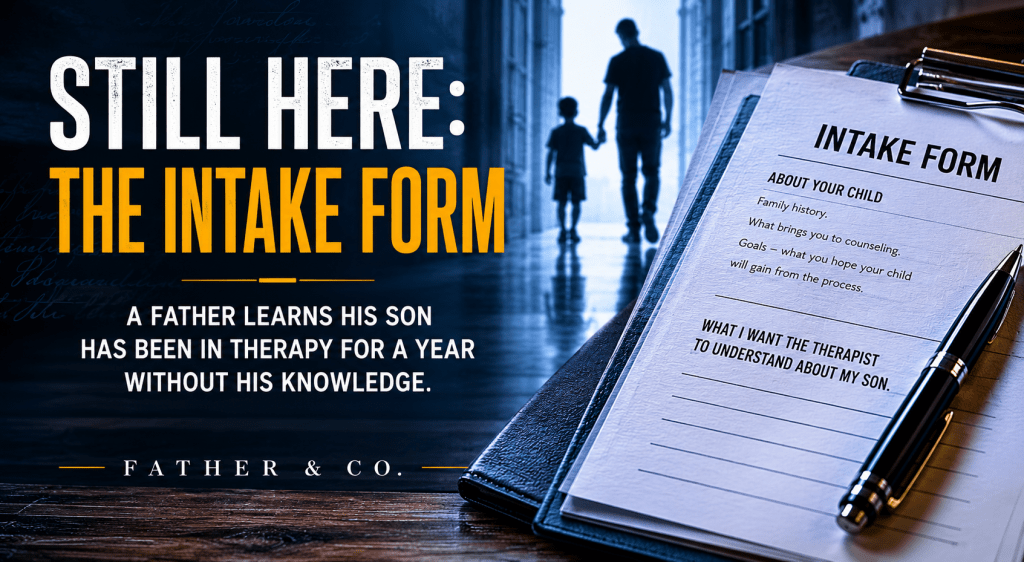
There is a form you fill out when your child starts therapy.
It asks about family history. About what brings you to counseling. About goals — what you hope your child will gain from the process, what you want the therapist to understand about who your child is.
I filled out that form in late May 2026.
My son had been in therapy for a year.
What I Knew Walking In
I knew the practice name. I knew Dylan had been seen roughly monthly since June 2025 — a full year of sessions by the time I found out — and that Dr. Mechak had described him as being in a good place.
I knew none of this until after April 27, 2026 — the evening Dr. Mechak responded to a letter I had sent him the day before his annual well visit, a letter documenting that I had been denied court-ordered parenting time and did not want my absence from the appointment to be interpreted as indifference.
I knew the rest of it the following morning, when Christina Avgerinos sent me an email at 7:43 AM noting, almost as an aside, that Dylan had started therapy last June. Eight minutes later, she sent a second email demanding I stop writing about our son.
I wrote about all of that on April 28. What I didn’t write about — because it hadn’t happened yet — was what came next.
The Practice
I contacted the practice. I introduced myself as Dylan’s father and noted that I had not previously been informed that he was a patient there. I provided a copy of our court order showing the information-sharing provisions that required his mother to provide me with provider contact information and to ensure providers had my contact information as well.
The response was professional. The practice owner confirmed that Dylan was a patient and said she would follow up to get me added to the account. She did not express skepticism. She did not ask me to work it out through counsel. She just handled it.
Within a day, I had portal access. His therapist sent a welcome email. She introduced herself, explained her approach, told me a little about how she works with children. She invited me to complete intake documents and said she would follow up with practice policies.
It took two emails to open a door that had been closed for a year. A door that had been kept shut by his mother, Christina Avgerinos.
The Form
The intake asked me to describe what brings Dylan to counseling.
I thought about that for a while.
The honest answer is that I don’t know what brings him to counseling — because I wasn’t part of the conversation when it started. I don’t know whether it was Dylan who asked, whether Christina decided, whether Dr. Mechak recommended it. I don’t know what Dylan said in his first session, or his second, or any of the sessions before I learned therapy was happening at all.
What I wrote was something closer to the truth I could document: that Dylan’s parents separated when he was very young, that he has grown up primarily in one household, that he has experienced significant changes in family structure, and more than two years of limited contact with his father. That therapy can offer him a space to develop healthy emotional regulation, communication skills, and the kind of coping tools that will serve him across his life.
I did not write that his mother has denied court-ordered parenting time since January 21, 2024 — that Dylan has not seen me in over two years. I did not write that the last time I sought enforcement, the court declined to act. I did not write that I had no idea he was in therapy until a pediatrician’s response email told me so.
Not because those things aren’t true. Because his therapist is Dylan’s therapist, not a custody evaluator. The form was asking what would help her understand my son, and that meant starting with who Dylan is — not with a recitation of what has been done to me.
What I Did Write
I wrote about Dylan as I knew him.
That he was quick to laugh when he was small. That he was curious and engaged, the kind of toddler who wanted to understand how things worked. That he had a strong sense of fairness and didn’t like to feel overlooked.
I wrote that I had been largely absent from his daily life for reasons I could not control, and that this absence — engineered through access denial — was not a reflection of my interest in him or my commitment to his wellbeing.
I wrote that I hoped the process would give him tools, not just for the questions he was already carrying, but for the ones he hadn’t thought to ask yet.
And I wrote, plainly, that this was the first time I had been included in any aspect of his mental health care, and that I was grateful to have the opportunity now.
One sentence. No accusations. Just a timestamp.
The Thing I Kept Coming Back To
His therapist wasn’t hostile.
The practice owner wasn’t hostile.
Dr. Mechak wasn’t hostile.
Once I reached out, every provider responded. Portal access arrived within a day. The intake process moved forward like any normal intake process. His therapist’s email was warm and professional. She seemed genuinely committed to the work she was doing with Dylan.
And yet I still ended up learning about a year of therapy from a note buried in a pediatrician’s appointment update — the same morning I was told to stop writing.
That’s what keeps sitting with me. Not that there was one person who decided to exclude me from my son’s care. But that a parent can become invisible through the accumulation of small omissions. No one at the practice made a hostile decision. No one set out to keep Dylan’s father in the dark. A child came in with his mother. His mother was the contact. His mother was listed on the account. Routine followed routine, and a year passed.
Our court order requires that I be provided with contact information for Dylan’s healthcare providers. That provision exists precisely because the family court understood that this kind of quiet erasure is possible — that a parent can disappear from a child’s medical and educational life without a single dramatic decision. A chain of routine omissions, and you’re gone.
I was gone for a year of therapy. A year of sessions where my son sat with someone and processed whatever he needed to process, with whatever information he had about why his father wasn’t around. His father, who he hasn’t seen in over two years — since January 21, 2024.
I don’t know what he said in those sessions. I don’t know what he was told. I don’t know how my absence has been explained to him, or whether it’s been explained at all.
What I know is that I’m in the system now. My name is on the account. It was another thing his mother failed to disclose and shut me out from. But I am here now. The door is open.
The Record
I submitted the intake form on May 29, 2026.
I have not yet had a conversation with his therapist about Dylan. That step comes later — after she reviews what I submitted, presumably after she discusses the process with Dylan, on a timeline that belongs to the therapeutic relationship rather than to me.
That is appropriate. She has known him for a year. I am starting from the beginning.
The hardest part of filling out that form was not the questions about family history, or mental health, or goals for counseling.
It was the realization that I was introducing myself — in writing, to a stranger — to someone who already knew my son.
Dylan has a therapist who has heard his voice, seen his face, and sat with him through a year of sessions.
His father filled out the intake form this month. Last night, to be precise.
That is the record. I’m not going anywhere.
Avgerinos v. Phillips, Case No. 168564-FL, Circuit Court of Montgomery County, Maryland.
This article is part of the Still Here series, documenting one father’s ongoing fight to remain present in his son’s life.

Need help reviewing or organizing court or formal documents?
Father & Co. offers non-legal document review and organization for people representing themselves. This includes clarity, structure, neutral tone, and timeline organization — not legal advice or representation.
Have a story, experience, or resource to share?
Submissions are reviewed with care and discretion. We respect privacy and handle sensitive information responsibly.
What has been the court's response to the denial of your parenting time?