


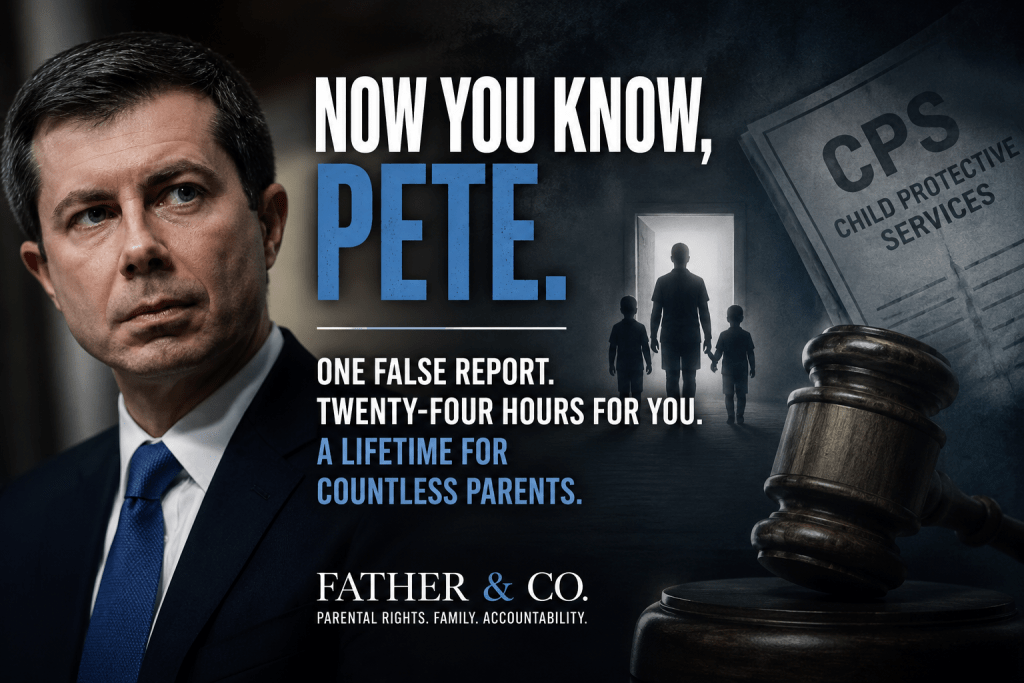
Pete Buttigieg got one day inside the system that swallows families whole. The people we cover don’t get out in 24 hours.
On June 26, 2026, Pete Buttigieg published a Substack post that has been read by millions. In it, he described one of the worst experiences of his life: an anonymous caller contacted Child Protective Services with a fabricated allegation against him. Officers and a CPS worker arrived at his home. He was separated from his four-year-old twins. The children underwent forensic interviews without their parents present. For twenty-four hours, Buttigieg did not know what he had been accused of.
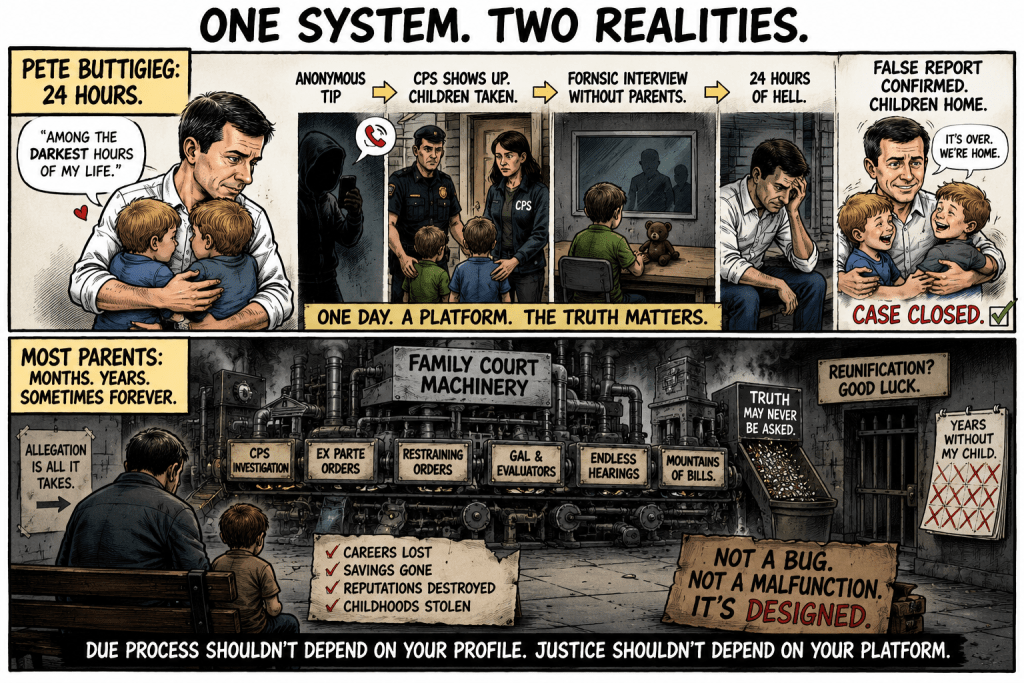
He called it “among the darkest hours of my life.”


Michigan State Police confirmed the report was false. The officer on the case told Buttigieg directly that he believed it was politically motivated. It was over in a day.
For the parents we cover at Father & Co., it is never over in a day.
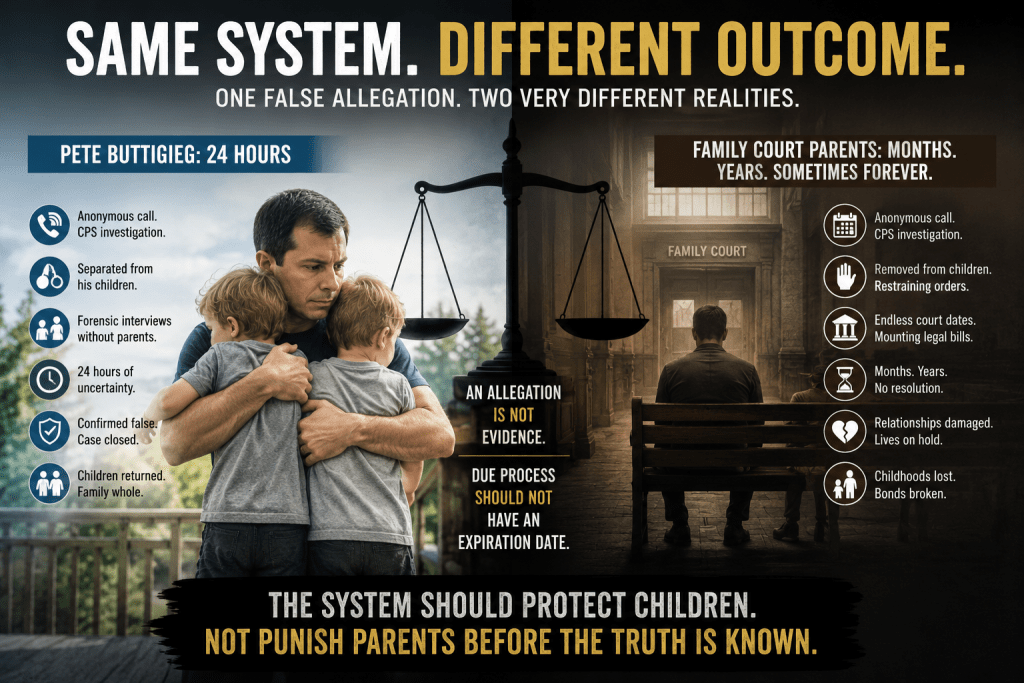
What Buttigieg experienced in twenty-four hours, targeted parents in family court live through in months. Sometimes years. Sometimes permanently.
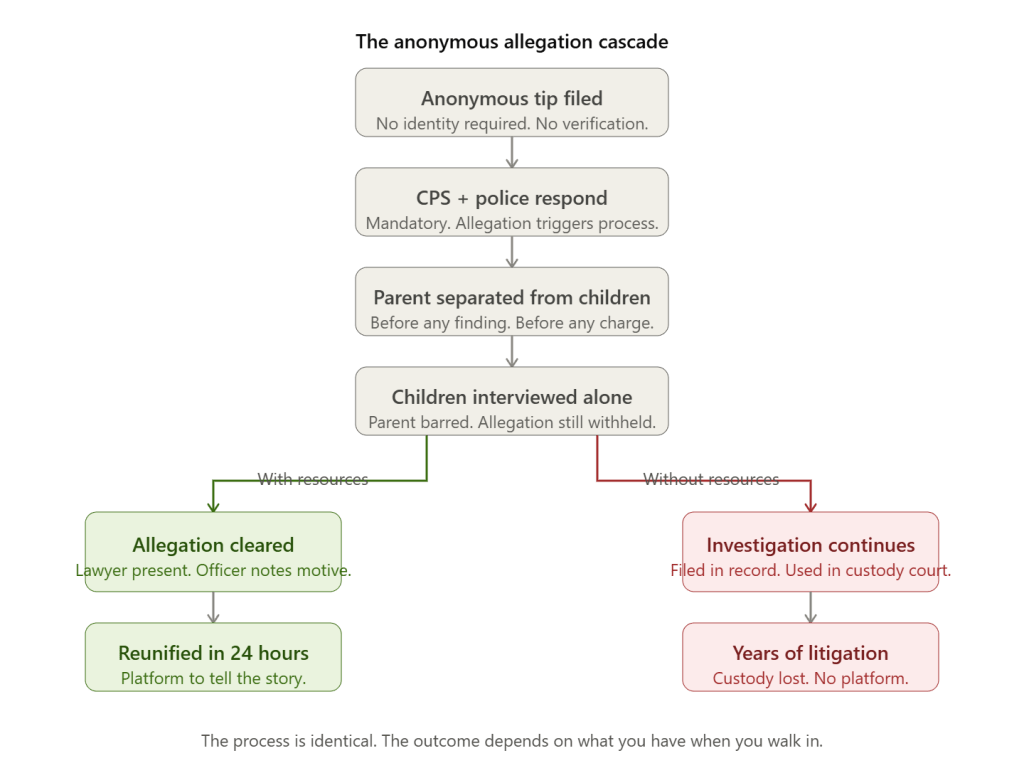
Buttigieg described the mechanism precisely, and he deserves credit for putting it on the record in detail. An anonymous tip. Immediate CPS involvement. Separation from his children pending investigation. A forensic interview he could not attend. The allegation withheld from him until the very end of the process. He wrote that he was told he should not be alone around his own children until investigators returned.
That is the architecture of the system — not a bug, not a malfunction. That is how it works.
What Buttigieg experienced in twenty-four hours, targeted parents in family court live through in months. Sometimes years. Sometimes permanently.
In March 2015, British actor Greg Ellis — known for Pirates of the Caribbean, Star Trek, and over 130 video game titles — was playing with his two sons at his Los Angeles home when police arrived. An allegation had been made. Within eight hours, he was handcuffed and removed from his home, subjected to a temporary restraining order, incarcerated, and separated from his children. He later wrote that he looked back from the police car and saw his ten-year-old son watching him go.
Ellis was later vindicated on the abuse allegations. He still lost custody of his children.
The gap between those two sentences — vindication and outcome — is where the system lives. Buttigieg was right that making a false report is a crime. He was right that it should never be normalized. What he could not have known on that kitchen deck, waiting for his husband to pull up in the family Jeep, was that for thousands of parents moving through family court at any given moment, the false report is not an aberration. It is a tactic. And the system, as designed, processes it before asking whether it is true.
The response to Buttigieg’s post was immediate and, notably, crossed partisan lines. Rep. Derrick Van Orden, a Republican congressman from Wisconsin, replied publicly: “This has happened to our family, and I agree, this is horrible.” He added: “I hope they find the folks that did this and send them to prison.”
A Republican congressman. Saying it happened to his family, too.
That is the point Father & Co. has made from the beginning. This is not a political issue. It is not a gender issue in isolation. It is a due process issue — and it lands on families regardless of their politics, their profile, or their ZIP code. The difference is that most of them don’t have a Substack with millions of readers when it does.
Buttigieg wrote that he could not understand how anyone could “fail to respect the absolutely fundamental principle that whatever you think about someone in politics, you leave people’s kids out of it.”
We agree. And we would extend it: whatever you think about someone in a custody dispute, you leave the process honest. The presumption of innocence does not dissolve at the family court door. An anonymous allegation is not evidence. A CPS visit is not a finding. A temporary restraining order is not a verdict.
The presumption of innocence does not dissolve at the family court door.
These are principles the system claims to hold. In practice, the machinery runs on the allegation itself — and for parents without political capital, a lawyer on retainer, or an officer willing to characterize the motive on the spot, the machinery does not pause to ask whether what it received was true.
Buttigieg said he wants to press criminal charges if possible — not just for his family’s sake, but to draw a line. He has that opportunity, and we hope he uses it. But the line he wants to draw already exists in theory. What is missing is the political will to enforce it — and to build accountability into a system that currently offers more protection to the person who files than to the person named.
That is what a false accusation costs when the system doesn’t close it in a day. Not twenty-four hours of darkness. A childhood.
He has a platform now that most of our readers will never have. The question is what he does with it.
Pete Buttigieg got his children back in twenty-four hours. He knows where they are. He can read them a bedtime story tonight.
There are parents reading this who have not tucked their children in for years. Who have spent those years in courtrooms, in waiting rooms, on hold with attorneys who bill by the quarter hour, filing motions that go nowhere, sending letters that go unanswered. Who have watched their children’s birthdays pass from a distance, marked not by celebration but by the calculation of how many more years until those children are eighteen and can choose for themselves. Who lie awake wondering whether the version of them that their children are being raised on — the dangerous one, the unstable one, the one the false allegation described — is the only version their children will ever know.
The fury he felt for one day is what some parents carry for the rest of their lives.
That is what a false accusation costs when the system doesn’t close it in a day. Not twenty-four hours of darkness. A childhood. The child’s and the parent’s both. Children growing up without half of who they are, half of their history, half of their identity — not because a court found anything, but because an allegation was filed and the machinery never stopped.
Buttigieg was right to be furious. He should stay furious. And he should know that the fury he felt for one day is what some parents carry for the rest of their lives, with no platform to put it on and no officer to tell them it’s almost over.
Because the faceless parents who never get a Substack post, never get millions of readers, never get an officer who tells them it looks like a hoax — they went through the same door he walked through. Most of them are still inside.
They went through the same door he walked through. Most of them are still inside.
Father & Co. covers parental rights and family court accountability across all parents and all circumstances. If you have a family court story to share, contact us at fatherand.co.

Need help reviewing or organizing court or formal documents?
Father & Co. offers non-legal document review and organization for people representing themselves. This includes clarity, structure, neutral tone, and timeline organization — not legal advice or representation.
Have a story, experience, or resource to share?
Submissions are reviewed with care and discretion. We respect privacy and handle sensitive information responsibly.
Now you know, Pete. Anonymous allegations are not evidence. CPS contact is not a finding. A temporary restriction is not a verdict. Yet family courts treat accusations as ignition, then force parents to spend fortunes proving they are not monsters while children lose birthdays, bedtime stories, and half their identity. Buttigieg should press charges if possible, but he should also use his platform to expose the broader system. False reports are not rare tactical accidents. They are weapons in custody warfare. The presumption of innocence cannot die at the family-court door. One day of terror should become a reform agenda.
Former Secretary Buttigieg’s false-CPS-report ordeal shows why due process safeguards are urgently needed for all families. False allegations seem to be accelerating across the U.S. This suggests that we not only need stronger and better systems respecting due process rights, but we also urgently need penalties for false allegations.
Article: https://fatherandco.substack.com/p/ptsd-is-not-a-parenting-defect-family