


In short: Giselle Smiel faces five felonies for picking up her crying child at a San Diego school. Her team says the charges collapse on venue, missing kidnapping elements, and ADA violations—all documented below.
Records, not rhetoric—venue, access, and the law in a case reshaping one mother’s life.
Overview
Court records and charging documents show five felony counts against Giselle Smiel, including kidnapping (Penal Code § 207) (§ 207 requires force or fear + substantial distance—neither seen on video.) and custody/visitation interference (Penal Code §§ 278–278.5) (§ 278.5 needs a “lawful custodian” with clear court-ordered rights—here disputed.). Based on transcripts, videos, and process documentation—including ADA correspondence—Ms. Smiel’s support team argues the record does not establish § 207’s force/fear plus substantial movement and that any claim of “lawful custody/visitation” under § 278.5 was disputed on the relevant dates.
Ms. Smiel was taken into custody on September 4, 2025. Supporters say no warrant was presented and Miranda warnings were not given prior to any questioning; they also point to delays in discovery. Even after a warrantless arrest, the state must secure a prompt judicial probable-cause review and timely arraignment; Miranda warnings are required before custodial interrogation if the state intends to use statements.
Background
Arrest Without Lawful Warrant or Miranda
Advocates state that a criminal protective order (CPO) restricting the former spouse’s contact has been in place since 2020; they say it runs for up to ten years under California DV authorities. They further report that, amid a late-2024 medical emergency involving Ms. Smiel’s child, a custody-modification order issued in her absence and without notice or personal service; Ms. Smiel later sought mediation.
Months later, prosecutors filed the case after an investigative report from the L.A. County District Attorney’s Child Abduction Unit (CAU). Supporters contest Los Angeles venue and state that no warrant was shown when Ms. Smiel was arrested.
“They never showed her anything—no lawful warrant or charging documents were ever presented. She was just taken,” stated Renata DeMello.
Ms. DeMello is Ms. Smiel’s ADA support person, who corroborated the accounts in interviews and correspondence.
What the School Footage Shows (May 1, 2025)
School Video Timeline
District video from Double Peak K–8 in San Marcos (San Diego County) shows school staff admitting investigators from the L.A. County DA’s Child Abduction Unit.
A separate clip recorded by Ms. Smiel captures audio of her child crying, while she confronts the LA County Child Abduction Unit Agents outside the gate.
A CPRA response to The Thunder Report reflects no arrest or incident report for that encounter. Those contemporaneous facts cut against a kidnapping narrative tied to that date and reinforce the venue dispute.
Count 1 — Kidnapping (Penal Code § 207(a))
Why L.A. Venue Fails
The complaint alleges simple kidnapping. Ms. Smiel’s support team contends the record does not establish force, fear, or substantial movement, citing the May 1 school video and multiple eyewitness accounts. Two San Diego County Sheriff’s deputies—SRO Robert Riggs and Deputy James Manibusan—were physically present on scene and did not authorize or execute any arrest, confirming no lawful warrant or probable cause existed within San Diego jurisdiction.
The filing lists Los Angeles County; however, all alleged actions occurred in San Diego County. Unless prosecutors identify specific qualifying acts or effects occurring in Los Angeles—under California’s mandatory venue statutes—or demonstrate that the child was taken, kept, or found in Los Angeles County, venue in Los Angeles remains jurisdictionally defective and in active dispute.
Collateral Counts — Custody/Visitation Interference (Penal Code §§ 278, 278.5)
These counts turn on whether the accused took/kept/withheld a child and thereby maliciously deprived a lawful custodian or visitor of rights defined by law or court order. Advocates maintain that no qualifying criminal conduct occurred in either county and that a disputed custody status—even if true—does not itself create probable cause for a criminal offense. On that view, there is no jurisdictional footing to establish venue in Los Angeles or any other county; without an underlying criminal act, jurisdiction never attached, and the prosecution is void from inception, they argue.
Access is Due Process of Law — ADA & Rule 1.100
ADA Requests Ignored
While in custody and after transfer to Los Angeles, written requests sought real-time captioning, remote access, and participation by a designated support person. Advocates report no Rule 1.100 written determination in the file (Rule 1.100 mandates a written ADA decision within days—none in file.) and say the requested aids were not provided.
Under ADA Title II, public entities must ensure effective communication and give primary consideration to requested aids; Rule 1.100 requires a prompt written decision and a short window for review.
Advocates also assert that critical criminal proceedings occurred without Ms. Smiel’s participation. A felony defendant’s presence is generally required at critical stages—those where presence contributes to fairness—and the Fourteenth Amendment guarantees meaningful notice and an opportunity to be heard. Read together, the alleged failures in effective communication, written determinations, and presence form the core of the constitutional challenge.
Systemic Tools & Lines Crossed
Title IV-D Overreach
The DA’s Child Abduction Unit uses civil recovery procedures authorized by Family Code §§ 3130–3135, while prosecutors exercise separate criminal charging authority under Gov. Code § 26500 and Penal Code §§ 277–280. Title IV-D provisions, including Family Code § 17514, govern child-support/abduction-recovery administration and confidentiality; they do not create criminal jurisdiction.
Advocates argue that blending Title IV-D administrative mechanisms with felony prosecution blurs statutory boundaries, violates separation-of-powers principles, and risks using civil tools to predetermine criminal outcomes—a practice not authorized by any statute and affirmatively prohibited by constitutional due-process guarantees.
The Human Cost
Supporters describe a mother whose life tilted: time apart from her children, lost income, mounting legal bills, and the familiar trauma of prior abuse compounded by what they call institutional betrayal. Bail was initially set at $500,000 while she was managing a medical crisis; it was later reduced to $100,000, and she was released.
Call for Justice
“The charges should be dismissed for lack of required criminal elements, improper venue, and serious constitutional and ADA defects,” said ADA support person, Renata DeMello.
Advocates also call for state and federal oversight into the use of family-court mechanisms inside criminal prosecutions and for vacatur of any orders found constitutionally infirm.
How to Help:
Support the defense fund (managed by verified supporters; contributions do not confer legal services or influence coverage).
Exhibits:
Copy of the CPO Against J.Smiel:

Charging Document:
June 2025 responses from SDCSO:



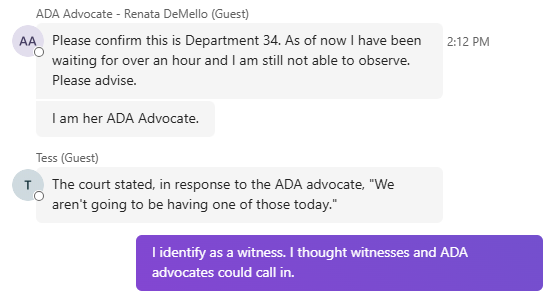
October 6, 2025, ADA Advocate Denied Remote Access:
Support Independent Journalism
The Thunder Report and Fatherand.Co are funded solely through reader support. Help sustain investigations that hold public institutions accountable.
Donate, Buy Me a Coffee, or Subscribe for Updates.
Confusing? Yes.
I didn’t notice a no contact order with her children, or a specific custodial doc here for Nov 2024 period.
I only saw a domestic violence order of protection.
Does she have counsel? California seems to provide a constitutional right to counsel which the state would be required to provide, if she is unable. Criminal (any imprisonment possible) ✅ Yes (constitutional) according to U.S. Const. amend. VI; Cal. Const. art. I §15. Juvenile dependency / parental rights ✅ Yes (statutory & due process) Welf. & Inst. Code §§317, 317.5. Civil commitment / involuntary confinement ✅ Yes (due process) Welf. & Inst. Code §§5302, 5365. Civil contempt with possible jail ✅ Yes (due process) In re McCann. Ordinary civil matters (no liberty at stake) ❌ No Lassiter v. DSS.