


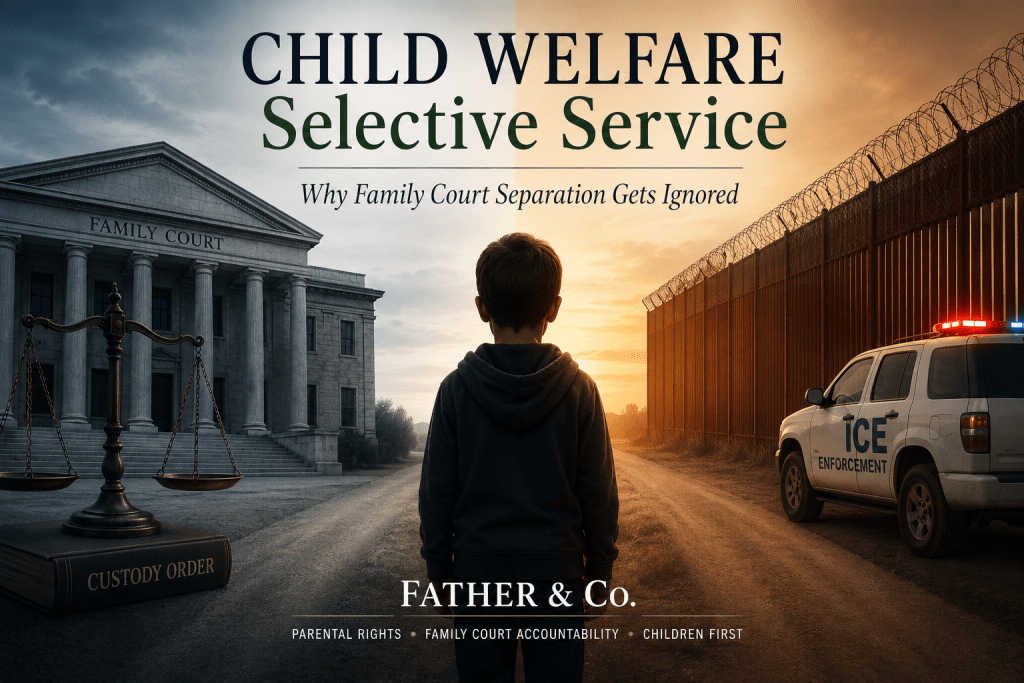
Politicians who can’t find the urgency to fix family courts that sever thousands of American children from fit parents every year become experts in child welfare the moment an ICE headline arrives. The difference isn’t compassion. It’s cameras.
By Michael Phillips | Father & Co.
A senator posted about ICE ripping kids from their parents. Within hours, the reply came from a Maryland outlet covering the other separation epidemic — the one that never trends, never generates a congressional hearing, and never seems to qualify as a crisis worth addressing. The exchange was brief. The question it raised is not.
Thousands of American children are cut off from fit, citizen parents every year by family courts that operate with almost no external accountability, no federal oversight, and no political constituency powerful enough to force reform. These are not edge cases. They are the documented, recurring output of a system that has been dysfunctional for decades — and that dysfunction has been studied, reported, and largely ignored by the same political class now performing anguish over children at the border.
This is not an argument against caring about immigration enforcement and its effects on families. It is an argument about what political attention actually measures — and what it doesn’t.
“The same politicians who ignore family court abuses, parental alienation, and children losing contact with fit parents suddenly become child welfare experts when the conversation involves illegal immigration.”
Consider what it takes to generate a child welfare emergency in Washington. A federal agency. A named villain. A policy that can be reversed by executive order. A coalition of advocacy organizations with fundraising infrastructure tied to the issue. Media that has already framed it as a civil rights story. All of those ingredients were present for family separation at the border — which is why it produced hearings, legislation, and sustained outrage.
Now consider what family court separation looks like through the same lens. The responsible parties are diffuse: a judge here, a guardian ad litem there, an attorney who billed $400 an hour to recommend cutting off a parent who never harmed their child. No single agency to protest. No executive order to demand. No coalition with the budget to make a senator’s office return a call. And critically: no partisan utility. Family courts fail fathers and mothers. They fail in red states and blue states. There is no clean villain, and therefore no clean politics.
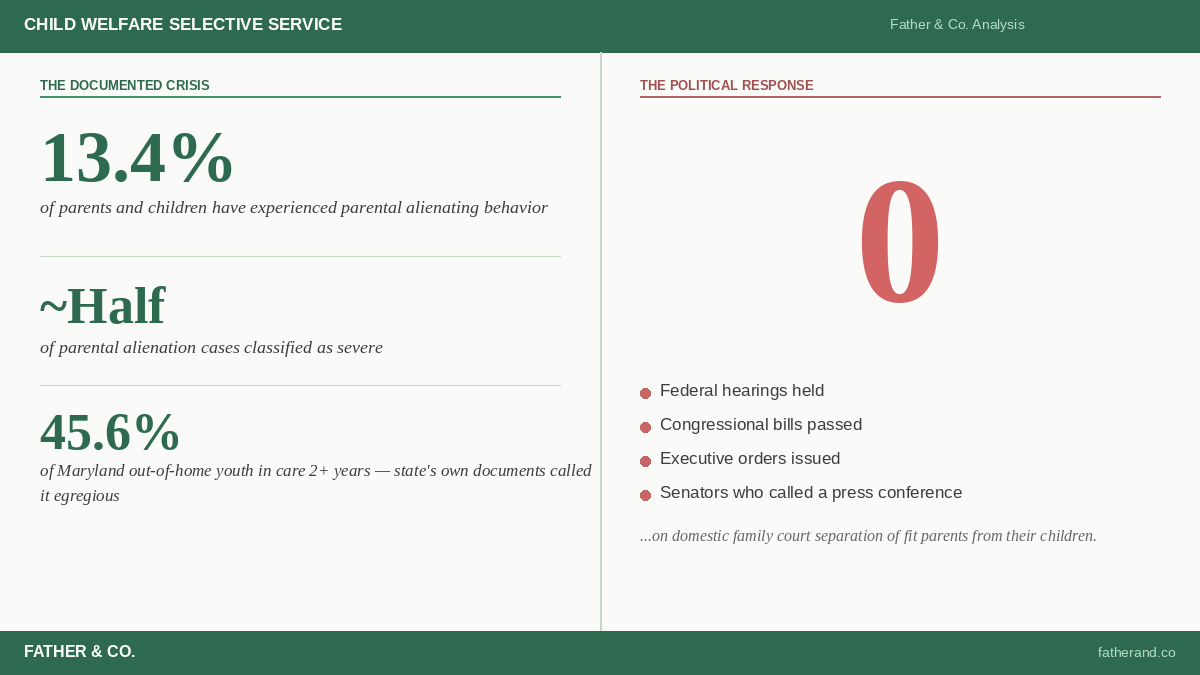
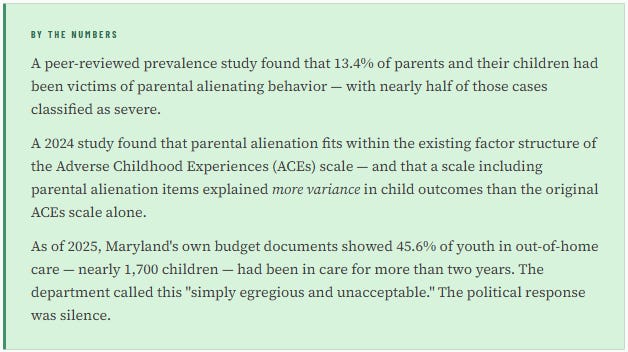
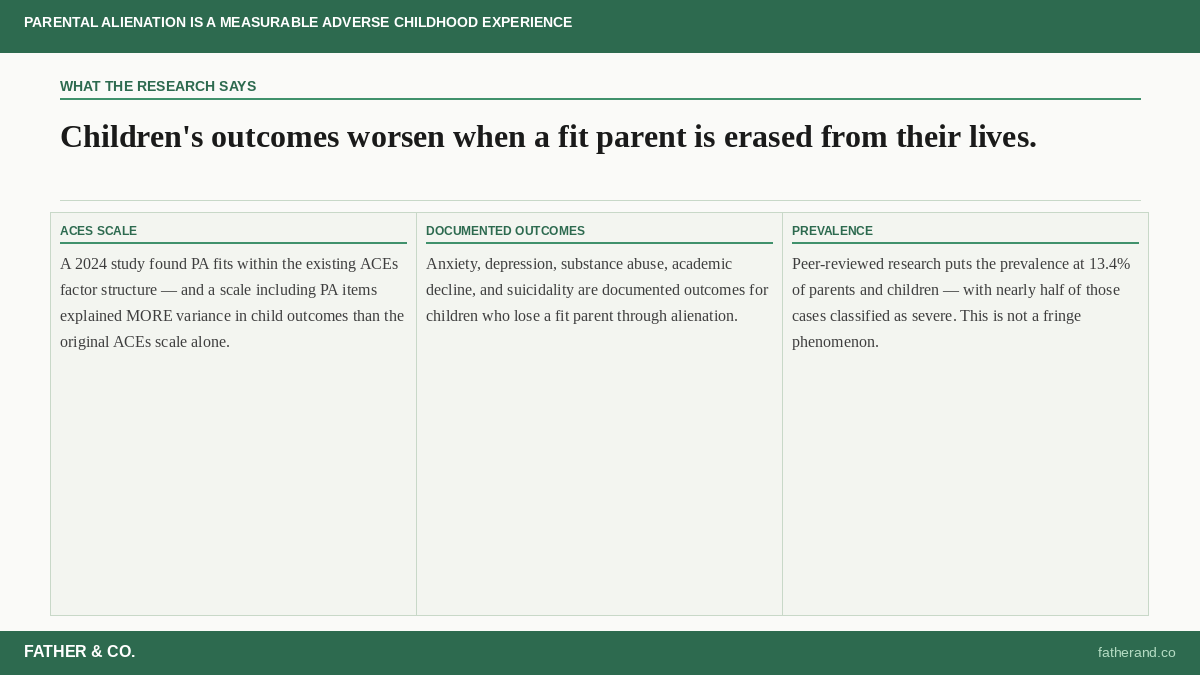
The parental alienation research base has grown substantially over the past decade. What it documents is not a fringe phenomenon but a measurable adverse childhood experience — one whose outcomes include anxiety, depression, substance abuse, academic decline, and suicidality. The children living those outcomes are American citizens. Their targeted parents are American citizens. Their suffering is not contingent on which side of a border they were born on, and it does not generate a single fundraising email.
There is a version of this argument that becomes a cynical deflection — “what about the other kids” deployed to do nothing about either group. That is not what this is. The claim here is specific: if the standard for political engagement is “children being separated from parents who love them,” that standard applies, or it doesn’t. The family court system fails that test tens of thousands of times a year, in jurisdictions controlled by both parties, and the political response has been functionally zero.
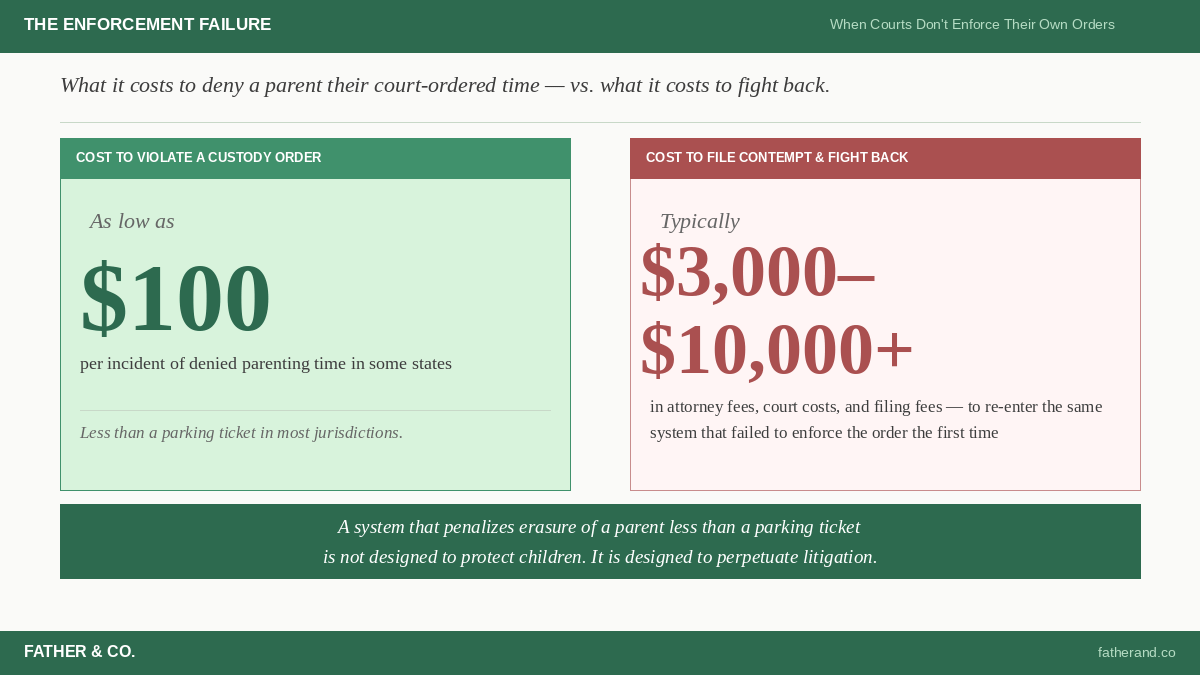
The enforcement gap alone tells the story. When a family court order is violated — when parenting time is denied, when a child is withheld, when a custody arrangement is unilaterally dismantled by the party with physical control — the remedy is to file a contempt motion, retain counsel, and re-enter the same system that failed to enforce the order the first time. In some states, the fine for a documented violation of a court-ordered parenting plan is less than a parking ticket. There is no federal mechanism. There is no emergency hotline. There is no senator calling a press conference.
That asymmetry is not accidental. It is the product of a system that has no external accountability because no political constituency has ever been powerful enough to demand it. Family court operates in a closed loop: the attorneys, guardians ad litem, evaluators, and mediators who profit from contested custody proceedings have a structural interest in ensuring those proceedings remain as long and expensive as possible. The parents paying for it — on both sides — are too depleted to organize. And the children at the center of it cannot vote.
A system that charges more to contest a parking ticket than it penalizes for erasing a parent from a child’s life is not a system designed to protect children. It is a system designed to perpetuate litigation.
The families covered in these pages — Reichert, Gano, Reyna, Fishman, Sewell, and others — are not abstractions. They are citizens who went to family court expecting a functioning legal system and found instead a machinery that treated their children as a revenue stream and their parental relationships as a negotiating chip. They are still waiting for a senator to call a hearing. They will keep waiting.
The test of whether a politician actually believes that separating children from fit parents is a crisis is not what they say when the cameras are on immigration. It is what they do when the cameras are off, and the system doing the separating is domestic, diffuse, and bipartisan. By that measure, the child welfare commitments of most elected officials are not commitments at all. They are performances, calibrated to the news cycle and the donor base, and scheduled to end the moment the headline does.
The children in family courts don’t have a news cycle. They have a docket number and a parent who can’t get a court order enforced. That is the child welfare crisis that predates every administration, outlasts every election, and will continue long after the current immigration debate has moved on to the next thing.
It deserves at least one senator willing to notice.

Father & Co. covers parental rights and family court accountability with a gender-neutral editorial standard. Father-specific framing is used only where data supports a documented gendered disparity. Coverage spans custody enforcement, parental alienation, and the structural forces shaping outcomes for children and families in domestic court systems. | fatherand.co

Need help reviewing or organizing court or formal documents?
Father & Co. offers non-legal document review and organization for people representing themselves. This includes clarity, structure, neutral tone, and timeline organization — not legal advice or representation.
Have a story, experience, or resource to share?
Submissions are reviewed with care and discretion. We respect privacy and handle sensitive information responsibly.
If separating children from loving parents is a crisis, then family court is one of America’s largest child-welfare scandals. Court orders go unenforced. Parenting time gets blocked. Alienation is rewarded. Contempt becomes expensive theater. Parents are drained financially while children are emotionally mutilated by a system with almost no outside accountability. This is not a fathers-only issue. It is a children’s issue, a due-process issue, and a corruption issue. Politicians who cry on command over immigration headlines but ignore domestic family-court destruction are not child advocates. They are performers. The family-court machine needs hearings, audits, and consequences.
I appreciate the effort and descriptions in this article. How can we get a local paper, podcaster or investigative organization listening? You are the starting “camera.” Your article caused me to brainstorm a flow chart with starting points (I can share a link if you'd like to see the chart). Maybe call organizations and see if they will say that they support parental and children rights and be willing to be listed publicly on a list of organizations that are working on fixing the problems? If they don’t support, then list them in the “don’t support” column and what their reason for not currently supporting is. Also, can you/we share stories from children who are now “legal” adults who will describe the terrible impact? I might be able to ask a friend or two to share their stories. They shared that they are “children of divorced parents” with negative experiences. I bet if we list judges who regularly separate parents and begin tracking the number of none 50|50 custody decisions that they make, then the judges and public would begin to see the scale of the problem faster and might alter behavior.